


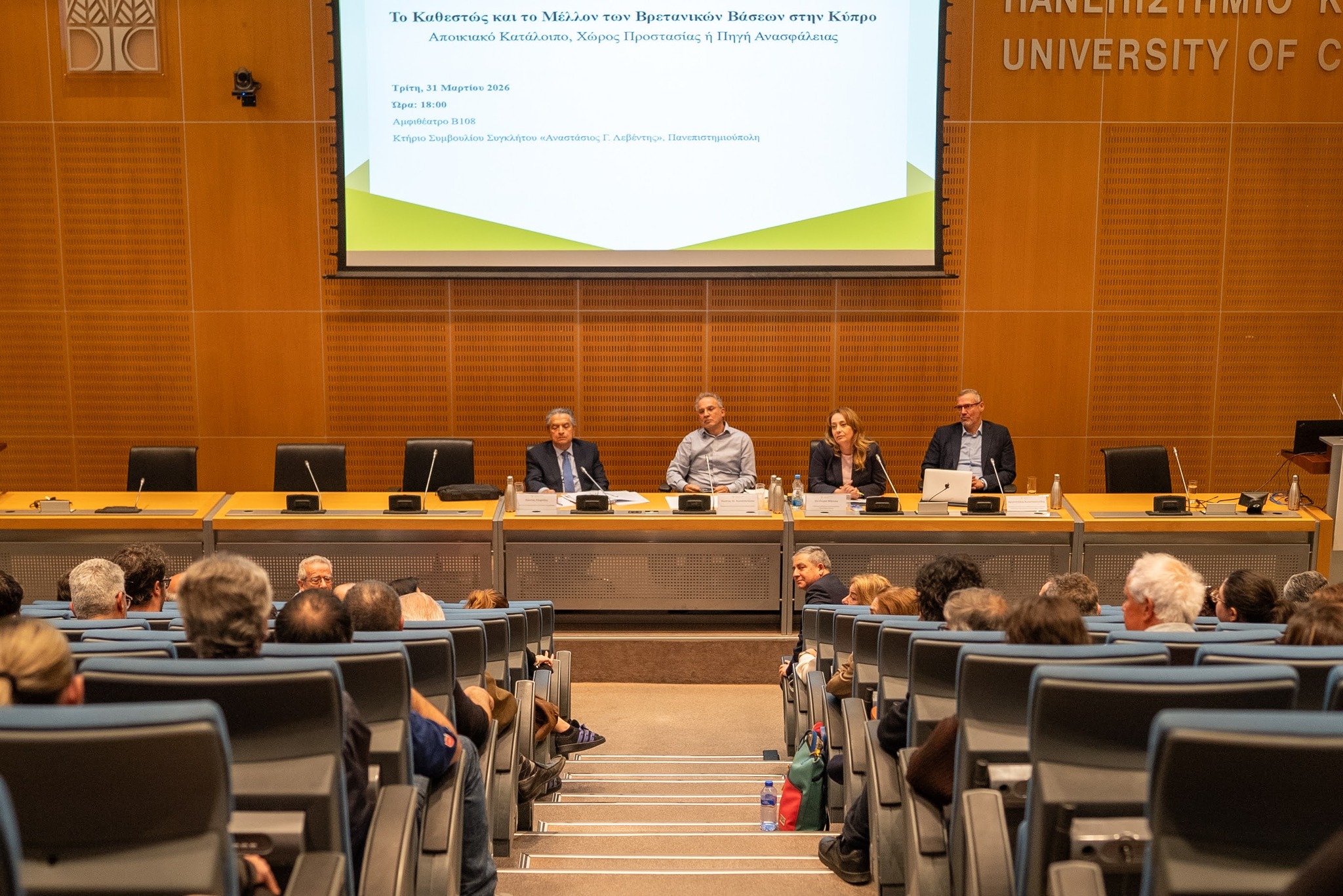
The Republic of Cyprus must clarify precisely what it is seeking with regard to the British Bases on the island, speakers said at a discussion organised by the University of Cyprus on Tuesday evening on the status and future of the bases. The panel brought together former Attorney General of the Republic Costas Clerides, Associate Professor of International Law and Human Rights Law Aristotle Constantinides, and Professor of International Relations Costas M. Constantinou, each analysing the issue from a different perspective.
The Mauritius precedent
Former Attorney General Costas Clerides drew on the case of Mauritius and the Chagos Archipelago, highlighting the "persistent claims of a small state" which, despite British resistance, pressed on until it secured the opening of negotiations with London and ultimately prevailed.
He noted that in 1965, under the Lancaster House agreement, the United Kingdom had agreed with elected representatives of Mauritius to detach the Chagos Archipelago from Mauritius so that the Diego Garcia complex could be used as a US military base. Continued challenges to the legality of that act led the matter to the UN General Assembly, which sought an advisory opinion from the International Court of Justice. The court ruled that the UK was obliged to end its administration of the archipelago as soon as possible, so as to complete the decolonisation of Mauritian territory in a manner consistent with the right of peoples to self-determination.
Although the British government did not accept the advisory opinion, the matter was referred to the UN General Assembly, which in March 2019 adopted Resolution 73/295, endorsing the court's opinion and declaring the archipelago an integral part of Mauritius, calling on the UK to withdraw within six months. That did not happen.
One of Britain's positions had been that elected Mauritian representatives had consented to the separation, Clerides noted. The court, however, ruled that the consent of the then colonial council of ministers had not been based on the free and genuine expression of the popular will, given that one party was under the dominance of the other.
Clerides also referred to Cyprus's contribution to the case, noting that in its oral pleadings the Republic of Cyprus cited a July 2018 ruling by the UK Supreme Court in the Bashir case, which found that the 3% of Cypriot territory occupied by the British Bases remains a British colony. Cyprus further argued that severing a country's territorial integrity and retaining part of its territory constitutes a violation of the principles of self-determination and complete decolonisation, and that a people cannot lawfully waive or consent to the restriction of that right.
In conclusion, Clerides said that the persistent claims of a small state, reinforced by the principles of international law, the ICJ advisory opinion and the subsequent UN General Assembly resolution, had resulted in the recovery of sovereignty over part of a territory that had been withheld by a former colonial power, and had led to a consensual repositioning of the matter on a modern legal footing fully compatible with international law.
Legal avenues open to Cyprus
Associate Professor Aristotle Constantinides examined the various legal paths available to Cyprus, including the pursuit of unilateral abrogation, renegotiation, or an arrangement along the lines of the 2014 settlement.
Noting that we are living through a period of historic change in which the role of international law is being undermined, Constantinides said the discussion offered an opportunity to recall that international law, for small states such as Cyprus, "however devalued it may become, remains a cornerstone, and when we need to exercise many legitimate claims, we will ultimately resort to it." He added that Cyprus should at the very least not contribute to this erosion of international law, because if the available rules and mechanisms were to disappear or be eroded, "we will not be able to use them."
On Cyprus's options, he said that if unilateral abrogation of the bases' status were pursued, which he described as politically "much more difficult, especially with the Cyprus problem unresolved," it is something that legally "could hold," but would require in-depth study of specific aspects.
If the aim were instead to partially amend the Treaty of Establishment, rights and obligations through negotiations with the UK, he said that "can be done" under the existing framework and the rules of the Vienna Convention reflecting customary law. "If we want something simpler, easier, like what we had in 2014, that can obviously be done," he added, noting that these are scenarios that depend on the political objectives being pursued. "I would like to believe that these various scenarios have been examined. However, the decision is fundamentally a political one," he said. International law, he concluded, appears capable of facilitating whatever political objectives are chosen.
Neutrality as a strategic option
Professor of International Relations Costas M. Constantinou argued that exploring forms of full or partial demilitarisation, or military neutrality, would constitute a "pragmatic strategic choice" for Cyprus.
He said that a substantive and comprehensive settlement of the bases issue cannot come before a solution to the Cyprus problem, as part of which the abolition or time-limited presence of the bases could be agreed. What the government "can and should" seek in the meantime, he said, includes requiring the British Bases to consult with the Republic of Cyprus on any involvement in armed conflicts, and to obtain Nicosia's consent.
Noting the growing demand for foreign bases due to the changing nature of modern warfare, he said Cyprus must decide whether it wants British or other bases on the island, whether it would offer permanent or temporary facilities, and to whom and for what purpose.
In conclusion, he expressed the view that Cyprus's long-term security is best served by provisions of military, not political, neutrality that would allow it to avoid participating, directly or indirectly, in armed conflicts that violate fundamental principles of international law, while at the same time supporting, where possible, actions grounded in international legality within the UN framework and the Common European Security and Defence Policy, in ways that do not reproduce neo-colonial security hierarchies and dependencies, but instead reinforce the sovereign equality and political autonomy of states.
Debate from the floor
In the discussion that followed, former Foreign Minister Erato Kozakou-Marcoullis argued that if the government had raised the issue of abolishing the bases, it was "extremely dangerous for the course of the Cyprus problem," adding that anything that diverts attention from "the overriding priority" of a solution to the Cyprus problem "will be extremely dangerous for Cyprus."
Responding to a question, Clerides expressed the view that the treaties signed in 1960 under British pressure as a condition for granting Cyprus its independence should not be interpreted too rigidly. A court could find that a former colonial power continues to retain territory belonging to the state, and that this is anachronistic in light of how international law has evolved, he said, adding that now is a good moment for the Republic of Cyprus to pursue this.
Source: CNA