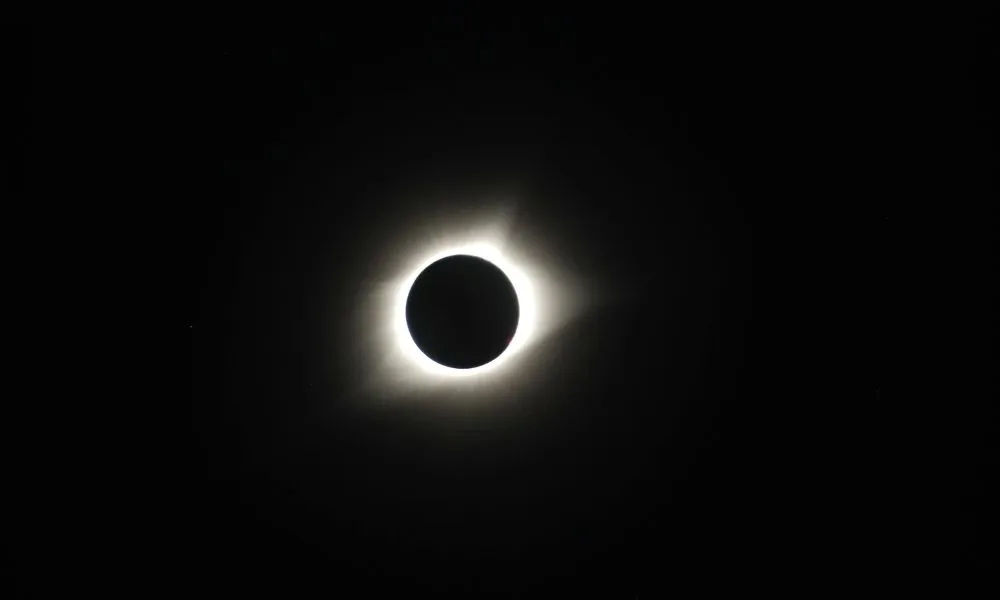

Continental Europe has not seen a total solar eclipse since August 1999. On 12 August 2026, that changes, with a dramatic path of totality sweeping across the North Atlantic and reaching northern Spain near sunset. It is the centrepiece of a year that also brings an annular eclipse, two lunar eclipses, three supermoons and multiple meteor shower peaks.
The headline event: total solar eclipse on 12 August 2026
It has been more than 25 years since the last total solar eclipse visible from continental Europe. In August 1999, the Moon briefly covered the Sun, plunging parts of Europe into darkness. Twenty-seven years later, a total solar eclipse returns, placing Spain firmly in the spotlight.
The eclipse’s path begins in northern Russia, crosses the Arctic Ocean and eastern Greenland, reaches maximum eclipse offshore from Iceland, then continues over the Atlantic towards Portugal and northern Spain, arriving shortly before sunset.
In northern Spain, some cities are expected to experience complete coverage of the Sun for around 1 minute and 50 seconds. Across wider parts of Europe, as well as North America and western Africa, the event will be seen as a partial eclipse.
The partial-eclipse footprint also includes parts of north-western Greece (Corfu, Igoumenitsa, Konitsa, Kastoria and Florina), but the coverage is so small it is described as practically unobservable.
This will be Spain’s first total solar eclipse since 1905 and Iceland’s first since 1954.
Another solar eclipse in 2026: the “ring of fire” on 17 February
Before August’s main event, an annular solar eclipse takes place on 17 February 2026, when the Moon passes in front of the Sun but does not cover it completely. The Sun appears as a bright ring around the Moon’s silhouette. NASA lists the annular eclipse as visible in Antarctica, with a partial eclipse visible across a wider region including parts of Africa and South America.
Why scientists care: studying the Sun’s corona
As astrophysicist Fiori Metallinou of the National Observatory of Athens explains, total solar eclipses create rare conditions for solar physicists to observe and photograph the Sun’s outer atmosphere, the solar corona, which becomes visible when the Sun is obscured. By comparing the corona across eclipses, scientists can better understand the processes taking place there and how they relate to solar activity.
The Mediterranean proximity of the 2026 eclipse is also expected to encourage professionals and amateur astronomers to organise trips, with Greek astronomy groups already planning travel to Spain for the event.
Solar activity and aurora chances in 2026
Although the peak of solar activity is expected to have passed in 2025, solar activity remains high in 2026. The practical result is an increased chance of more impressive aurora displays, especially in northern countries.
The Moon in 2026: lunar eclipses, supermoons and a blue moon
A useful rule of thumb is that a solar eclipse tends to occur roughly two weeks before or after a lunar eclipse. In 2026, the year’s solar eclipses are also followed by lunar eclipse events.
Total lunar eclipse: 3 March 2026
On the morning of 3 March 2026, a total lunar eclipse will tint the Moon with orange-red hues, often referred to as a “blood moon”, as the Earth’s shadow fully covers the Moon and sunlight filtered through Earth’s atmosphere casts coppery tones. Visibility spans large parts of the Americas, the Pacific and significant areas of Asia and Oceania.
Partial lunar eclipse: 27–28 August 2026
A partial lunar eclipse follows on 27–28 August 2026, best seen from parts of Africa and Europe, including Greece, as well as parts of Asia. In Athens, it is expected to be visible around 6:50am on 28 August 2026.
Three supermoons in 2026
2026 is also set to deliver three supermoons:
-
3 January 2026
-
24 November 2026
-
23 December 2026 (expected to be the closest of the year)
A supermoon appears larger and brighter because the full Moon occurs close to perigee, the nearest point of the Moon’s orbit to Earth.
A blue moon in May
There will be two full moons in May 2026 (1 May and 31 May), making the second one a blue moon.
Meteor showers: the best nights of 2026
Perseids: peak 12–13 August 2026, with excellent conditions
The Perseids peak on the night of 12–13 August 2026, and 2026 is expected to offer unusually good viewing because the Moon is at 0% illumination, meaning minimal moonlight interference. The shower is active from mid-July through late August.
Other key meteor shower peaks (selected)
The American Meteor Society lists the following peak windows in 2026, among others:
-
Lyrids: 21–22 April
-
Eta Aquariids: 5–6 May
-
Southern Delta Aquariids: 30–31 July
-
Alpha Capricornids: 30–31 July
-
Orionids: 21–22 October
-
Southern Taurids: 4–5 November
-
Northern Taurids: 11–12 November
-
Leonids: 16–17 November
-
Geminids: 13–14 December
-
Ursids: 21–22 December
Planet highlights: a busy year for conjunctions and “parades”
February 2026 is expected to feature a notable grouping of planets visible in the evening sky, with brighter planets easier to spot and the more distant ones requiring binoculars or a telescope. Beyond that, 2026 includes several close pairings and conjunction-style moments involving the Moon, Venus, Jupiter and Mars across the year.