The President of the Nicosia District Organisation of Local Government has spoken out against the cuts, sending urgent letters to the Minister of Agriculture and the President of the Republic. Constantinos Yiorkadjis proposes punitive pricing for overconsumption, public awareness campaigns, and stronger tools for detecting leaks.
The decision to impose a 10% reduction in household water supply, approved by the Council of Ministers on 23 January 2026, has raised serious concerns within the Nicosia EOA. Its President warns that, in practice, a horizontal reduction does not translate into a mild impact for consumers or the network. As he notes, “residents will not experience this as 10%, but far more likely as 30%–50% in hours without water, which amounts to around 12 hours of water cuts per day.”
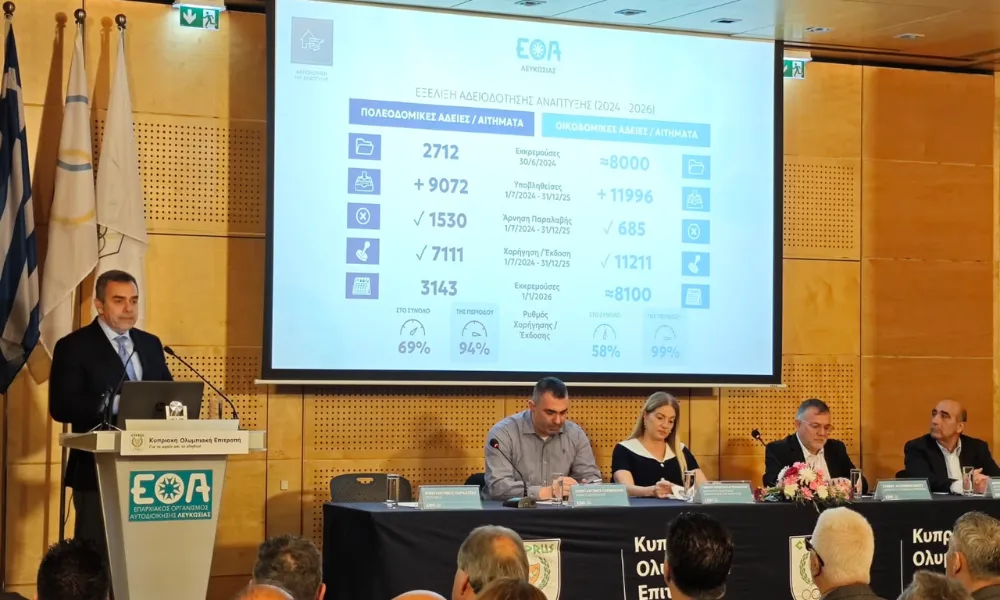
During a press conference on the organisation’s first 18 months of operation, following a question by Politis to the Point, Mr Yiorkadjis said the measure may not deliver the expected savings and could instead trigger a chain of technical problems that ultimately affect everyday life.
Why “10%” can mean far more problems
In his urgent letter to the President of the Republic, Mr Yiorkadjis argues that a blanket 10% reduction in water supply to EOAs is unlikely to be implemented without actual cut-offs. In real conditions, these lead to much longer interruptions for specific areas. He warns this could cause operational problems, including damage and leaks, as the network is stressed by repeated shutdowns and restarts. “Any cuts in areas such as western Nicosia would create chaos in water supply, with some districts at risk of being left without water for days or even weeks,” he cautions.
He also notes that in some areas demand already reaches the system’s maximum capacity. Particular concern is raised for higher-altitude neighbourhoods that depend on pumping, further complicating the application of such a measure.
Lessons from 2008–2010: 20% savings, but at a cost
In a separate letter to the Minister of Agriculture, Dr Maria Panayiotou, Mr Yiorkadjis refers to the water cuts of 2008–2010, when a 20% reduction in consumption was achieved. This, however, required households to receive water only three times a week, for 12 hours per supply. As he points out, “You have stated on the radio that a 10% reduction is not difficult and will not affect quality of life. Unfortunately, historical experience does not support this.”
Crucially, he notes that the practice of cut-offs placed heavy strain on the network and increased non-revenue water by 7–10 percentage points. Currently, non-revenue water within the Nicosia EOA stands at around 20%; with cut-offs, it could rise to 27%–30% once normal flow is restored.
In other words, a measure aimed at reducing consumption risks increasing losses within the network itself, a factor that must be accounted for in overall planning.
Leak detection efforts also undermined
Mr Yiorkadjis adds that the Nicosia EOA has already launched a tender for 3,000 devices to detect hidden leaks, at a cost of €1.5 million, as part of efforts to reduce water losses. However, a key prerequisite for these devices to function is uninterrupted water supply. Under a regime of cut-offs, the investment “will deliver no benefit”.
Moreover, implementing water cuts requires the mass opening and closing of valves on an ongoing basis, necessitating additional staff. This, he says, diverts human resources away from network maintenance, leak detection, and repair works.
EOA proposals: pricing, information, better tools
Based on the issues raised in the letters, Mr Yiorkadjis describes water cut-offs as a “last resort”, arguing they may create more problems than they solve and negatively affect quality of life.
His proposals to government include:
- Approval of EOA regulations introducing new pricing and overconsumption measures, in line with recommendations from the Water Development Department.
- Combining the new pricing policy with intensive public information and awareness campaigns.
- Increasing funding for the purchase and use of leak-detection equipment.
In the same context, his letter to the President of the Republic suggests an alternative path: moving ahead with the approval of operating regulations that focus on pricing policies for large consumers, as recommended by the Water Development Department.
The stakes: saving water without a “technical boomerang”
The core position of the Nicosia EOA, as outlined in the correspondence and reiterated publicly by Mr Yiorkadjis, is that water supply cuts should not be the first option. Experience shows they can increase losses, intensify damage, and undermine efforts to reduce leaks.
What is needed, according to his proposals, is a balanced policy mix that reduces consumption in a targeted way, penalises excessive use, and protects the resilience of the network, ensuring that savings do not return as technical and social costs.