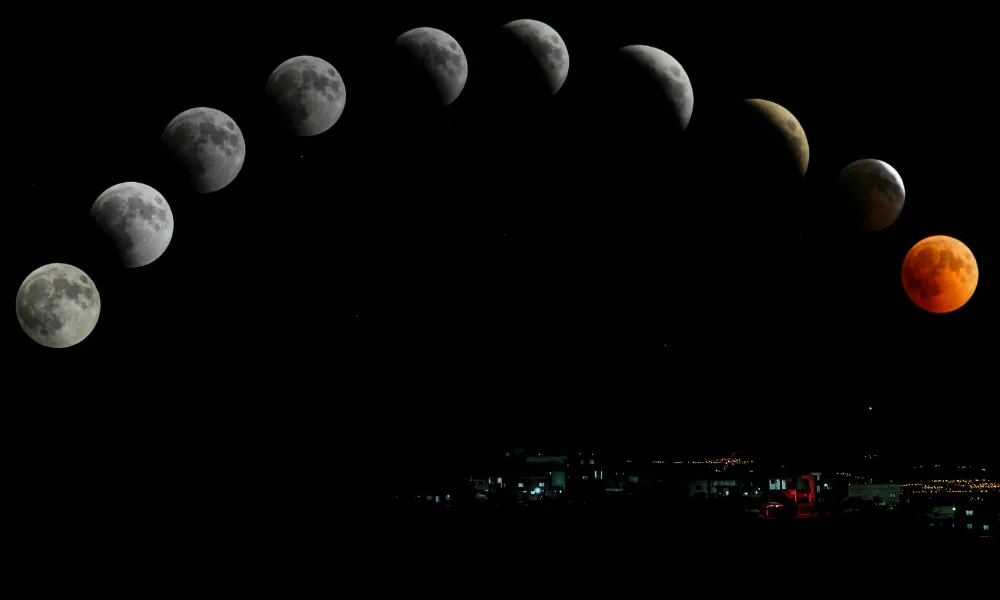
A total lunar eclipse is expected to occur in early March, drawing global attention due to the red colouring the Moon will take during totality. According to Space.com, around 2.5 billion people worldwide are expected to be able to observe at least part of the phenomenon. The next total lunar eclipse is not expected before New Year’s Eve 2028.
Timing of the eclipse
The total lunar eclipse will take place between 2 and 3 March 2026.
According to the data provided:
- The eclipse will occur between 3:44 a.m. and 9:22 a.m. EST
- This corresponds to 08:44 – 14:22 GMT
- In Greece time, this corresponds to 10:44 a.m. – 16:22
The phase of totality, when the Moon will appear red as it passes through the deepest part of Earth’s shadow, will occur:
- Between 6:04 a.m. and 7:02 a.m. EST
- Equivalent to 11:04 – 12:02 GMT
- Equivalent to 13:04 – 14:02 Greece time
The totality phase is expected to last 58 minutes.
Geographical visibility
The phenomenon will be best visible in:
- Western North America
- Australia
- New Zealand
- Eastern Asia
- The Pacific region
Visibility will depend significantly on local weather conditions. Current forecasts suggest that northwestern Mexico, the southwestern United States and inland Australia already present increased probability of clear skies and favourable observation conditions.
Weather impact on observation
The ability to observe the eclipse will depend largely on local atmospheric conditions. Cloud cover and visibility levels will determine whether the phenomenon can be seen clearly in each region.
Next total lunar eclipse
According to astronomers, the next total lunar eclipse after this event is not expected to occur before New Year’s Eve 2028.
Source: cnn.gr