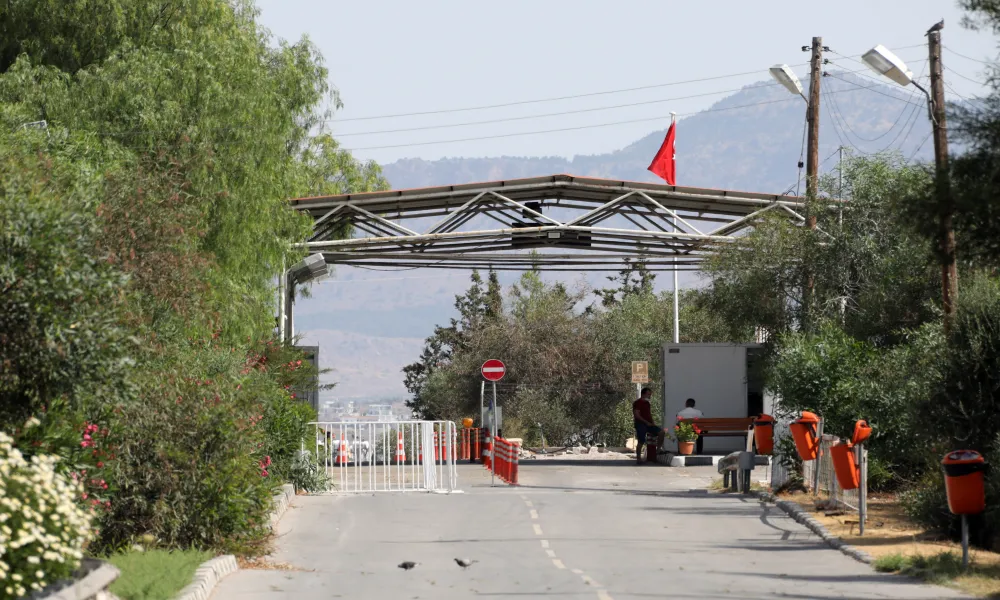
The anniversary of the opening of the checkpoints does not lend itself to ceremonial platitudes. It is not a day for easy declarations about "hope" and "rapprochement." If we are honest with ourselves, it is an uncomfortable reminder of what could have happened, and did not, because we did not want it to.
In the early 2000s, tens of thousands of Turkish Cypriots, more than fifty thousand in repeated mobilisations, flooded the streets demanding a solution, a European future, and liberation from Turkey's suffocating control. These were not symbolic marches. They were a mass, authentic social demand for a change of course, for reunification. At the same time, on the Greek Cypriot side, there was no equivalent mobilisation, no social pressure in the direction of a solution. There was silence. And silence, in politics, is rarely neutral.
2004 marked the first great turning point. Akel's "no, to cement the yes" on the Annan Plan, combined with the broader political climate of the period, was not simply a disagreement over a text. It was the triumph of a logic of postponement, a "not now" that translated in practice into "probably never." Rather than capitalising on the momentum that existed in both communities, primarily on the Turkish Cypriot side, the safety of inaction was chosen instead.
Thirteen years later, in 2017, the scene repeated itself with different protagonists but a similar outcome. At Crans-Montana, the withdrawal of Anastasiades in his capacity as negotiator for the Greek Cypriot community sealed the collapse of a process that many considered the closest to a solution in decades. Responsibility, of course, does not rest with one person or one side. But the responsibility of the leader who holds the wheel is always greater, primary and decisive.
Between these two historical milestones, a pattern repeats itself: the fear of the political establishment to bear the cost of decisions. Akel and Disy, the parties that have largely determined the course of the Republic of Cyprus over recent decades, cannot stand outside the frame, absolved of responsibility. With different starting points and different rhetoric, they arrived at the same result: the preservation of the status quo.
The status quo is not static. It is actively harmful.
The perpetuation of the Cyprus problem serves as the substrate for a series of pathologies that afflict Cypriot society. Corruption finds space to flourish in an environment where the absence of any overall perspective and the lack of checks and balances reduces accountability and reinforces clientelism. The cost of living is burdened by structural distortions and limited choices in half a market, in half a country. The modernisation of the state is delayed as political energy is consumed in managing the unresolved Cyprus problem rather than in shaping a vision for the future.
The most alarming dimension, however, is deeper: the internalisation of partition, the belief that "we are better off this way." A society that gradually reconciles itself to the idea that "this is how things are, nothing can change," that reacts to almost nothing, demands nothing, applies no pressure, but channels its anger into furious social media posts and choices of the Fidias variety, is not moving toward resolution and social progress but toward stagnation.
The anniversary of the opening of the checkpoints could have been a story of success, a celebration for the country and its people. It became instead a reminder of missed opportunities.
The Turkish Cypriots proved at the time that a society can mobilise en masse to change its fate. The question that remains, two decades later, is whether we are willing to wake up, or whether we will continue to dress up partition as a "second best solution."