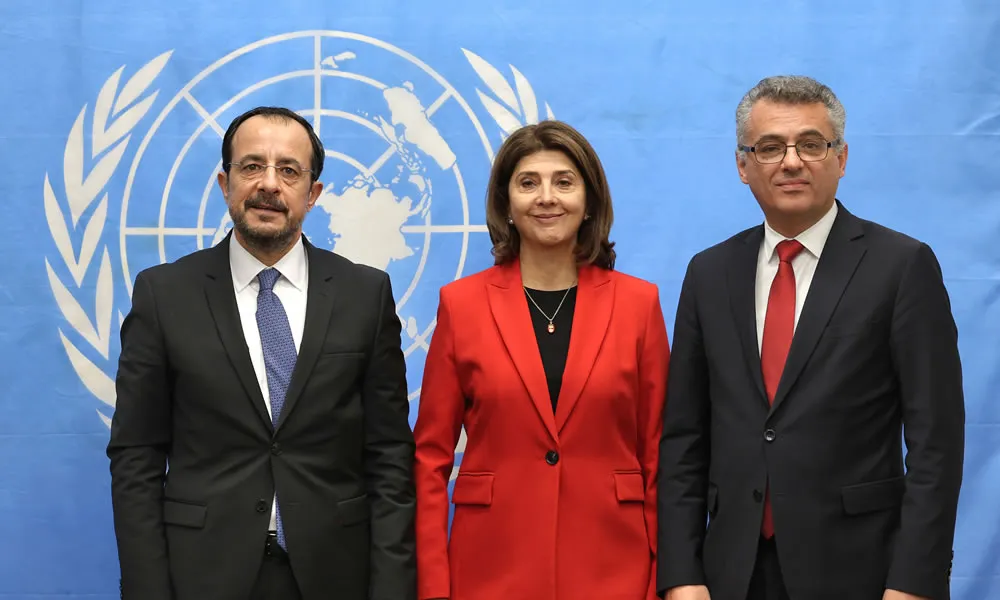
The UN envoy María Ángela Holguín will return in January, but she will need to spend considerable time securing the commitment of the two Cypriot leaders so that she can recommend to Secretary‑General António Guterres the next step: convening a new expanded “5+1” meeting under the Secretary‑General, with the participation of the three Guarantor Powers.
The problems
- The reconstruction of the negotiation framework based on the joint Christodoulides–Erhürman statement that “the real objective is the resolution of the Cyprus problem with political equality, as described in the UN Security Council resolutions.” Clarifying the objective was important, but of course not enough.
- Reversing the negative climate on the island so that a productive dialogue can take place. The most important CBMs, as is well known, remain pending.
- Addressing the political motives that disrupt the effort.
Convergences
María Ángela Holguín considers it positive that “the two leaders exchanged detailed views on previous milestones of the negotiations, such as Crans‑Montana in 2017, the Berlin Framework, and other points of convergence” (interview with Turkish ANKA, 15/12). However, she sees very clearly that Christodoulides and Erhürman “devote excessive time discussing technical details,” resulting in “undermining the purpose of political dialogue.”
This problem became very evident during the three‑hour meeting on 11 December. In January, Olguín intends to separate the discussion on the substance of the Cyprus issue from the confidence‑building measures (CBMs). For this reason, she will take a decisive step and submit a document containing the convergences. The UN will shoulder the responsibility of preventing endless discussions over “interpretations” of what has been agreed: “If there is no agreement on a structured framework, there is a risk that the talks will collapse again, as has happened in the past after long procedural discussions…”, Holguín told ANKA.
Confidence‑Building Measures (CBMs)
Christodoulides and Erhürman agree that “confidence‑building measures are important for creating a favourable environment, but they do not substitute for achieving a solution to the Cyprus problem.” Before leaving Cyprus, Holguín requested an end to time‑wasting and sufficient technical preparation for CBMs at the negotiators’ level, so that they will be ready to be announced in January.
For quite some time, the UN has been criticising the Cypriot leaders for the way they handle the lives of their citizens.
Guterres insists on opening new crossing points, facilitating economic cooperation, and implementing joint energy projects. Several CBMs are already on the table. While it is unrealistic to expect all of them to be implemented, the UN has taken a position, putting pressure on the leaders to demonstrate their genuine will -with new crossing points- before convening a new “5+1” meeting.
Christodoulides and Erhürman know very well that since 2020 (during Ersin Tatar’s term), the opening of new crossing points, combined with strengthening bicommunal trade, is not only a demand of Guterres. It is also required by the Security Council, which included a relevant paragraph in its latest resolution (January 2025), as well as by the European Union.
The crossing point that is most suitable and simultaneously fulfils the purpose (decongesting mass crossings in Nicosia and facilitating trade) is that of Mia Milia, and for this reason it has priority, regardless of other locations.
Holguín’s approaches reflect instructions given by Guterres that this time negotiations must be conducted “differently” from the past, which proved unproductive. This brings her somewhat closer to the methodology proposed by Tufan Erhürman, but it does not satisfy his demand to avoid a return to the existing status quo or to impose consequences on whoever may be responsible in case of a collapse. This issue will be addressed only at the highest political level of the UN, with a recommendation from the Secretary‑General. It also concerns the EU, which is involved supportively through its envoy, former Vice‑President and Commissioner Johannes Hahn.
Tactics and crises
The fuelling of “artificial crises” and misinformation also constitutes a serious problem for the UN. It knows this very well, having experience with incomprehensible actions and even provocations in the past aimed at sabotaging dialogue. Early signs have already appeared, with leaks and false news prompting an unusual reaction from Holguín (15/12): “these are speculations that do not contribute to the process”.
A major Greek‑Cypriot newspaper with close ties to the Presidential Palace wrote that Erhürman was leaving the 11 December meeting to receive phone instructions from (Turkish Foreign Minister) Fidan. Erhürman did not leave this unanswered, saying that everyone present knew he was communicating with the Turkish‑Cypriot mayor of North Nicosia to be briefed in detail about the bicommunal Nicosia sewage project, which was included in the CBMs.
Christodoulides exerts constant pressure on Erhürman to provoke his reaction. Although he considered the agreement on a solution with political equality, as described in the Security Council resolutions, important, Christodoulides hinted in Le Figaro about Erhürman’s positions, saying that the new Turkish‑Cypriot leader “has not stated, at least publicly, that he supports a two‑state solution.”
Holguín, on the other hand, interprets Erhürman’s stance as a clear shift away from Ersin Tatar’s two‑state positions, which had prevented the creation of common ground: “On 11 December, the leaders agreed to return to a clear path toward negotiations with the same point of reference: political equality,” Holguín said (15/12) in an interview with Yeni Düzen.
Christodoulides is preparing for Cyprus’ Presidency of the EU Council and has repeatedly extended an “invitation” to Tayyip Erdoğan to discuss the Cyprus issue and to participate in an informal EU–Middle East summit in Cyprus in April 2026. Christodoulides presents himself to the public as negotiating directly with Turkey. He is photographed with Erdoğan and Fidan at international summits and even proposes “confidence‑building measures” with Turkey, such as opening a Turkish port to Cypriot ships in exchange for EU visa liberalisation for Turkish businesspeople. So far, such gestures and proposals receive no response, are rejected, or remain hanging without any comment from Ankara, such as the invitation to Erdoğan through Le Figaro.
Tufan Erhürman reacted by describing Christodoulides’ invitation to Erdoğan for dialogue on the Cyprus issue as “an approach that ignores the status of the Turkish‑Cypriot side in the negotiations”, which, as is known, take place on an equal footing between the two community leaders under UN auspices.
However, for the UN, and for the EU envoy Johannes Hahn, the priorities are different: the Cypriot leaders must first “step into each other’s shoes” if they want to begin and conclude the common goal they have declared and which has remained unresolved for 51 years.