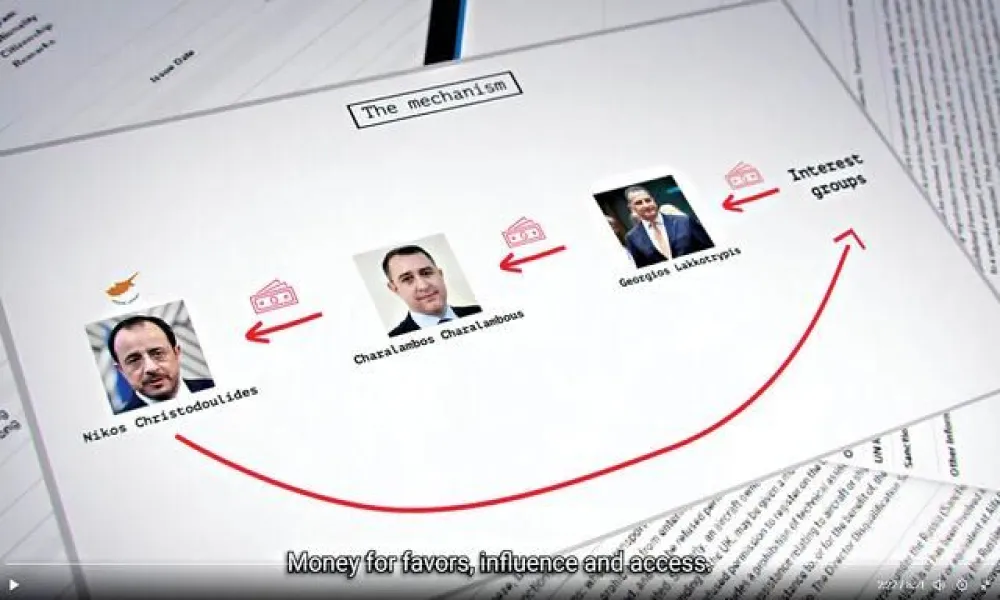
From the beginning of the year, developments in Cyprus surrounding the Videogate scandal have radically altered the political agenda. One week after the release of the controversial video, public opinion had already formed a firm view, that of entanglement and influence peddling at the highest levels of government. Internationally, President Nicos Christodoulides was left exposed. Particularly telling was the headline in the Financial Times on 12 January, “The Cypriot government sinks into a corruption scandal”. Videogate will continue to haunt him for the remainder of his term, until 2028.
But what is happening in Cyprus, and why does the same story repeat itself every few years?
Is the country under strain because of a so called “hybrid attack”, as the Cypriot president claims? Or is it in fact suffering from a crisis of leadership?
Next week, Christodoulides will address the European Parliament on the priorities of the Cypriot Presidency of the Council of the EU, and it is quite possible that he will find himself in an uncomfortable and uncontrolled environment.
Buying Time
Following the public outcry over the video and the subsequent resignations, Christodoulides attempted on Thursday 15 January to shift attention back to the issues of the Cypriot Presidency, on the occasion of the visit of the College of Commissioners.
On Tuesday 13 January, the Attorney General, George Savvides, appointed an independent criminal investigator, a former judge, “to assist the police investigations into the controversial video”. Yet, for days now, no one in the Attorney General’s Office has clarified where the focus of the criminal investigation lies. “There are some directions, elements, statements and individuals, but I do not wish to engage with aspects and objectives,” Savvides said in Parliament on 14 January.
It is very likely that events will be stretched over time, as no timetable was set for the investigator. This has also happened in the past in similar corruption cases involving political figures, such as the golden passports scandal. The targeting and speed of investigations often determine the outcome in such cases. It is no coincidence that, according to European assessments, namely European Commission reports on the rule of law, Cyprus’s justice system does not deliver effectively. Very few corruption cases have reached the courts, and the results have been even more meagre.
Offences
In this case, a number of questions arise based on what has been verified through facts and the controversial but authentic statements of the protagonists themselves. In the video circulated by an unknown account on X, individuals from the president’s close circle are seen engaging in actions which, according to legal circles, indicate a series of potential criminal offences. These range from influence peddling to bribery, from abuse of power to illegal lobbying and the flow of illicit political funds, among others. All of this took place over a considerable period of time and did not involve fictional characters.
A Pattern
The edited video captures the most widespread pattern internationally in such corruption cases, conducted behind closed doors. Individuals who exercise political power collaborate with intermediary friends and businesspeople seeking favourable treatment in exchange for benefits, transfers and cash. A political ally of the president appears to act as an intermediary, Lakkotrypis. A close associate of Christodoulides is also his relative, Charalambous. Meanwhile, a prominent local businessman maintains multiple financial relationships with the state and a close relationship with the president and other politicians. Ultimately, the three were seen together in a video call with the alleged foreign investors.
During the discussion, references are heard, among other things, to the funding of an election campaign in cash beyond the limits set by law. There is also a link made to a flow of “donations” presented as supposed corporate social responsibility, through transfers for charitable purposes to a fund established by law and operating under the First Lady. Donors remain anonymous, creating a high risk of entanglement. This risk was recorded in a recent report by the Auditor General as recently as November.
What Hybrid Attack?
The media did not follow the government’s one dimensional narrative of a “hybrid attack”, promoted through police leaks, intelligence reports and statements by the government spokesperson. Journalists rightly raised questions about the content of the video, namely the words of its protagonists, which are difficult to dismiss or forget. Consequently, the core of any criminal investigation concerns, from the outset, the opaque manner in which the collaboration took place. Identifying the source of the video has some significance, but it does not overshadow its content.
Failure to Assume Responsibility
This is not the first time that Cyprus, an EU member state, has been disgraced because of how its leadership exercises power. Cases of widespread corruption at the highest levels of authority have proven to be well founded, including the golden passports scheme, scandals involving contractors and rigged public works, among others. These cases are documented in international reports and corruption indices and exposed by international media, regardless of the fierce resistance they encounter from those in power within Cyprus, where the justice system often drags its feet. Interventions by the European Public Prosecutor’s Office have recently become more frequent in the investigation of scandals in Cyprus.
President Christodoulides reacted as though he were untouched by the scandal. Society, however, has formed a different view of his record at the Presidential Palace. Videogate merely exposed his weaknesses when the glass finally overflowed. The resignations, of the president’s office director and the First Lady, came far too late. They were presented as voluntary, although everyone knows that they occurred under pressure. Christodoulides compounded the error by portraying them as acts of self confidence and pride, without assuming even the slightest responsibility, not even for mistakes or omissions.
The Vassiliou Era
The Videogate scandal coincided with the death of former president George Vassiliou. He was perhaps the most distinctive Cypriot leader of his time. He linked his name to consistency in the effort to resolve the Cyprus problem, to dialogue and reconciliation with the Turkish Cypriot community. Under Vassiliou, significant steps were taken towards the progress and modernisation of Cyprus. He worked to secure a stable future for Cyprus within the EU. It was during his presidency that the application for accession was submitted, and he personally led the Cypriot negotiating team for accession.
Looking back to the late 1980s, one finds in George Vassiliou the qualities that are missing from today’s political class in Cyprus. A man of the market and a cosmopolitan figure, he took important steps to move Cyprus away from old style party politics and introversion. The modernising momentum he represented was halted after his electoral defeat in 1993, as he served only one five year term. Yet even after Cyprus joined the EU, a process to which Vassiliou contributed decisively, modernisation was left orphaned. Nepotism, the distribution of the spoils of power and control of the state apparatus kept Cyprus far behind.
George Vassiliou gave Cyprus credibility and persuasive power on the international stage. He too passed away at an advanced age, with concern etched on his face, but also with an innate sense of hope. “There cannot be two states in Cyprus, we joined the European Union,” he said in one of his last meetings with friends a few months ago.