The Cyprus issue has moved beyond a conventional negotiating stalemate into a deeper phase of structural paralysis. What is lacking today is not simply agreement, but the minimum political will required to even sustain a meaningful process. This is increasingly reflected in the conduct of international actors.
The European Union’s Special Envoy for Cyprus, Johannes Hahn, has now formally stepped down following a brief but consequential tenure of just ten months, adding another layer of uncertainty to an already stalled process. Initially presented by the Greek Cypriot leadership as a sign of renewed diplomatic momentum, Hahn’s departure reflects not only a change of office but also the limits of that momentum. A seasoned Austrian diplomat and former European Commissioner with extensive experience in enlargement and regional policy, Hahn resigned to assume the presidency of the General Council of the Austrian National Bank, a role he took up on January 1 after concluding his final contacts on the island in mid-December 2025. His exit, coming without any tangible progress on the ground, underscores a broader pattern: international engagement continues to fluctuate, but without a structured framework or political will, such efforts fail to translate into movement toward a settlement.
At the United Nations, statements following meetings between Secretary-General António Guterres and leaders of both sides have become formulaic, repeating references to “next steps” without any substantive content. The quiet withdrawal of UN envoy María Ángela Holguín, with no indication of a return, reinforces the conclusion that the process has lost direction. What remains is not a negotiation, but a diplomatic routine detached from outcomes.
Rejection of framework blocks progress
The persistence of this deadlock cannot be explained by complexity alone. It is closely linked to the failure to adopt a results-oriented framework that could anchor a renewed process. The methodology proposed by Tufan Erhürman offers such a framework, combining four interdependent elements: explicit recognition of political equality, a defined timeframe for negotiations, preservation of past convergences and a mechanism ensuring that failure does not simply reproduce the status quo.
This approach has been regarded, at least implicitly, as constructive by the UN Secretary-General and his envoy. Yet it has not been accepted by the Greek Cypriot side, effectively blocking any structured return to negotiations.
The same reluctance is visible in the non-implementation of confidence-building measures. The opening of new crossing points, discussed for more than five years and widely seen as a low-risk step to improve daily interaction, has not materialized. This is not a technical delay but a political choice, one that has further eroded trust and reinforced the perception that the current status quo remains preferable to compromise.
Bases move seen as political diversion
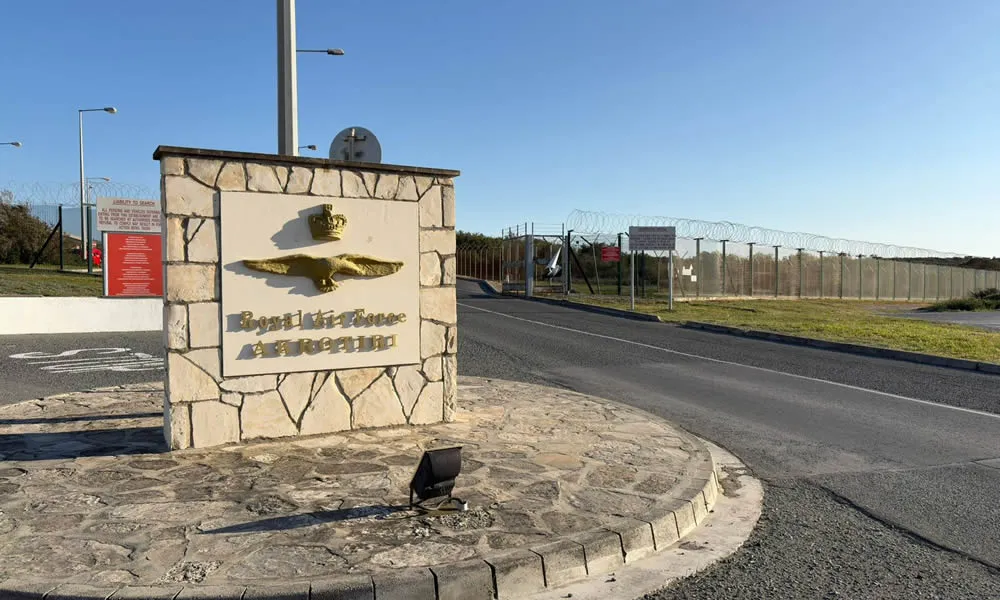
Against this backdrop of stagnation, the decision by Greek Cypriot leader Nikos Christodoulides to bring the British Sovereign Base Areas into the spotlight appears less like a strategic initiative and more like an attempt to reshape the political agenda. The absence of clarity regarding the objective, whether abolition, status revision or simply the opening of discussions, adds to this impression.
At a time when the core Cyprus problem remains mishandled and unresolved, introducing a new and highly sensitive issue risks diverting attention rather than addressing underlying challenges. In this sense, the bases debate may serve as a substitute narrative, projecting diplomatic activity in the absence of real progress. Such an approach carries risks. Rather than creating momentum, it may further complicate the landscape by adding a new layer of disagreement to an already frozen conflict.
Not bases, but sovereign territory
A central misunderstanding in public discourse concerns the nature of the British Sovereign Base Areas themselves. These are not comparable to conventional military bases established through bilateral agreements.
As Professor Dr. Füsun Arsava underlines, most foreign military installations operate within frameworks that preserve the sovereignty of the host state. Cyprus is fundamentally different. Under the 1960 agreements, the territories in question were never transferred to the Republic of Cyprus and remain under full British sovereignty.
Former ambassador Ahmet Ünal Çeviköz captures this distinction succinctly: This is not base allocation but sovereignty. Retired general and strategist Haldun Solmaztürk situates this arrangement within the geopolitical realities of decolonization, where departing powers retained strategic assets while newly independent states accepted the terms. He characterizes the bases as an anomaly sustained by the unresolved nature of the Cyprus problem, suggesting that their future is inseparable from a comprehensive settlement.
Continuity of treaties limits options
International law further constrains the scope of any potential change. As retired ambassador Hasan Göğüş emphasizes, the stability of the international system rests on the principle of continuity. Agreements remain binding regardless of changes in government, ensuring predictability in interstate relations. Without this principle, every political shift would reopen settled arrangements, creating systemic uncertainty.
Göğüş also highlights the distinction between sovereignty and operational limitations, noting that restricted access in facilities such as Incirlik does not alter the underlying sovereignty of the host state. In Cyprus, however, sovereignty itself lies with the United Kingdom, placing the issue in a fundamentally different legal category. Any attempt to revisit the status of the bases must therefore contend not only with political realities but also with the enduring force of treaty obligations.
Exclusion triggers legitimacy crisis
Perhaps the most immediate and consequential risk lies in the question of inclusion. Any discussion involving sovereignty, security or territorial arrangements in Cyprus must, by definition, involve both of the island’s co-founding communities. Turkish Cypriots are not a minority but an equal partner in the 1960 constitutional order. Excluding them from deliberations on the future of the British bases would create a profound legitimacy deficit from the outset.
Sovereignty cannot be redefined unilaterally, and any process that sidelines one side may proceed diplomatically but will lack political viability. More importantly, it will deepen mistrust and reinforce division. Past experience has consistently shown that one-sided engagement does not resolve disputes in Cyprus; it entrenches them. Repeating this pattern in such a sensitive domain risks transforming an already complex issue into a new source of conflict.
Timing risks further escalation
The timing of the current debate is particularly problematic. With Hahn stepping back, Holguín absent and no substantive negotiation framework in place, the diplomatic environment is ill-equipped to absorb new and contentious issues. Introducing the bases question under these conditions does not create an opportunity for progress. Instead, it risks generating additional friction and hardening positions.
In a context where even incremental confidence-building measures have failed to materialize, the addition of a sovereignty-related debate may further destabilize the already fragile equilibrium. Rather than opening space for dialogue, it may close it.
Issue belongs within a comprehensive settlement
The British Sovereign Base Areas are embedded in the historical and constitutional fabric of Cyprus. They cannot be meaningfully addressed in isolation from the broader political settlement.
As Solmaztürk suggests, their continued existence is tied to the unresolved nature of the Cyprus problem itself. Any attempt to treat them as a standalone issue risks distorting both their origin and their significance. They may form part of a comprehensive solution, but they cannot substitute for one.
Ultimately, the principle remains straightforward: if sovereignty is to be discussed in Cyprus, it must involve both of the island’s co-founding peoples. Without that, the debate will not produce a solution. It will simply add another layer to a conflict that has already resisted resolution for decades.