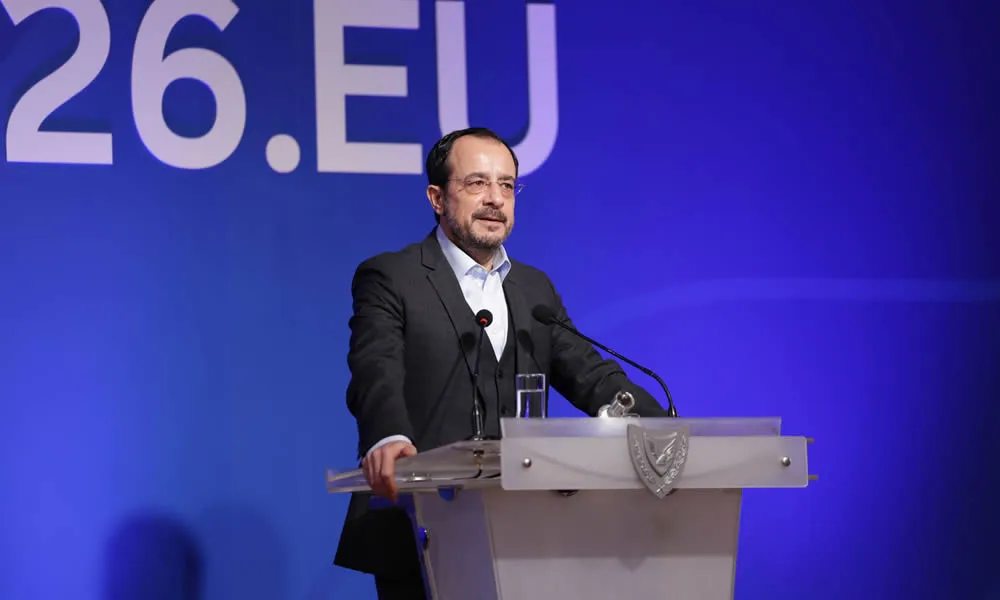

How serious or how casual are President Nikos Christodoulides’ recent statements regarding the presence of the British Bases in Cyprus? And, as Tufan Erhürman has argued, should Turkish Cypriots have a say in matters concerning their future on the island?
What is certain is that the public positioning of the President of the Republic on the British Bases brings back to the forefront one of the most complex and politically charged issues of Cyprus’s statehood: the coexistence of sovereignty with the constraints arising from the historical framework of Independence. His remarks, which include references to a “clear plan” and even to the possible abolition of the Bases, cannot be viewed in isolation from the broader political and geostrategic environment, nor from the legal commitments that have governed the Republic of Cyprus since 1960.
Rhetoric or strategy?
At first glance, the President’s statements appear to oscillate between political intent and rhetorical exaggeration. Describing the British Bases as a “colonial relic” is not new. On the contrary, it reflects a long-standing position held by a significant segment of the country’s political class. However, publicly raising the possibility of their abolition, without a concrete legal or diplomatic roadmap and with only general references, including comparisons to the case of Mauritius, raises legitimate questions as to whether this is a realistic policy objective or a statement driven by domestic political considerations.
The timing is not accidental. Cyprus is entering a pre-election period ahead of parliamentary elections, amid a rise in nationalist and anti-federal voices. The reference, even implicitly, to a return to the unitary state of 1960 constitutes a political choice with a clearly defined audience. In this context, the statements may function less as a mature diplomatic position and more as a political signal aimed at specific electoral constituencies clustered around parties such as DIKO, EDEK and ELAM.
The legal framework: commitments and limits
The first and perhaps most critical question concerns the legal basis of such positions. The British Bases in Cyprus are not merely military installations but sovereign areas of the United Kingdom, as established by the 1960 Zurich and London Agreements. These treaties regulate not only the presence of the Bases but also the broader constitutional and international framework of the Republic of Cyprus, including the system of guarantees.
A unilateral challenge to or abolition of these treaties by Nicosia is not legally feasible without serious consequences. Any change would require either the consent of all contracting parties or a fundamental revision of the international framework governing the Republic. Moreover, it raises the question of whether dismantling these agreements could create dangerous legal precedents, particularly in relation to Turkey, which continues to invoke the same treaties to justify, albeit abusively, its presence on the island.
Turkish Cypriots and the question of participation
The President’s position that Turkish Cypriots can have a say on the issue of the Bases only “after returning to the Republic of Cyprus” raises significant political and ethical questions. On the one hand, it reflects the legal reality: the Republic of Cyprus is the only internationally recognised state on the island. On the other, it overlooks the political reality of division and the need to include the Turkish Cypriot community in any future settlement.
Completely excluding Turkish Cypriots from the discussion on such a critical issue, and here Erhürman’s objections carry weight, risks undermining prospects for a solution to the Cyprus problem. Rather than acting as a bridge, this approach reinforces a logic of exclusion that has historically led to deadlock. In any case, any comprehensive settlement, whether federal or otherwise, will require agreement from both communities, including on issues such as guarantees and the presence of foreign troops.
The dilemma of guarantees
Particularly noteworthy is the potential reaction of the United Kingdom. At the Crans-Montana talks in 2017, Britain adopted a more flexible stance, aligning with Greece in favour of abolishing the system of guarantees. This was widely regarded as a significant diplomatic gain for the Greek Cypriot side, alongside the 2014 agreement under which a substantial portion of the Bases would have come under Greek Cypriot administration.
However, if the Republic of Cyprus places the issue of removing the Bases on the table, it is far from certain that London would maintain the same position. Linking the removal of the Bases with the simultaneous abolition of guarantees could prompt a reassessment of the British stance, with potential implications for negotiations on the Cyprus issue.
Judging by the way President Christodoulides is handling the matter, it appears he neither expects nor prioritises negotiations on Cyprus. At the same time, he seems unable to recognise that the crisis in the Middle East is leading to a gradual convergence of interests between the United Kingdom and Turkey on security issues, particularly within the European Union framework and in the region more broadly, where both are adopting more flexible and pragmatic positions.
Could such convergence, if the Bases are brought into the equation, translate into a joint British and Turkish stance on Cyprus, partly overturning Britain’s positions to date? This remains unlikely, given that the United Kingdom continues to recognise the legitimacy and sovereignty of the Republic of Cyprus. However, if Nicosia turns the issue of the Bases into a central diplomatic front, it could prompt a shift in British policy towards a more Turkey-oriented approach.
History offers a reminder. When Jack Straw was heckled in Nicosia in 2006, he later had little hesitation in making statements even in favour of a two-state solution. London views the Bases as a critical strategic asset. If it perceives its presence to be under threat, it may seek to safeguard its interests through alternative alliances or alignments. In this context, Turkey could emerge as a useful partner, given its military capacity and regional influence.
Geopolitical reality
Those who favour synthesis rather than rupture argue that, until a Cyprus settlement is reached, the Bases could be viewed differently. In a context of increasing instability in the Middle East, their presence acquires added significance. On the one hand, Cyprus may be exposed to risks due to the use of the Bases in military operations. On the other, their existence enhances the island’s geostrategic value and creates a framework of security and cooperation with Western powers, including Greece, France and the United States.
The removal of the Bases could be seen as strengthening the sovereignty of the Republic of Cyprus. However, it could also create a security vacuum or weaken the country’s international position at a time of heightened regional tensions. The question, therefore, is not only whether abolishing the Bases is desirable, but whether it is strategically prudent under current conditions.
The consequences
The President’s statements on the British Bases operate within a fine line between political demagoguery and strategic positioning. While they reflect genuine concerns and historical sensitivities, they also raise serious legal, diplomatic and geopolitical questions.
A unilateral approach to the 1960 treaties is difficult to implement and may have unpredictable consequences. Excluding Turkish Cypriots from the discussion runs counter to the need for a comprehensive settlement, while any shift in the United Kingdom’s position remains a factor that cannot be ignored.
Ultimately, the issue of the Bases cannot be approached in a fragmented or purely communicative manner. What is required is a coherent strategy that takes into account international law, balances of power and, above all, the prospects for resolving the Cyprus problem.
Unless, of course, the objective is no longer a federal solution but a two-state outcome. In that case, once President Christodoulides signs such a settlement with Erhürman, he would be in a position to demand the removal of the Bases from a “Greek Cypriot Republic”. Even then, however, who could guarantee that the Dhekelia Bases would not end up under Turkish Cypriot control?
Mauritius: does it create a precedent for Cyprus?
The United Kingdom’s decision to negotiate the return of the Chagos Archipelago to Mauritius has revived a key question within Cypriot public debate: does this constitute a precedent that Cyprus can invoke regarding the British Bases?
The short answer is that it creates a political and moral precedent, but not a direct legal instrument that can be applied to the Cypriot case. The substance lies in the subtle but crucial differences.
The Mauritius case concerns the Chagos Archipelago, which was detached from the colony in 1965, shortly before independence, to create the British Indian Ocean Territory. The United States and United Kingdom military base at Diego Garcia was subsequently established there.
The key point is that this detachment was later deemed a violation of international decolonisation law. In 2019, the International Court of Justice ruled that the United Kingdom should end its administration of the islands, as the decolonisation process had not been lawfully completed. This was followed by a United Nations General Assembly resolution in the same direction.
The current negotiations between London and Port Louis are therefore not a generous political gesture but the result of sustained international pressure, legal argumentation and the gradual delegitimisation of British sovereignty over Chagos.
By contrast, the British Bases in Cyprus did not arise from a unilateral colonial act prior to independence, but from an international agreement. The 1960 Zurich and London Agreements, signed by Cyprus, Greece, Turkey and the United Kingdom, explicitly provided for the creation of two sovereign base areas under British administration. In other words, the legal status of the Bases is the product of an agreed constitutional and international order, not a disputed decolonisation process.
This is the fundamental legal obstacle to transferring the Mauritius model to Cyprus.