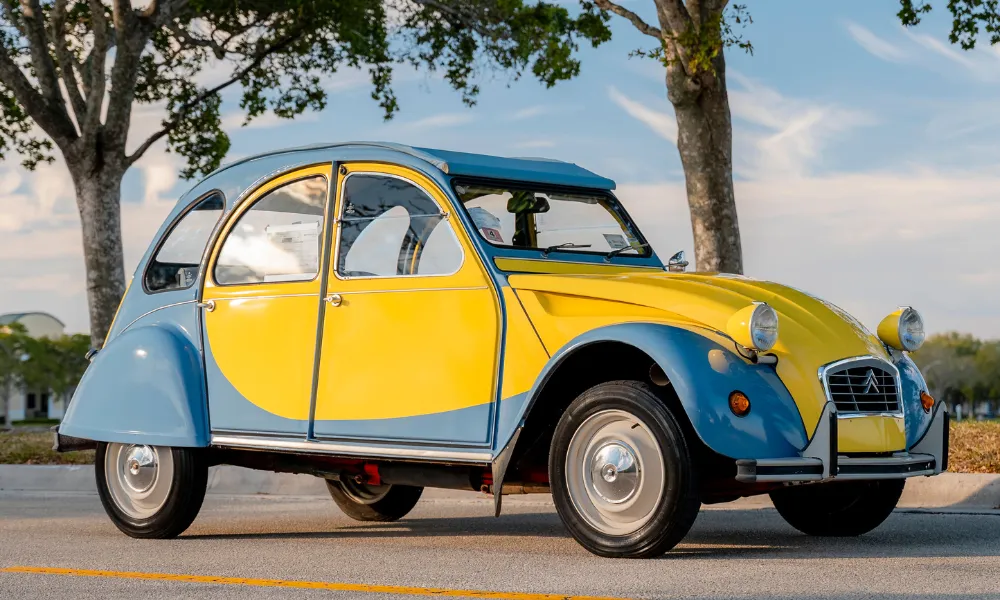

French carmaker Citroën has unveiled a new electric concept inspired by its legendary 2CV, one of the most recognisable cars in its history. The company says it intends to move the model from concept to production within the next two years, at a starting price of around €15,000.
The concept unveiled in Paris
The concept was presented in Paris on 12 October 2026. It reimagines the original Deux Chevaux for a new generation of drivers.The design combines minimalist styling, a spacious interior and modern electric technology.
Size and design approach
The vehicle measures 3.76 metres in length.
According to Citroën, it aims to combine the simplicity and affordability of the original 2CV with the demands of contemporary mobility.
Production plans and price
Although the car is still a concept, Citroën says it intends to bring it into production within two years.
According to the company, the model is expected to be manufactured in Europe, with a starting price of around €15,000.
The story of the original 2CV
A project interrupted by war
The 2CV was designed at Citroën’s design office on Rue du Théâtre in Paris and fine-tuned at the company’s test centre in La Ferté-Vidame, in the Eure-et-Loir region.
Citroën built 250 pre-production models to be unveiled at the 1939 Paris Motor Show. The outbreak of the Second World War meant the show never took place.
Launch at the 1948 Paris Motor Show
The car was finally presented to the public at the Paris Motor Show on 7 October 1948. It was unveiled by Citroën’s Pierre Boulanger at the opening of the show.
Production began in July 1949. The first 2CV was powered by a 375 cc, 9 bhp air-cooled flat-twin engine, with a top speed of 50 km/h.
The name stands for “deux chevaux vapeur”, meaning “two steam horses”. It refers to the French system of taxing cars according to their engine power.
The car was an immediate success. At one point, buyers faced a waiting time of five years to get one.
New versions and long-distance raids
Citroën added a van version in 1951 and a more upmarket model, the 2CV AZL, in 1956. Later versions included the 2CV 4 and 2CV 6 in 1970, which could exceed 100 km/h, and the popular Charleston model in 1981.
The car’s ruggedness and ease of maintenance made it a choice for some of the toughest journeys of its time. Citroën organised three long-distance raids:
The 16,500 km Paris-Kabul-Paris raid in 1970.
The 13,500 km Paris-Persepolis raid in 1971.
The 8,000 km Africa raid from Abidjan to Tunis in 1973.
The end of production
In 1988, production moved from France to Portugal. The last 2CV left the Mangualde factory in Portugal at 4pm on 27 July 1990, 42 years after its launch.
In total, 5,114,959 2CVs were produced worldwide.
To mark the model’s 60th anniversary, Citroën presented a 2CV 6 dressed inside and out by Hermès at the 2008 Paris Motor Show.
Sources: Euronews, Citroën, History.com