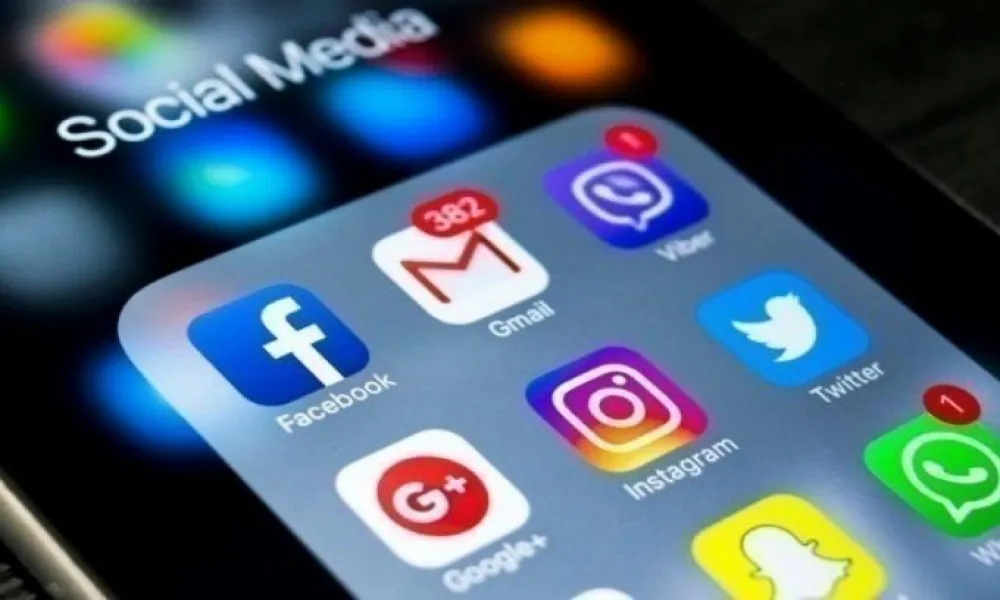

Greece has formally put its plan to restrict children’s access to social media before Parliament. The bill was tabled on Friday evening and will be examined by the competent parliamentary committee on Tuesday, 13 October. If passed, it will make Greece one of the first countries in Europe to set a legal minimum age for social media, with the restriction due to apply from 1 January 2027.
What the bill provides
The bill, submitted by Minister of State Akis Skertsos, is titled “Prohibition of the use of online social networking services by minors”. It sets 15 years as the minimum age for access to online social networking services.
The government presents the restriction as a preventive measure to protect minors.
Why the government says the ban is needed
According to the bill’s explanatory report, social networking services may pose risks to the physical and mental health, psychosocial development and safety of children under 15.
The report states that the widespread use of these services has led to a significant increase in daily use by young children. It links early exposure to algorithm-driven environments with an increased risk of problematic or addictive patterns of use. These environments are designed to maximise the time users spend on them through personalised recommendations, an endless flow of content and other mechanisms that hold attention.
How age will be verified
To apply the age limit in practice, the bill proposes using existing national digital age verification tools, namely the Gov.gr Wallet and the Kids Wallet.
The explanatory report clarifies that these applications are indicative tools and not the only permitted method. Other equivalent solutions may also be used, provided they meet the requirements of EU law.
Who will enforce the rules
Supervision of the new framework is assigned to two bodies: the National Council for Radio and Television and the Hellenic Data Protection Authority. Both acquire responsibility for monitoring how the provisions are applied.
Who is affected
According to the explanatory report, the measures primarily concern four groups:
Children under 15, whose access to social media will be restricted.
Parents and guardians.
Providers of online social networking services, who will have to comply with the age limit.
The national supervisory authorities responsible for monitoring implementation.
How the measure came about
Prime Minister Kyriakos Mitsotakis announced the plan on 8 April 2026 in a video posted on social media. “We decided to proceed with something difficult but necessary: to ban access to social media for children under 15,” he said.
He said at the time that the bill would come to Parliament during the summer of 2026, with the ban taking effect on 1 January 2027. He also sent a letter to European Commission President Ursula von der Leyen calling for action at EU level.
In September of the previous year, Mr Mitsotakis had said the government was considering a ban for children under 16, following the example of Australia.
Minister of Digital Governance Dimitris Papastergiou has since confirmed that the age limit will apply from 1 January.
The wider European picture
Greece is not acting alone. In September 2026, the European Commission proposed restrictions on social media use for children under 15 under its EU KIDS Act.
Several countries are taking similar steps:
France’s parliament has approved legislation banning social media for children under 15.
Denmark has announced a ban for children under 15, with parents able to allow access to certain platforms from age 13.
The United Kingdom has moved to ban social media for those under 16.
Spain has announced plans for a ban for those under 16.
Australia introduced a ban for children under 16, which Greece initially cited as its model.