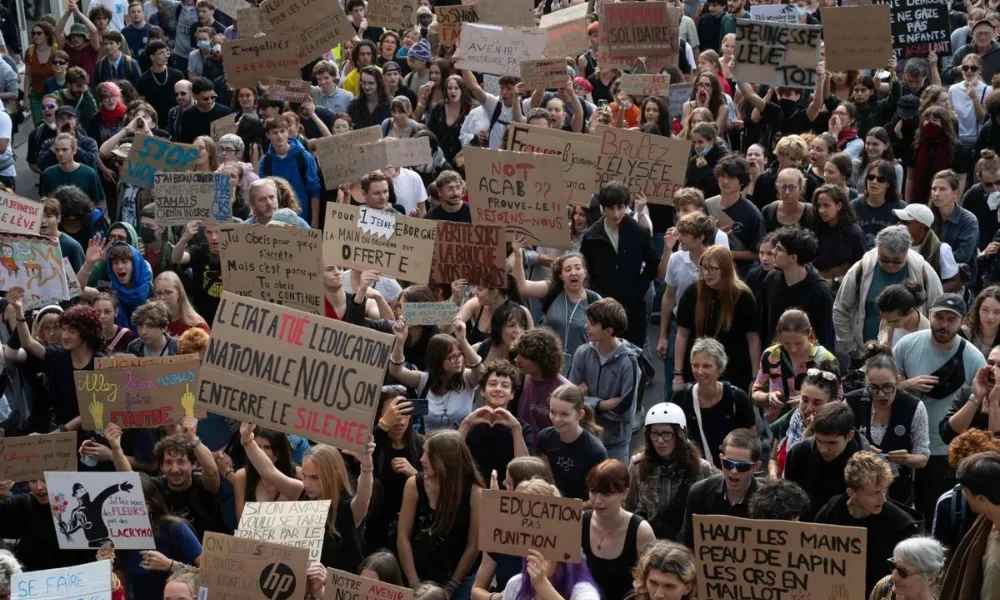

A protest by pupils at a single high school south-east of Paris has grown, in less than four weeks, into a nationwide movement that has disrupted hundreds of French schools and spread to universities. Pupils and students are protesting against missing teachers, crumbling buildings and overcrowded classes. They have now put forward 10 emergency measures that they want the government to adopt.
How the movement began
The movement began on Friday 18 September, when pupils at the Lycée Saint-Exupéry in Créteil, in the Val-de-Marne, went on strike in solidarity with their teachers to demand new teaching posts. Several teaching positions at the school were vacant.
The school was then blockaded on 21 September. Many schools across the Île-de-France region quickly followed, and the movement soon reached Marseille, Lille, Rennes and Strasbourg.
The Union syndicale lycéenne (USL), a high school pupils’ union, appears to have been behind the initial action. It pointed to a shortage of teachers and staff, run-down buildings, and overloaded timetables and classes.
From the Paris suburbs to the whole country
On Monday 28 September, the first blockades took place in Lille, Marseille, Lyon and Nice, and the Interior Ministry counted 180 schools disrupted. The movement grew further on 29 September, a day of action by public sector workers. From then on, the number of schools affected doubled each day, reaching 1,207 on 1 October according to the Education Ministry.
On Friday 2 October, around 400 schools closed their doors, and by then the movement had spread to universities.
The largest day so far came on Tuesday 6 October, the “third act” of the movement. Between 266,000 and 450,000 people marched across France, without major incidents.
Why pupils are protesting
Pupils are denouncing unsanitary buildings, overcrowded classes and teacher absences that are never covered, particularly in working-class neighbourhoods. They report classes of more than 35 pupils.
Pressure from Parcoursup, the national online platform that allocates places in higher education, is another central grievance. Pupils also cite heavy timetables alongside the shortage of teachers and the state of school buildings.
Unlike previous movements, this one is not united around a single central demand, which makes it harder for the government to manage.
The 10 emergency measures
The Union étudiante, a university students’ union, launched a platform of 10 emergency proposals for young people on Monday 5 October, together with the USL. The student organisations Unef, Fage and Solidaires étudiant.e.s have also signed it. An accompanying petition had gathered more than 9,000 signatures by midday the following day.
The 10 measures are:
1. Renovating school buildings. The organisations call for an emergency plan to renovate run-down and unsanitary school and university buildings. They want the work adapted to climate change, with cooling systems for heatwaves and proper insulation and heating for cold spells. They also want every school to have the means to maintain its premises and to provide clean, working toilets.
2. Recruiting more teachers and staff. They demand a large-scale recruitment plan so that every school has one nurse, one psychologist and one guidance counsellor for every 500 pupils. They want additional permanent teaching posts rather than contract jobs, a formal status for staff who support pupils with disabilities, and 800 more of these support staff.
3. Rethinking the school day. They want school hours overhauled at secondary and university level, a review of the reform of the baccalauréat and the lycée, and a guaranteed lunch break of at least an hour and a half.
4. 250,000 more university places and an end to selection. The organisations want to end algorithmic selection through the Parcoursup and Mon Master platforms by creating 250,000 additional places in higher education from September 2027. They would keep national application platforms, but without selection.
5. Protecting housing benefit. They call for the planned freeze on student housing benefit to be dropped. They want the benefit increased, restored for foreign students, and protected from a change in how it is calculated that would cut off 147,000 students.
6. Guaranteeing the €1 meal. They want university welfare services to receive the funding needed to guarantee meals at €1 for all students.
7. Scrapping higher fees for non-EU students. They want the “Bienvenue en France” scheme abolished, together with the higher tuition fees it charges students from outside the EU.
8. Increasing student grants. They demand a €200 increase in student grants, paid over 12 months, which they say would bring 300,000 more students into the system.
9. Strengthening pupils’ voice in schools. They want pupils to have more seats on school boards, list-based voting so that unions can be represented, and direct elections to the councils that represent pupils.
10. Ending repression and police violence. They want officers who commit violence to be prosecuted, and absences linked to the protests to be neither counted nor punished.
How the government has responded
On the evening of 30 September, Education Minister Édouard Geffray announced an online consultation platform through which every pupil can submit their views.
On 4 October, Prime Minister Sébastien Lecornu wrote to seven of his ministers saying classes should resume wherever safety allowed. He asked for priority action in every education authority on long-term absences and unfilled posts. The letter set out five priority areas: teaching conditions, school hours, buildings, Parcoursup and pupil representation.
Under pressure, Mr Lecornu later asked Mr Geffray to present initial measures. These included deploying 3,000 teachers without a fixed assignment to the schools facing the greatest difficulties.
On 7 October, Mr Lecornu gave a 15-minute televised address that contained no new measures. He referred the pupils’ demands to the budget debate, saying the education budget will be discussed in the National Assembly on 12 November. He said the government’s first decisions would be presented at the end of October.
The pupils’ and students’ organisations say this is not enough. USL president Ryad Rani said they have costed proposals and asked to meet the Prime Minister. Representatives said no concrete measures had been announced so far.
Police conduct under scrutiny
The way the protests have been policed has become a major issue. On 7 October, Interior Minister Laurent Nuñez temporarily suspended the use of stun grenades at high school protests, after a 15-year-old lost a hand in Lens two days earlier. Eighteen investigations have been opened by the IGPN, the internal police inspectorate.
Amnesty International France has said that a movement which was initially peaceful was met with force by the authorities, including tear gas, baton strikes and large numbers of arrests. Mr Lecornu said that police officers have no instructions to confront pupils.
A political dimension
Several politicians, including members of the government, have accused the left-wing party La France Insoumise of orchestrating the movement. Party leader Jean-Luc Mélenchon has dismissed the accusation.
The movement has also drawn wider support. The education unions Snes-FSU, CGT, FO and Sud called a day of strikes and protests on Thursday 8 October in support of the pupils.
What happens next
A first assessment of the government’s measures is expected on 16 October, with initial responses due by the end of the month. The Prime Minister has also asked the education and higher education ministers to propose real improvements to the 2027 Parcoursup campaign before the end of October.
With information from AFP, L’Etudiant, Maire-info, CIDJ, Public Sénat, LCP and Amnesty International France