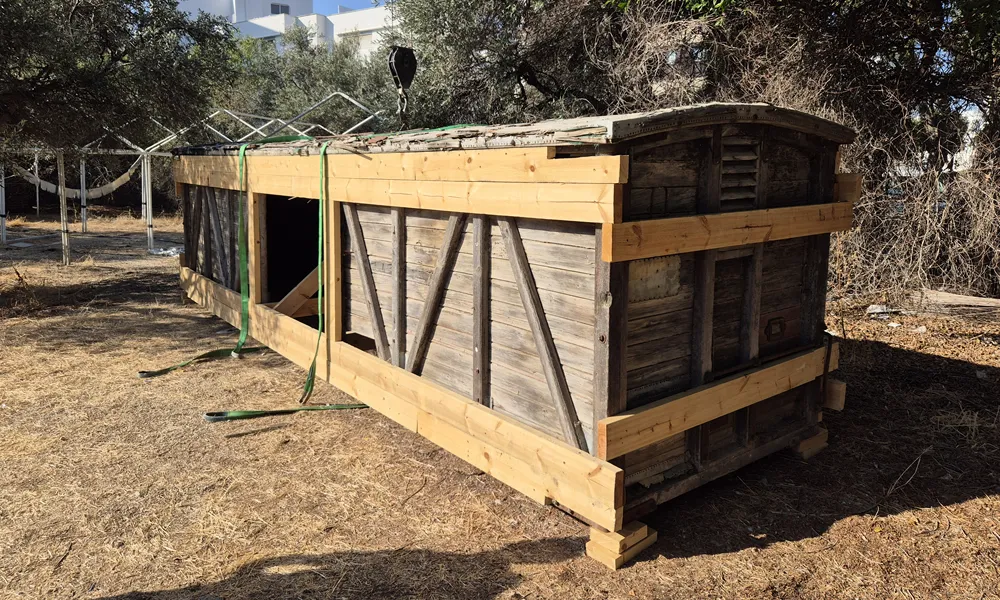

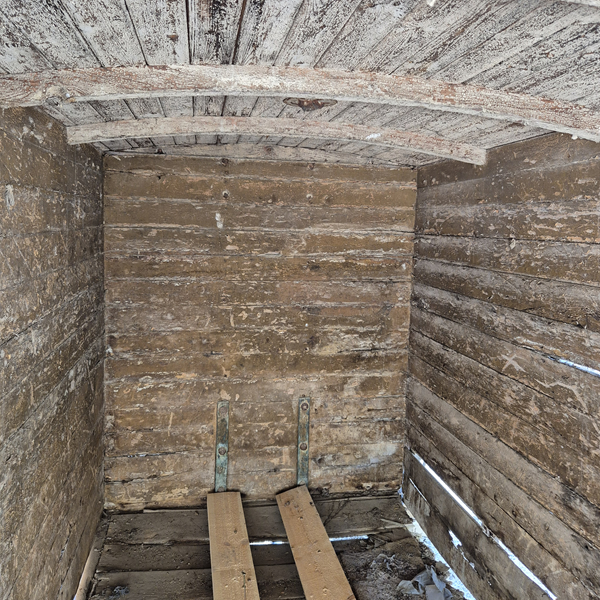
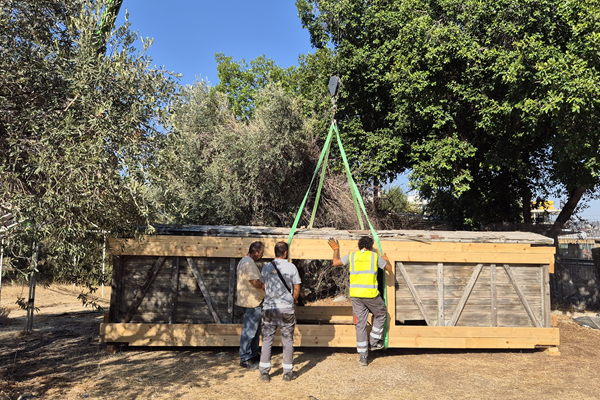
Two Cyprus Railway freight wagons started their final journey back to the station on Monday after sitting idle in a back yard in the capital for nearly 75 years.
The wagons were bought after the railway’s demise in 1951 by Costas Pikis, the well-known owner of the former Chanteclair Cabaret in Nicosia.
They then spent the next three quarters of a century parked in the backyard of a property on Kennedy Avenue in Nicosia. When Pikis’ godson, lawyer Achilleas Demetraides came into possession of the two old wagons, he decided to donate them to the Antiquities Department.
From freight to playground
“The two wagons have been parked in the yard on Kennedy Avenue since the 1950s. I used to play in them as a child. Now, they’re on their last journey, going to their resting place,” he said.
The department sent the wagons, which were likely purchased in the early 1900s when the railway was launched, to its woodworkers on Monday for a lengthy and costly restoration process. Once ready, they’ll be sent to the Cyprus Railways Museum in Evrychou village, a former railway station itself.
What Demetriades didn’t realise was that years ago, his father – Lellos Demetriades, the former mayor of Nicosia for 30 years – had donated a Post Office wagon, also bought by his uncle Pikis after the railway’s closure, which ended up restored and displayed at the Evrychou museum.
The postal wagon, which even contains pigeonholes for the letters sent to each village, is exhibited under a shed in the yard of the museum next to a hand pump track, formerly used for inspection of the line.
Wagons sold to locals after closure
Despite the fact the Cyprus Government Railway (CGR) was in operation for nearly five decades, the postal wagon in Evrychou is currently the only one on public display. At least, until the two donated freight wagons are added to the collection. While the department does not have any passenger wagons in its possession, there may still be some in private hands.
According to an Antiquities Department official, when the CGR closed down in 1951, the British disassembled all the tracks, and sold the rail, locomotives and rolling stock underframes as metal scrap in auction. With the metal gone, the wooden wagons were then sold off to locals for use as storage, garden sheds, caravans, while one family even converted a passenger wagon into their home.
A different era in Cyprus transport
The Cyprus Government Railway ran from 1905 until 1951 when it closed due to financial constraints. The first section heading from Famagusta to Nicosia was 60 kilometres long, running through the Messaoria plain. By 1907, a further 39 kilometres had been added, from Nicosia to Morphou in the west. By 1915, a second extension from Morphou to Evrychou was added, and a distance of 23 kilometres was completed, marking a total of 122 kilometres of railway tracks on the island.
The third and final section of the CGR was the hill section from Morphou to the southern terminal at Evrychou, which operated from 1915 until 1932. The line transported timber, agricultural goods and mail.
According to the Antiquities Department, before airmail, the railway was important for mail distribution on the island. Apart from regular passenger and freight services, the CGR also had special trains, such as the ‘Bathing Specials’ which ran every Sunday to Famagusta.
Special trains were also organised for the annual Orange Festival in Famagusta, while during the Second World War, the CGR played a significant role as a prime mover of troops, stores and ammunitions from Famagusta harbour to the Royal Air Force airfield in Nicosia.
With road transport on the rise, making trains non-profitable, the British colonial government took the decision to shut the railway service, with the last train departing from Nicosia Station on December 31, 1951.
Other railway installations were also set up in Cyprus, mainly to transport minerals. In 1915, the Cyprus Mines Corporation constructed a railway to transport ore from the Skouriotissa mine to a jetty at Karavostasi in Morphou Bay, which linked with the CGR at the Kargotis River Junction. There was also a mineral railway linking the mines at Kalavasos and Drapia to the processing plant at Vasiliko. This line remained in service until 1977.
Evrychou railway station
Following its closure in 1932, the Evrychou station building was used as quarantine quarters for contagious diseases, then as a dormitory for Forestry Department employees. In 1957 it was damaged by fire. The abandoned station fell into disrepair until 2008, when it was restored by the Antiquities Department.
Today, it houses the only Cyprus Railways Museum on the island. Original documents, drawings, photos and various objects related to the railways of Cyprus are exhibited in the Museum, as well as scale models of stations and rolling stock.