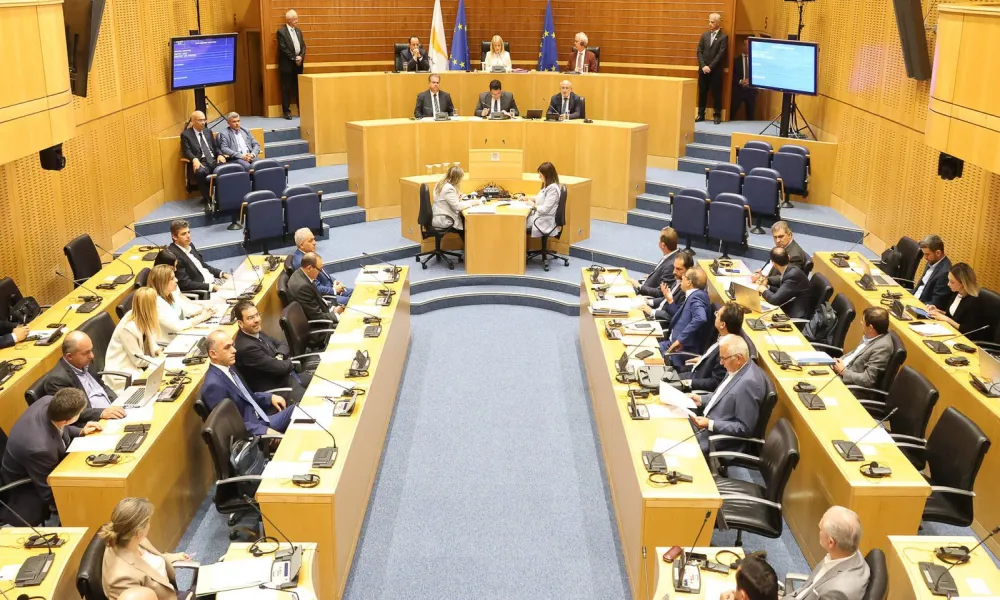
The parliamentary election of 24 May produced several winners. The battle for the presidency of the House of Representatives produced far fewer.
DISY leader Annita Demetriou succeeded in securing a second term as Speaker, but her victory was anything but inevitable. The support of the Direct Democracy movement in the first round proved decisive. Had the party of MEP Fidias Panayiotou opted to back DIKO leader Nikolas Papadopoulos, Demetriou would not have advanced to the second round on DISY's 17 votes alone.
ELAM was reportedly prepared to support Papadopoulos if Direct Democracy had reached an agreement with DIKO. Under that scenario, Papadopoulos would have secured 20 votes and a place in the second round. He would then have been strongly favoured to become Speaker, as DISY would have had little choice but to back him against AKEL's candidate, whose support base appeared capped at 19 votes.
The process unfolded like a political thriller. Negotiations continued until the final hours and alliances remained fluid. Only the four votes of the ALMA movement were firmly committed to AKEL from the outset.
DISY's pragmatism pays off
Among the major parties, DISY was arguably the only one to interpret the parliamentary election result with complete realism.
Retaining its 17 seats gave the party a significant advantage over its rivals. Had DISY fallen to the 13 seats predicted by some pre-election polls, the party leadership may have seriously considered supporting Papadopoulos for Speaker.
The arithmetic of the new parliament and the difficulties of forging cross-party alliances left limited room for manoeuvre. A partnership between DIKO and AKEL was always unlikely. DIKO remains part of the governing camp, while AKEL is the principal opposition party. Their policy positions diverge sharply and relations between the two parties are strained.
For DISY, the route to victory was clear. The party needed only to secure the backing of Direct Democracy to ensure Demetriou reached the second round. As a result, it focused almost exclusively on Panayiotou's movement and ultimately succeeded in convincing the young MEP.
DISY also calculated that DIKO would never support AKEL leader Stephanos Stephanou in a second-round vote. The strategy carried risks but remained the most realistic option available. In the end, political pragmatism prevailed.
AKEL chooses consistency over convenience
AKEL entered the contest with limited coalition options.
Its 15 seats, combined with ALMA's four, were enough to secure a place in the second round but insufficient to win the speakership outright.
Theoretically, AKEL could have joined the winning camp by backing Papadopoulos. Such a move might have weakened the broader centre-right and improved prospects for future cooperation with DIKO ahead of the 2028 presidential election.
Yet that argument found little support within the party leadership. There was no guarantee that any future alliance would emerge, and Papadopoulos repeatedly insisted that the Speaker election should not be linked to presidential calculations. He also made clear that DIKO had no intention of leaving the government.
During discussions, AKEL explored whether DIKO might consider an alternative candidate, given Papadopoulos' poor standing among sections of the party's grassroots membership. However, AKEL stopped short of seriously pushing another name, including that of Christiana Erotokritou.
The reality was that AKEL did not genuinely want such an alliance.
The parliamentary election had already delivered a positive outcome for the party. AKEL was the only established political force to increase its absolute number of votes. Party officials attributed that success to its stance on the Cyprus issue and its strong focus on social and economic policy.
Having regained credibility among voters, AKEL viewed support for DIKO as a potential step backwards that could trigger internal divisions. It may have lost the battle for the speakership, but it preserved its reputation for political consistency and ideological coherence.
Papadopoulos and the politics of opportunity
Nikolas Papadopoulos approached the contest as a politician determined to seize a rare opportunity.
With a realistic chance of becoming Speaker, the DIKO leader explored every possible avenue. He opened channels of communication with all parties and ruled out no potential alliance.
He was prepared to work even with ELAM if it helped secure the necessary votes.
When it became clear that DISY would not support him, he turned towards AKEL. When AKEL declined, he sought support from ELAM and Direct Democracy instead.
For critics, this demonstrated a lack of ideological consistency. For supporters, it reflected political realism and a willingness to build majorities wherever possible.
That approach carries risks. In pursuing the speakership, Papadopoulos placed considerable strain on DIKO's parliamentary relationship with DISY. Tensions escalated to the point where DIKO's leadership eventually decided that, if Papadopoulos failed to reach the second round, the party would back Demetriou.
The decision amounted to a form of damage limitation. Even so, questions about DIKO's credibility and long-term alliances are unlikely to disappear.
ELAM misses a strategic opportunity
ELAM entered the new parliament with doubled representation and eight seats, giving it the potential to play a kingmaker role.
Instead, the party became trapped by its own strategy.
Although ELAM seriously considered supporting Papadopoulos, it ultimately adhered to its long-standing practice of fielding and backing its own candidate.
The DIKO leader's candidacy offered ELAM an opportunity to achieve two objectives simultaneously: preventing both Demetriou and AKEL's candidate from winning. Yet the strategy depended heavily on the stance of Direct Democracy.
The four MPs aligned with Panayiotou ultimately proved the decisive factor, leaving ELAM sidelined despite having twice as many seats.
The contrast with 2021 is striking. Then, ELAM's support helped Demetriou become Speaker for the first time. The party gained visibility and credibility, while also expanding its appeal among some DISY voters.
This time, its more insular strategy elevated Direct Democracy to the role of kingmaker instead.
The Fidias factor
Despite its modest parliamentary presence, Direct Democracy emerged as perhaps the most influential player in the entire process.
Its support secured Demetriou's victory and once again placed Panayiotou at the centre of political attention.
From the beginning, the movement appeared determined to maximise the political value of its decision. Panayiotou publicly stated that his party would announce its position last in order to avoid disrupting negotiations. In reality, the delay also allowed Direct Democracy to ensure it would ultimately align itself with the winning side.
The strategy delivered both political and communications benefits.
As a relatively new movement without a clearly defined ideological identity, Direct Democracy also sent a broader political message. Its decision suggested that it may be more inclined to cooperate with forces on the centre-right than with the left in future political contests.
ALMA and the road to 2028
For ALMA, the parliamentary election was never an end in itself.
The movement was founded with an eye on the 2028 presidential election and the ambitions of its founder, Odysseas Michaelides. However, its electoral result fell short of expectations. A vote share of 5.8% and roughly 21,000 votes is unlikely, on its own, to provide a credible path to the second round of a presidential contest.
Under those circumstances, Michaelides is unlikely to impose his candidacy on AKEL or the broader opposition camp.
ALMA's highly confrontational election campaign, including the inclusion of former AKEL figure Irene Charalambidou on its ticket, created tensions with the left. The Speaker election therefore offered an opportunity to rebuild relations.
Viewed through that lens, ALMA's swift support for AKEL leader Stephanos Stephanou becomes easier to understand. While the party floated Charalambidou's name during discussions, its principal objective was broader: to revive the prospect of cooperation ahead of 2028.
The challenge for ALMA now is avoiding the perception that it has become merely a junior partner to AKEL rather than an independent political force in its own right.
A vote with long-term consequences
The Speaker election was ostensibly about filling the second-highest office in the Republic. In reality, it served as an early test of strategy, discipline and political positioning ahead of the next presidential cycle.
DISY demonstrated the value of pragmatism. AKEL prioritised ideological consistency. DIKO pursued opportunity wherever it could find it. ELAM discovered the limits of self-imposed isolation. Direct Democracy confirmed its ability to influence outcomes disproportionate to its size. And ALMA took its first tentative steps towards rebuilding bridges with the opposition.
The outcome may not determine the 2028 presidential election, but it has already revealed much about the alliances, ambitions and calculations that will shape the road towards it.