
It is undoubtedly a positive development that Cyprus has been included in the European plan for the 2026 summer firefighting fleet through rescEU and is participating, for the first time, in the firefighter pre-positioning programme. This is particularly important this year, as the summer is expected to be exceptionally hot due to climate change and the El Niño phenomenon.
For the record, and lest we forget, it is worth recalling that the architect of rescEU—which upgraded and strengthened European civil protection policy as a whole—was Christos Stylianides, European Commissioner for Humanitarian Aid and Crisis Management from 2014 to 2019. It is also worth noting that rescEU was included among the 20 most significant achievements of the Juncker Commission.
The firefighter pre-positioning programme was launched in 2022, again at the initiative of Christos Stylianides, who, as Greece’s Minister for Climate Crisis and Civil Protection, submitted a comprehensive proposal that was adopted by both the European Commission and the Member States. Today, the programme is regarded as a complete success and has effectively become an established institution. It remains puzzling, however, why the Cypriot Government delayed for four years before deciding that Cyprus should also participate in the programme.
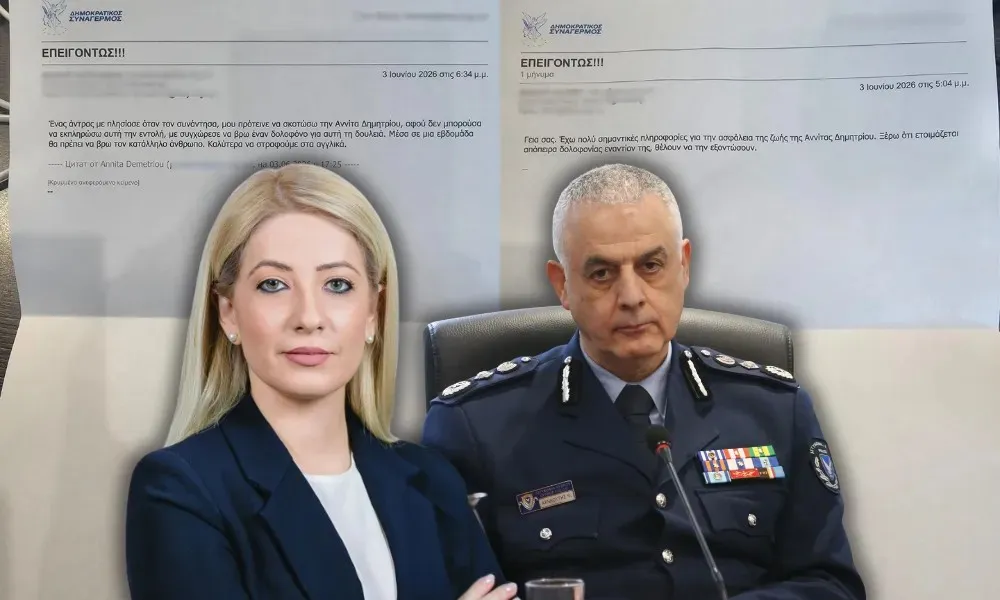
Police investigate threats against Annita Demetriou
Annita Demetriou received three threatening emails last Tuesday and immediately notified the police, who attended DISY headquarters and took possession of her assistant’s computer for examination. The investigation is expected to reveal the route the emails took and possibly identify information pointing to the sender. Some claim the messages originated in Limassol and carried a Bulgarian connection.
The most interesting aspect, however, is something else entirely. Just three hours after the police had taken possession of the messages, Ms Annie Alexoui revealed the threats in a video and even presented copies of the emails. Some within DISY contacted Themis Arnoutis and complained that police officers had leaked the information, but he disagreed. According to him, others may also have had access to the messages, and therefore the leak could not automatically be attributed to the police.
How Annita secured the Speakership
Efforts to secure Annita Demetriou’s election were pursued on two fronts once it became clear that DIKO would contest the first round with Nicolas Papadopoulos and would even seek the presidency of the House of Representatives. DISY then turned in two directions: towards Direct Democracy, with Averof Neophytou acting as the key intermediary and maintaining close coordination with Annita from the outset, and towards ELAM, with Nicos Anastasiades serving as the main channel.
Anastasiades failed to alter ELAM’s position, which ruled out supporting Annita. On the contrary, the party went a step further, allegedly with encouragement from President Christodoulides, suggesting that if Direct Democracy backed Nicolas, ELAM would do the same. With 20 votes, the DIKO candidate would have reached the second round and, in all likelihood, become Speaker of the House, given that he would also have secured DISY’s support.
The negotiations that changed the outcome
Those plans ultimately failed for two reasons. First, Fidias demanded that a video be recorded with President Christodoulides in which the latter would publicly commit to specific undertakings. This was not accepted. While both Christodoulides and Nicolas provided the assurances verbally, Fidias considered that insufficient.
Second, “Grandfather Averof”, as Fidias refers to him, worked his magic. WhatsApp was reportedly buzzing, and numerous meetings took place with Fidias, some attended by Annita herself. Direct Democracy’s proposals on pensions, demographics and housing were accepted, and the now-famous video was produced. Yet Averof’s principal argument appears to have been that there is long-term political potential with DISY, whereas Christodoulides is “a fairground attraction that is coming to an end”.
A partnership that could extend to 2028
DISY and DIKO confronted one another in the first round of the House presidency election. However, once it became clear that victory would emerge from within the centre-right bloc—meaning the scenario of AKEL supporting Nicolas had effectively collapsed—it was understood, and indeed discussed between Annita and Nicolas, that whoever lost would support the winner in the second round.
This cooperation strengthened the perception that DISY and DIKO could also work together in the presidential elections, albeit under certain conditions. Specifically, DISY, with its 27.2 per cent electoral base, would have the right to nominate the presidential candidate in 2028.
In any event, DIKO is expected to assume the presidency of the House in a year’s time, provided it withdraws from government and aligns itself with the DISY candidate.
Fidias emerges stronger
We do not seek to determine who was right or wrong, but judging by the outcome, Fidias appears to have emerged as the biggest winner among the smaller parties. Unlike ALMA, Direct Democracy found and played its role, sending the message that a “small” movement can evolve into a serious actor in party politics.
Odysseas, by contrast, placed all his bets on AKEL, and what happens between now and 2028 remains to be seen. If anyone gained ground among AKEL’s left-wing supporters, it was Eirini Charalambidou, whose public statement contributed significantly to securing support for Stefanos. This move may well place her on AKEL’s shortlist of future candidates—something the party would be unlikely to oppose if it wishes to keep ALMA close. AKEL’s reasoning is simple: there is virtually no chance that its supporters would ultimately switch their votes to Odysseas.
Political courtesy in parliament
ELAM’s conduct reflected a lack of political civility. All MPs went to congratulate the newly elected Speaker of the House, as tradition dictates, but ELAM’s MPs did not. One could argue that Christos Christou congratulated her from the parliamentary podium, but a simple handshake would hardly have caused any harm.
By contrast, the President of the Republic congratulated her immediately after her election via Twitter and later telephoned her. They eventually spoke on Friday morning as he was departing for Montenegro. Whatever his political preference may have been, the President demonstrated a high degree of political decorum.
A masterclass in political imagery
Former Metropolitan Bishop of Paphos Tychikos could easily find employment in an image-building consultancy and command a respectable salary. He could even serve as a communications adviser to President Christodoulides, who will undoubtedly require public goodwill in the coming months.
Consider the photograph: Tychikos sitting at the entrance of the Metropolis with suitcases behind him, apparently ready to depart because he has been forced out, accompanied by the hymn “Phos Hilaron” playing in the background. When the post appeared on social media, it was genuinely moving—at least initially.
The difficulty, however, is that many people cannot forget the absurd episodes associated with him, which diminished the standing of the Church of Cyprus: the kollyva, the Coca-Cola controversy and the delivery boys. We are confident that “little Tychikos” will not be left homeless. Archbishop Georgios will undoubtedly find him somewhere to stay.
During his three-day visit to Istanbul as Vice-President of the Parliamentary Assembly of the Council of Europe, Nikos Tornaritis raised the issue of Hagia Sophia and the need to restore this globally significant cultural monument to museum status. His meetings with Ecumenical Patriarch Bartholomew and with influential figures in Turkey were not merely symbolic gestures.
They form part of a broader effort to keep communication channels open, with the aim of restarting meaningful discussions on the Cyprus issue and strengthening the presence of global Hellenism in major international debates. Politics is not merely the management of day-to-day affairs; it is also the defence of principles, values and historical memory.
Police findings leave key questions unanswered
The police were unequivocal regarding their investigation into the “Santi” case. According to their findings, everything was fabricated, meaning there is no case against those who were accused.
Nevertheless, many questions remain unanswered and the public expects clarification. For example, who was the mastermind behind the operation? If some within the police continue to insist that a young woman from Geri somehow knew Mylonakis, Morphakis and Nathanael, and possessed information about who was communicating with whom simply because she monitored the internet, they are unlikely ever to be believed.
It is clear that someone either possessed or was actively manufacturing such messages. One hopes that the second phase of the police investigation will uncover further details, allowing a fuller picture to emerge rather than attributing everything to a single fantasist. If matters remain unresolved, people will continue drawing their own conclusions, while lengthy court proceedings are likely to follow.