
This article was first published on Parathyro
The ongoing saga surrounding the evaluation committees responsible for reviewing applications to the “POLITISMOS III” cultural grant programme continues to shift from week to week.
Since early February 2026, when artists began publicly expressing frustration over delays, nearly three weeks passed before the deputy ministry of culture issued a response. What followed was an uneasy picture, accompanied by what many perceived as a communication manoeuvre aimed at calming an increasingly anxious artistic community concerned about their professional prospects for 2026.
A protest prompts answers
It ultimately took the announcement of a protest for the deputy ministry to issue a statement addressing the long-awaited timeline for the evaluation process and the delays in announcing results for POLITISMOS III, as well as upcoming cultural grant programmes.
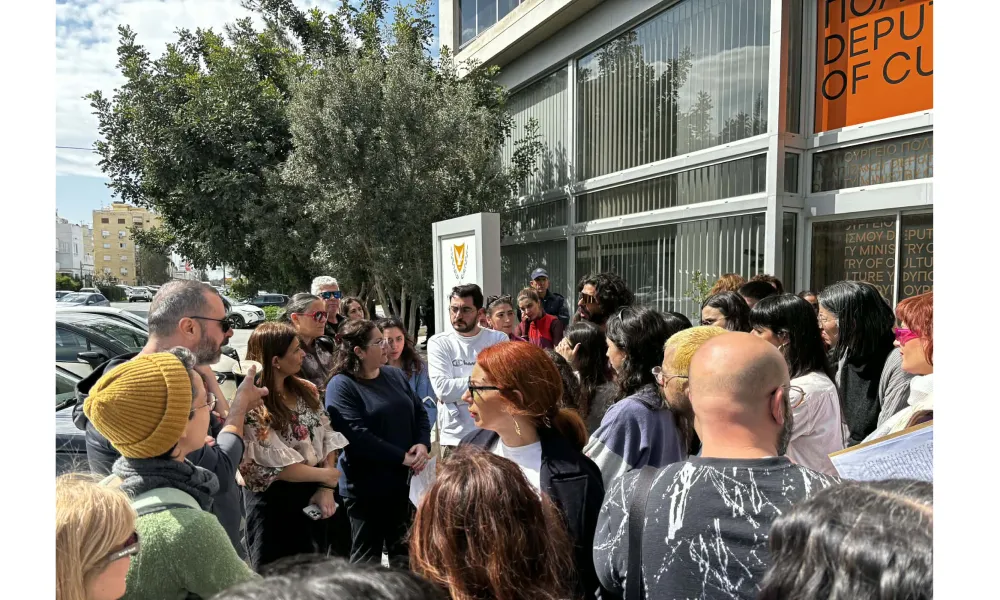
On Friday, shortly before noon, police arrived outside the building. Artists gradually gathered. At exactly 12.00, the ministry’s statement was sent to media outlets, while officials inside the building stepped outside to face the demonstrators.
The director of the department of contemporary culture, Ioanna Hadjicosti, was the only senior representative present.
Notably absent were Deputy Minister of Culture Vasiliki Kassianidou and Director-General Giorgos Papageorgiou. Their absence reinforced the sense among many artists that the cultural community they are meant to serve had been treated with disregard.
The scene that followed was striking: concerned artists surrounding ministry officials in an improvised exchange outside the building.
The decision for ministry officials to step outside appeared to function as a symbolic gesture meant to reinforce the opening line of the ministry’s statement: that the deputy ministry “expresses its respect for artists, their work and their important contribution to Cypriot society.”
Yet the atmosphere quickly turned awkward when artists asked the obvious question.
“Where is the deputy minister? Where is Mr Papageorgiou?”
The response was that they were attending a meeting in Larnaca. However, rumours circulated that they had chosen not to attend the protest and that officials had received instructions on what to say.
Speculation also emerged over who had called the police to the scene, although many considered that detail secondary.
Responsibility for responding to questions fell largely on Hadjicosti and the ministry’s press officer, who answered queries from the assembled artists.
Promises and shifting timelines
The first commitment given was that the names of the evaluators for POLITISMOS III would finally be published on Monday, March 9.
Yet contradictions quickly emerged. The ministry’s statement indicated that the evaluation process had already begun, while artists were told that the evaluation panels had only “almost been finalised” and that work would begin intensively from Monday.
Officials also explained that one evaluator had withdrawn and would be replaced.
This followed earlier indications, circulated among cultural reporters in late February, that the names of evaluators would likely be announced around February 23–24.
Three weeks later, artists are left wondering whether the promised approvals will indeed be granted on Monday or whether the timeline will once again shift.
A summer in doubt
Regardless of the exact date, artists say the delay has already made it extremely difficult to plan projects for the coming months.
Many noted that they had been assured results would be announced by late January. Hadjicosti acknowledged that this had been the goal but said changes in the process prevented it.
Asked whether compensation might be considered, similar to support provided during the Covid-19 pandemic, she said the possibility could be examined, although the overall budget remains unchanged.
According to the ministry’s statement, the evaluation process is expected to conclude within April, with announcements taking place sometime between early and late April depending on the workload in each sector.
Hadjicosti revealed that the programme received 440 applications, with the visual arts and music sectors generating the largest volume.
As a result, those two fields may experience longer delays, potentially pushing announcements toward the end of April.
Artists also questioned why the reasons for the delays had not been communicated earlier. The responses did little to ease concerns.
One artist noted that for a small organisation, a three-month delay could mean a loss of €8,000.
“We cannot lose €8,000 for unexplained reasons,” the artist said.
Hadjicosti responded that before any programme can be released publicly it must pass through several internal approval stages within the deputy ministry, a process that proved particularly time-consuming this year.
She stressed that the department of contemporary culture had been prepared and had begun work earlier, anticipating the demands of Cyprus’s upcoming EU Council Presidency.
Questions were also raised about the selection process for evaluators. Officials explained only that the final decision is made by the deputy minister.
Hadjicosti acknowledged that the silence of recent weeks could have been avoided. Artists also pointed to the absence of the two senior officials and the many emails sent requesting basic information about the timeline.
The ministry’s leadership, officials said, is willing to meet with cultural organisations later this week.
New programmes announced
Alongside the announcement regarding POLITISMOS III, the deputy ministry said a series of cultural funding programmes would be launched.
These include the KYPRIA festival programme, a scheme supporting cultural organisations with communication and international networking costs, a programme covering operating expenses for theatre organisations and another funding scheme for cultural organisations’ operational needs.
The “Cultural Decentralisation” programme is expected to be announced later in March, along with several smaller initiatives.
Hadjicosti said the KYPRIA programme will proceed under its existing format this year, as there is insufficient time for consultation and structural changes.
However, consultations are expected to take place later in March with the aim of reshaping the programme for the following year. She noted that its objectives are currently not clearly defined.
Officials reiterated that the goal is to begin announcing the results of cultural grant programmes each December for the following year.
Events affected by regional tensions
Meanwhile, ministry officials are also dealing with broader pressures.
Alongside internal disagreements over cultural funding delays, they must now manage the impact of the Middle East crisis, which has directly affected Cyprus following the crash of a drone near the Akrotiri base and the growing presence of naval and air forces in the wider region.
As sirens sound repeatedly in Akrotiri and authorities conduct emergency alert tests, several cultural events have already been postponed.
The informal meeting of EU culture ministers, scheduled for March 5–6 at the Cyprus Conference Centre, was among the first events to be affected, as travel became impractical amid the developments.
According to information available, the exhibition “George Pol. Georgiou – Cyprus the Eternal,” originally scheduled to open on March 12, has also been postponed.
In addition, the Cyprus Choreography Showcase has been pushed back to September 2026.
A difficult year for culture
Even without the geopolitical developments, many in the cultural sector believe 2026 was already shaping up to be an extremely difficult year.
Some now fear that administrative decisions and prolonged delays may have undermined much of the cultural activity originally planned for the summer.
There is hope, however, that the leadership of the deputy ministry will recognise the scale of the problem. Others suggest that the presidential palace may eventually step in with recommendations, sending a message that the Christodoulides administration does not need to carry additional crises at this moment.