
This was first posted in Parathyro, Politis' cultural page
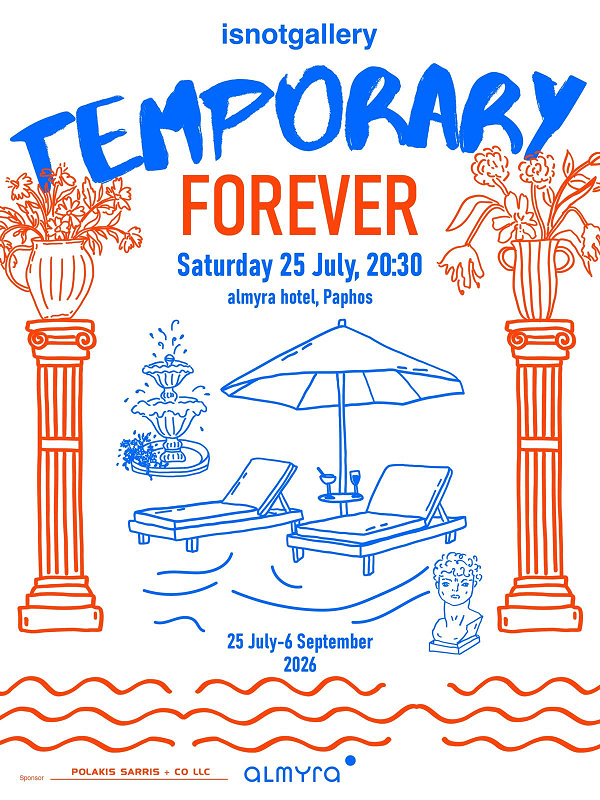
Ten summers after it began, the established summer collaboration between isnotgallery and Almyra returns with a new group exhibition, "Temporary Forever." Curated by Andros Efstathiou, the show explores the ongoing tension between the transient and the permanent, placing time at the centre of the artistic experience.
It is an institution that returns each summer with the same regularity as the season itself: ten summers of art in a space made not to be stayed in, but to be returned to.
According to this year's concept, summer never stays, but returns, regularly, reliably. Each year it arrives as though for the first time and departs as though for the last. This repetition, summer coming back, identical and different each time, is perhaps the most honest image for the artwork itself. A work is created within a specific moment, for specific reasons, and yet it aspires to outlast them all: to remain, to be remembered, to mean something beyond the moment of its creation. The temporary, then, is not the opposite of the lasting. It is the only way we know to confirm it.
This coexistence of the fleeting and the enduring lies at the heart of the exhibition. It is no accident that as early as 1966, Robert Smithson wrote of a new generation of monuments that made no claim to permanence, describing them as "not built for the ages, but rather against the ages." These were not monuments to failure or resignation, but ones already reconciled with their own decay, that made no pretence of eternity, and precisely for that reason managed to say something true about time.
Under Efstathiou's curation, every work in "Temporary Forever" carries its own version of this tension. There are works made from materials that will not endure, placed alongside others that insist on the permanence of metal, stone and photography. There are images that seem to ask to be forgotten, and others that seem to stubbornly refuse to disappear. None of these works resolves the question. All of them, however, give it shape.
The exhibition does not try to keep anything alive forever. It tries to stand, briefly, for as long as a summer lasts, at the point where the fleeting and the enduring stop being opposites and become, simply, two ways of measuring the same time.