
Visitors to the Louvre Museum these days may be surprised to find themselves learning not only about ancient Cyprus, but also about the island's modern water challenges and its increasing dependence on desalination plants, a solution that currently lies at the centre of government policy.
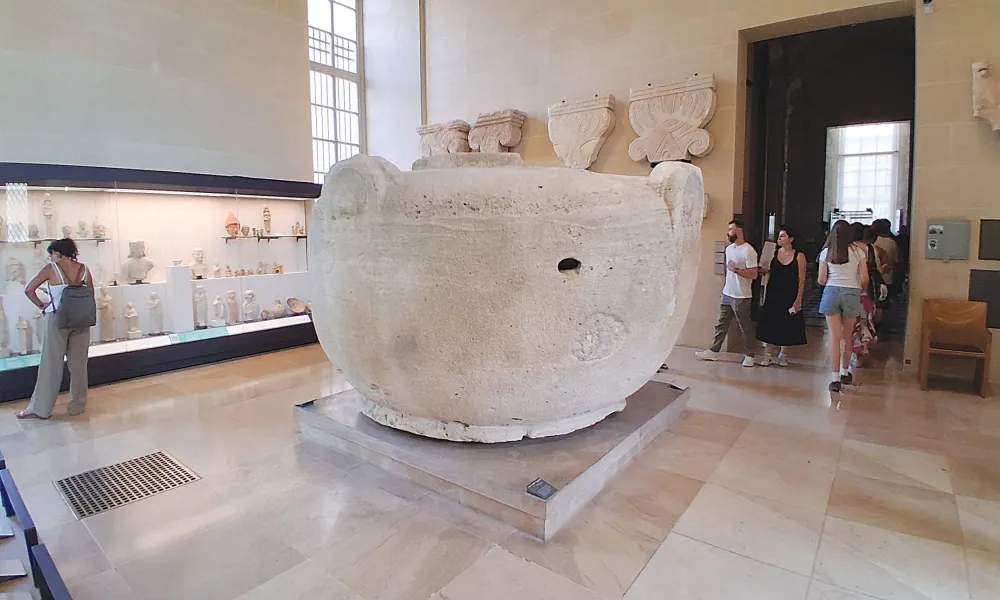
The reason is the famous Amathus amphora, a monumental limestone vessel dating to the 6th century BC, which was removed from the acropolis of Amathus and transported to the Louvre in 1865 by French architect Edmond Duhousset. Weighing approximately 13 tonnes, measuring more than three metres in diameter and almost two metres in height, it is regarded by archaeologists as unique in the world because of both its construction and its size.
The vessel dominates Room 316 of the Paris museum, which houses one of the world's most important collections of Cypriot antiquities. The Louvre's Cypriot collection comprises more than 4,000 artefacts, displayed in Rooms 316 and 300.
Beside the megalithic vessel, the museum has installed a large information panel linking the past with Cyprus' present-day water situation.
Under the title "The Amathus Vase and Water in Cyprus", visitors can read:
"This monumental limestone vase weighs more than twelve tonnes and can hold approximately 5,000 litres of water. Since antiquity, numerous reservoirs were built in Cyprus to collect and store rainwater. This vessel, much more elaborately decorated than ordinary reservoirs, was probably used to store water associated with the worship of Aphrodite. A model discovered in the ancient city of Idalion in Cyprus shows that movable ladders probably allowed worshippers to gain access to the inside of the vessel."
The text then connects the ancient artefact to present-day Cyprus:
"And today? Water, which has always been a precious resource in Cyprus, is becoming increasingly scarce as a result of climate change. The island of Cyprus now relies on seawater desalination plants to provide drinking water to its inhabitants. These plants, which are used in many countries facing drought, offer a solution to water scarcity. However, they require extremely large amounts of energy and discharge brine, which is harmful to marine biodiversity."
Eteocypriot symbols
The amphora features four curved handles decorated with bull heads.
Symbols appear near one of the handles and along the rim, which have been interpreted as inscriptions in the local Eteocypriot language.
The first "word", "a-na", appears frequently in Amathus and may signify "deity."
The vessel is believed to have been one of two monumental amphorae positioned at the entrance to the Temple of Aphrodite.
Fragments of the second amphora remain visible on the acropolis to this day.
Most of the Cypriot antiquities currently housed in the Louvre were transferred there by various French archaeological missions operating on the island from the 19th century through to the 1950s.
According to the laws in force at the time, archaeological discoveries were distributed between the Cyprus Department of Antiquities and the foreign archaeological missions conducting the excavations.