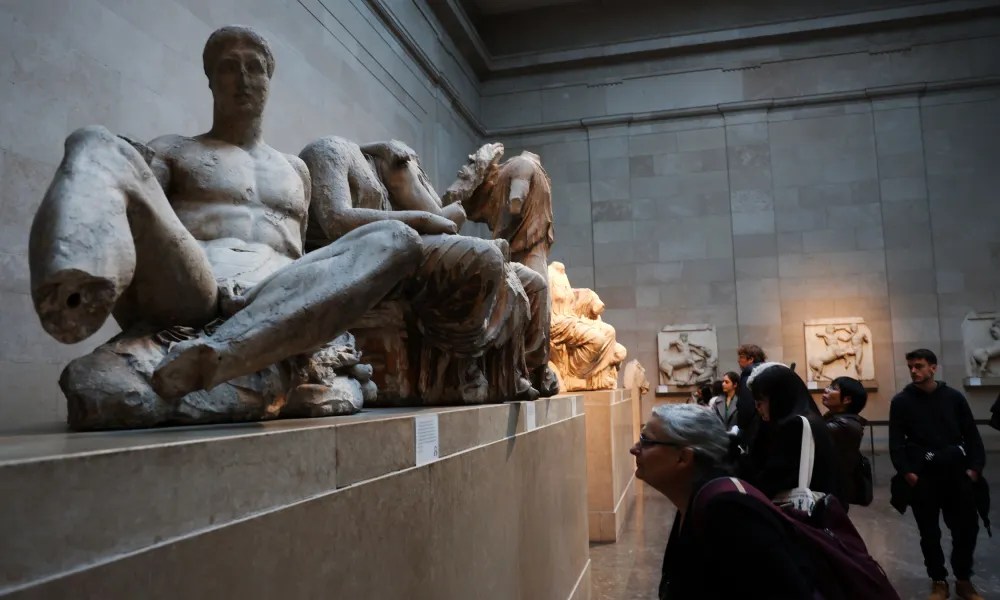

The UK government has ruled out, for now, any change to legislation that would allow the permanent return of the Parthenon Marbles to Greece, despite interventions by members of the House of Lords advocating their reunification.
The issue returned to the British Parliament, where discussion focused on the restrictions imposed by the British Museum Act 1963 and the prospects for reaching an agreement with Greece.
According to ERT, independent peer The Earl of Clancarty asked the government whether it had examined proposals for the permanent return of the Marbles, which remain in the British Museum.
Responding, culture minister Baroness Twycross said no government assessment of such proposals had been undertaken. She welcomed ongoing discussions between the British Museum and Greek ministers aimed at finding a mutually acceptable solution.
No plans to amend the 1963 law
During the debate, the Earl of Clancarty argued that the sculptures form a single artistic ensemble and compared their separation to dividing Pablo Picasso’s Guernica among different museums.
He suggested a limited amendment to the British Museum Act 1963 that would allow the museum to decide whether to return the Marbles.
However, Baroness Twycross made clear that the government is not planning to review the legislation, noting that such a proposal is not included in the government's legislative programme as outlined in the King's Speech.
While acknowledging that the British Museum operates independently, she said its decisions remain constrained by the existing legal framework.
Differing views in the House of Lords
The debate highlighted contrasting views on the issue.
Conservative peer Viscount Hailsham opposed the return of the Marbles, arguing that it could set a precedent for numerous other antiquities and cultural artefacts held in museums outside their countries of origin.
Labour peer Lord Dubs asked whether a return could be achieved under current legislation or whether new laws would be required.
Baroness Twycross pointed to the provisions of the 1963 Act, which permit the permanent removal of objects from the British Museum's collections only under very limited circumstances.
Meanwhile, Lord Addington of the Liberal Democrats referred to the temporary loan agreement involving the Bayeux Tapestry and questioned whether a similar arrangement could be explored for the Marbles.
Twycross replied that no such agreement currently exists and said the museum continues to seek a solution within existing legal constraints.
Ownership remains a key obstacle
The British side continues to consider a loan arrangement as a possible route forward.
However, Baroness Twycross reiterated that any such agreement would require Greece to recognise the British Museum's ownership of the sculptures and guarantee their return following the loan period.
That condition remains unacceptable to Greece, which does not recognise the museum's ownership claim.
Labour peer Baroness Chakrabarti criticised the loan proposal, arguing that Britain would be unlikely to accept a temporary-loan solution if objects from the Crown Jewels had been removed and were being claimed by another country.
Independent peer Lord Ricketts raised the example of the Bayeux Tapestry returning to France after its loan period.
In response, Baroness Twycross said there was no intention of retaining it in Britain permanently, remarking that such a scenario would occur only "over my dead body."
References to the Acropolis Museum
Support for Greece's position also came from Baroness Jones of Moulsecoomb of the Green Party, who highlighted the sections of the Parthenon where the sculptures are missing and argued for the monument's reunification.
Similarly, Baroness Hussein-Ece of the Liberal Democrats noted that Greece has sought the return of the Marbles for decades and has built the purpose-designed Acropolis Museum to house them.
She also pointed out that the British Museum keeps a large number of artefacts in storage that could be displayed instead.
Talks continue
The debate did not alter the government's position, with Baroness Twycross repeatedly stating that there are no plans to amend the law.
She emphasised the strong ties between Greece and the UK, built on shared history and values, but maintained that the government will not pursue legislation enabling the permanent return of the Marbles.
The current British prime minister previously voiced support for their return without conditions and had backed efforts to amend the 1963 law. Since taking office, however, he has left responsibility for handling the matter to the British Museum.
Discussions between the two sides remain ongoing, with the unresolved question of ownership continuing to be a major obstacle to any agreement.
Source: ERT