
A special report by the Audit Office has raised concerns about conflicts of interest, grants awarded to potentially ineligible beneficiaries, questions over transparency in funding decisions and shortcomings in financial controls within cultural funding programmes managed by the Department of Contemporary Culture.
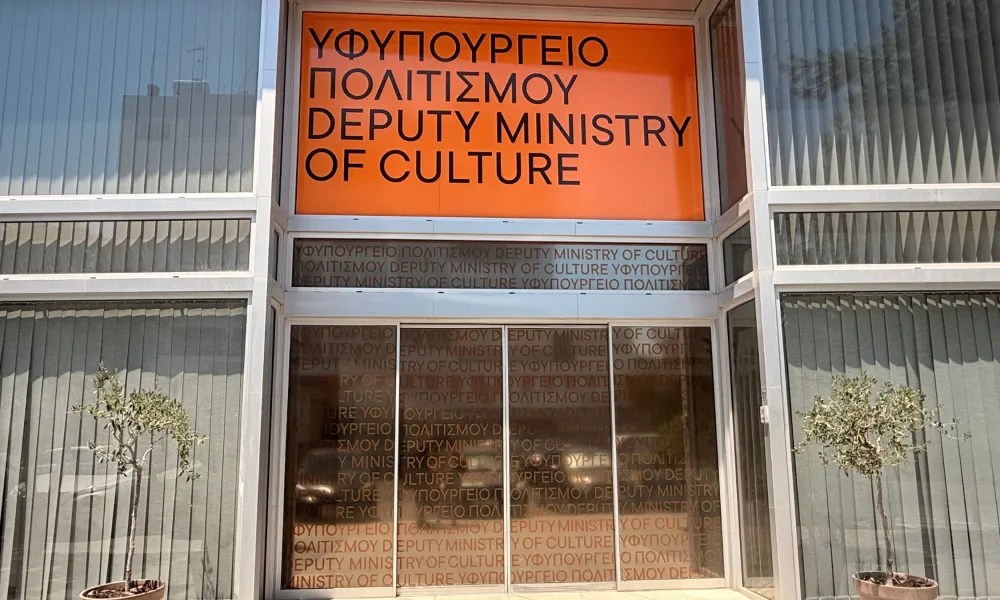
The findings touch on issues previously raised publicly by George Papageorgiou, now Director-General of the Deputy Ministry of Culture, when he was on the applicants' side of the process as Director-General of Nicosia For Art and Artistic Director of the Nicosia International Festival.
The 100-page report examines only the KYPRIA Arts Festival programme for 2024 and 2025 and the Music and Theatre sectors of the POLITISMOS II programme for 2025.
Although 2026 falls outside the audit period, the report also references significant delays this year in announcing funding results and the impact those delays had on cultural activity.
Background to the controversy
The report notes that Papageorgiou publicly criticised the funding process in September 2025 after the Nicosia International Festival failed to secure support under KYPRIA 2025.
At the time, he questioned both the composition of evaluation committees and the handling of conflict-of-interest complaints, arguing that ensuring independence is difficult in Cyprus' relatively small cultural sector because evaluators frequently serve on cultural boards or have professional collaborations with applicants.
After taking office at the Deputy Ministry in early 2026, Papageorgiou cited observations made by the Audit Office when introducing changes to evaluation committees and grant procedures.
Persistent funding shortages
Beyond governance issues, the report highlights a longstanding problem in Cyprus' cultural sector: insufficient funding.
Of 201 approved applications, 74 received no funding due to budget constraints.
The Department of Contemporary Culture says it has repeatedly requested larger allocations during annual budget preparation exercises.
Three cases of potential conflicts of interest
The Audit Office identified three cases involving actual or potential conflicts of interest.
The first involved a member of the KYPRIA 2024 evaluation committee who assessed an application for a festival in which the evaluator later appeared as an artist the following year. The Audit Office stressed that the subsequent collaboration does not in itself prove a conflict but warrants further scrutiny.
The second involved a member of the KYPRIA 2025 committee who evaluated an application submitted by an organisation on whose board the evaluator continued to serve until the date the committee appointment was announced. The same evaluator also assessed an application from a body with which there had previously been a professional relationship, without declaring the connection despite signing an impartiality declaration.
The third concerned a committee member who declared a conflict because a first-degree relative was involved in certain applications and abstained from evaluating those submissions, but continued to assess competing applications. The Audit Office said it was unclear whether that partial recusal was sufficient.
Court-related matter
In its response, the department said no legislation prohibits former evaluators from participating in funded projects after their term has ended and noted that, according to the person concerned, the invitation to participate in the festival came months after committee service concluded.
It also stated that one of the cases is linked to ongoing court proceedings, although it did not specify which one.
Conflict declarations signed late
The report found that members of the KYPRIA 2024 committee signed confidentiality and conflict-of-interest declarations in July 2025, roughly 17 months after evaluations were completed in February 2024.
The Audit Office also found that:
- declarations were not standardised,
- meeting minutes were not kept as required,
- documentation practices were inconsistent.
The department said the original terms of KYPRIA 2024 did not require such declarations but agreed that standardised forms should be signed before evaluations begin and noted that broader recusal criteria have already been introduced.
Concerns over evaluator restrictions
The Audit Office suggested including at least one department representative on evaluation committees and examining whether evaluators should be barred from applying for funding, directly or indirectly, for a set period before or after serving, such as two years.
The department said it had already changed the structure of the KYPRIA committee but warned that broad restrictions could significantly reduce the pool of qualified cultural experts available in Cyprus.
Questions over funding decisions
The Audit Office also raised questions over decisions to extend funding beyond initially approved projects.
According to an internal memorandum dated 17 April 2025, available funding was sufficient for the first 14 festivals. However, later correspondence showed that the Deputy Ministry's leadership proposed extending support to the 18th-ranked proposal so a project from the folk and traditional culture sector would also be funded.
A separate issue involved a classical music applicant rejected in 2024 because classical music was not listed as an eligible activity. Following complaints, both classical music and folk culture were added to KYPRIA 2025 even though those fields were already covered by another cultural grants programme.
While the Audit Office found no evidence that committee decisions were directly influenced, it said the timing raised transparency and equal-treatment concerns.
The department responded that all changes were approved by the then Director-General and Deputy Minister and said any reference to intervention should be supported by specific documentary evidence.
Funding after repeated lobbying
The report also questioned a case in the Music sector where an applicant initially denied funding because resources had been exhausted eventually received support after approximately six months of communication with the ministry.
The applicant ranked second on a reserve list and additional funds were ultimately secured from another programme that was not implemented.
The department said four reserve-list applications received funding in 2025 and insisted procedures were followed correctly.
Lower-scoring projects funded over higher-scoring proposals
In the Theatre sector, after three approved projects were withdrawn, two organisations scoring 84.08% and 83.58% received funding while a group of individuals that scored 84.95% did not.
The Audit Office said the decision was not adequately justified.
The department attributed the issue to a procedural misunderstanding by an official and said a uniform priority ranking system has since been introduced.
Grants to potentially ineligible recipients
Among the findings:
- A €50,000 grant was awarded under KYPRIA 2025 to a registered charitable foundation even though programme rules explicitly excluded such entities.
- Two organisations received a total of €70,000 in 2024 and 2025 despite warnings dating back to 2021 regarding potential dissolution.
- Five organisations in the Music sector received €74,036 although their constitutions did not clearly identify music as their primary activity.
The department defended the decisions, arguing that the organisations held valid registration certificates and that some programme criteria were open to interpretation.
Inconsistent scoring
The Audit Office identified multiple inconsistencies between evaluators' written comments and scores.
Examples included:
- Two Music applications receiving identical comments but scores of 80% and 93%.
- Two Theatre evaluation forms containing similar reasoning but scores of 85.66% and 94.68%.
- A 100/100 score for which no corresponding individual evaluation form could be located.
The report also found instances where scores were initially recorded in pencil and later completed in ink.
The department attributed some discrepancies to corrections and revisions during committee discussions but accepted that stronger documentation and individual justification of scores are needed.
Fourteen applications rejected under unclear rule
The Audit Office also criticised the handling of appeals.
Members of appeals committees had not signed conflict-of-interest declarations, while decisions often lacked detailed reasoning.
Particular concern centred on 14 rejected applications in Music and Theatre because not all creative contributors were listed as members of the applicant group.
The Audit Office said this requirement was not clearly explained in the 2025 programme terms and was only clarified in 2026.
The department said it will re-examine all affected cases, whether or not appeals were filed, with a review expected to be completed by January 2027.
Financial control weaknesses
The report identified significant weaknesses in financial oversight.
Supporting documents for financial reports were submitted to external auditors rather than directly to the department, which conducted no sample checks.
Among ten festivals reviewed, at least six showed indications that not all income had been declared or adequately documented.
In one case, an external auditor certified zero revenue even though tickets had been sold through an online platform.
The department said this approach previously had the approval of the Treasury but noted that:
- an independent external auditor has now been appointed,
- more detailed documentation will be required,
- revenue from ticketing platforms will be cross-checked.
Questions over invoices and documentation
The Audit Office also identified:
- invoices bearing electronically pasted signatures,
- invoices from apparently different suppliers carrying consecutive numbering sequences,
- concerns about the independence of accountants validating financial reports.
While the Audit Office said the findings do not in themselves prove fraud, it recommended further investigation and possible referral to law-enforcement authorities should evidence of criminal wrongdoing emerge.
Risk of double funding
The report highlighted a case where a festival received a €24,000 grant even though eligible expenses totalled only €22,300, creating a potential overpayment of €1,700.
The department said it will verify the figures by January 2027.
The Audit Office also warned of the risk of the same costs being supported through multiple grant programmes because of insufficient cross-checking mechanisms.
Transparency concerns
Questions were also raised about the classification of KYPRIA grants as operating expenditure rather than social benefits, meaning they do not appear on the annual grants list published by the Treasury.
The department said it is considering changing the classification in the 2027 budget.
The report also found gaps in the Central Register of State Aid, where only 15 of 42 approved grants to organisations in the Music sector had been recorded.
Dependency on state funding
The Audit Office argued that some festivals have become dependent on public funding and that certain organisers appear to rely on grants rather than developing sustainable funding models.
Internal correspondence cited by auditors suggested some festivals would not be viable without state support and that some organisations had become reliant on the expectation of annual grants.
The Audit Office recommended introducing criteria assessing applicants' financial capacity and requiring proof that part of project costs can be covered through their own resources or secured external funding.
Department rejects non-viability claim
The Department of Contemporary Culture disagreed with the suggestion that reliance on public funding automatically indicates a lack of sustainability.
It argued that public cultural funding is a standard policy tool internationally, particularly in countries with limited private sponsorship opportunities.
According to the department, many culturally valuable projects cannot be fully financed through ticket sales or private sponsorship.
It agreed, however, that stronger evidence of applicants' financial capacity should be required, provided any new rules do not unfairly exclude smaller or emerging organisations.
Delays and lack of impact assessment
The Audit Office also criticised delays in announcing 2026 grant results, saying these reduced cultural activity in the first half of the year and forced many projects into the second half under significant time pressure.
It recommended that future results be announced either during the previous year or, at the latest, within the first quarter of the implementation year.
Finally, the report concluded that there is insufficient evaluation of the effectiveness of cultural grant programmes beyond tracking how much funding is distributed and how many applications are approved.
The department accepted the need for stronger performance indicators but stressed that cultural value cannot be measured solely through financial or numerical data. It argued that assessments should also consider artistic contribution, audience development, accessibility, geographical reach, support for emerging creators and the long-term continuity of cultural activity.