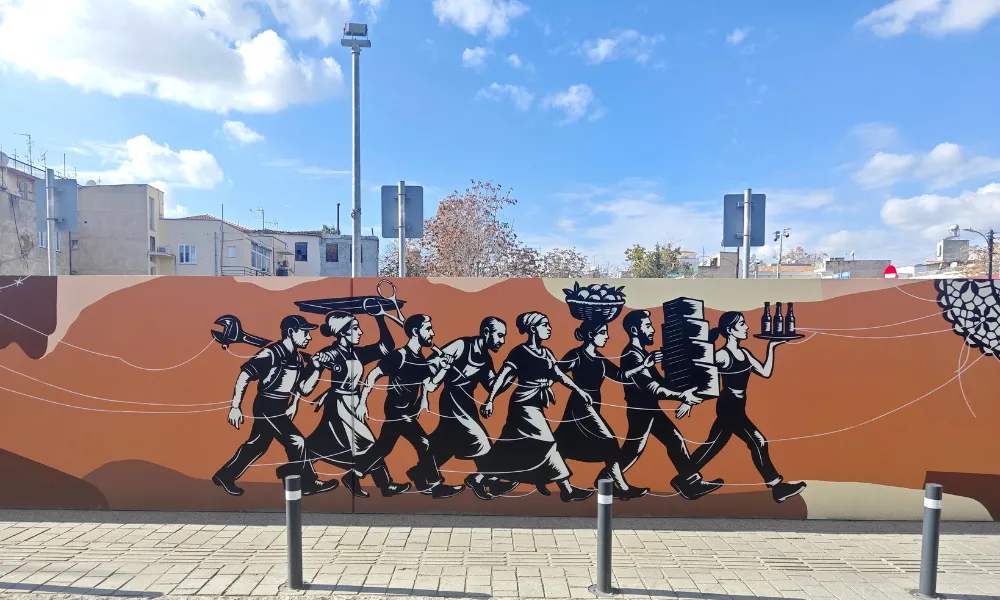

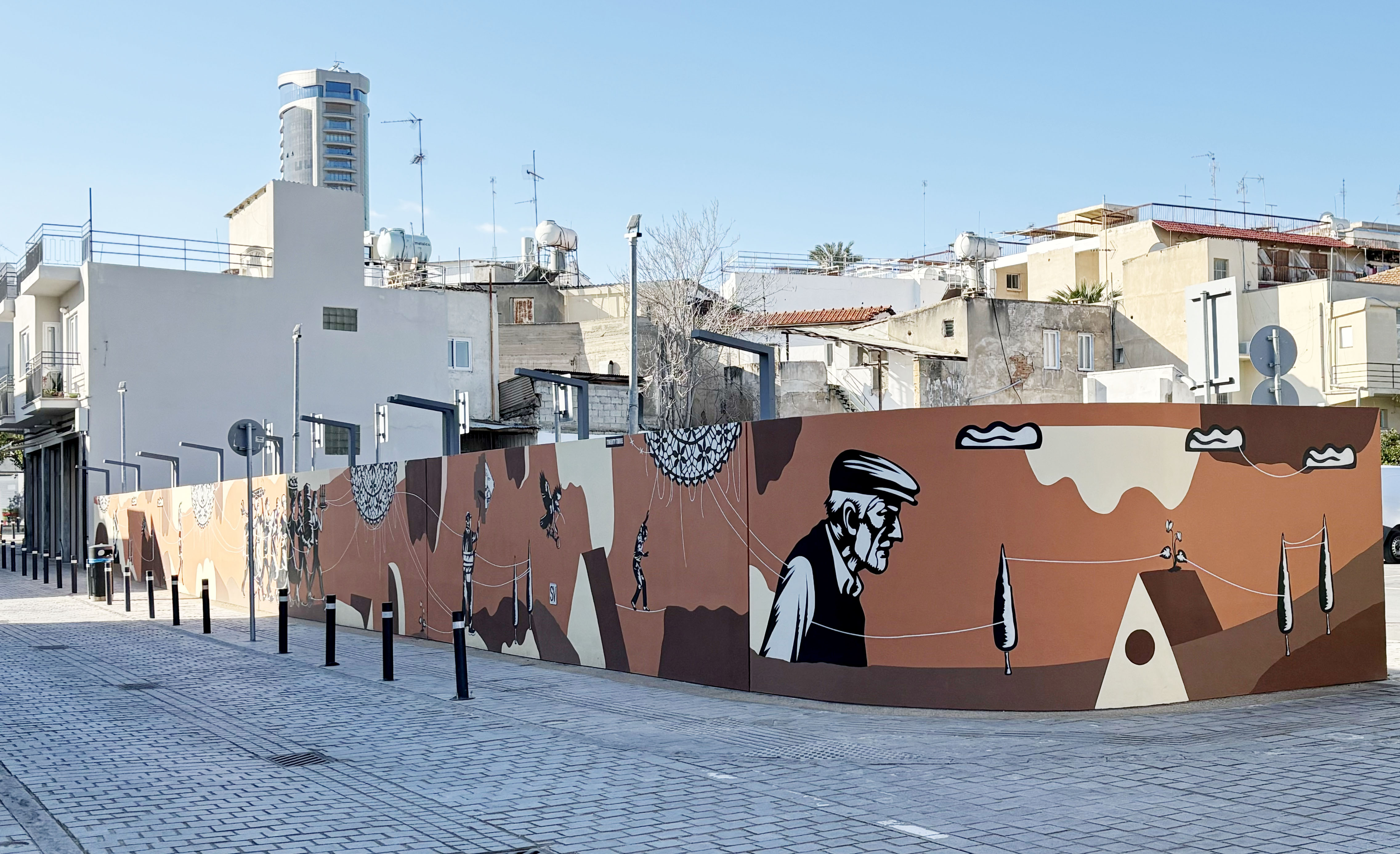
Descending towards the recently redeveloped Trikoupi Street in old Nicosia, a few metres past migrant barbershops, ethnic grocery stores and all-purpose shops that remain unchanged by time, a new mural comes to engage in dialogue with the history and everyday life of the area. Visual artist Twenty Three [23] adds another work to the city landscape, attempting to capture the social relationships and dynamics that compose life on this multilayered street.
You have mentioned that the mural reflects the “social net” of the area. How was this idea born?
The idea was born through conversations with people from the area. For years I have worked with methods of situated art practice, taking into account the space, the people and the context. What interested me was not only what they say about the street, but how they describe their relationships, who helps whom, who depends on whom, what they like about their neighbourhood and what bothers them in their everyday life.
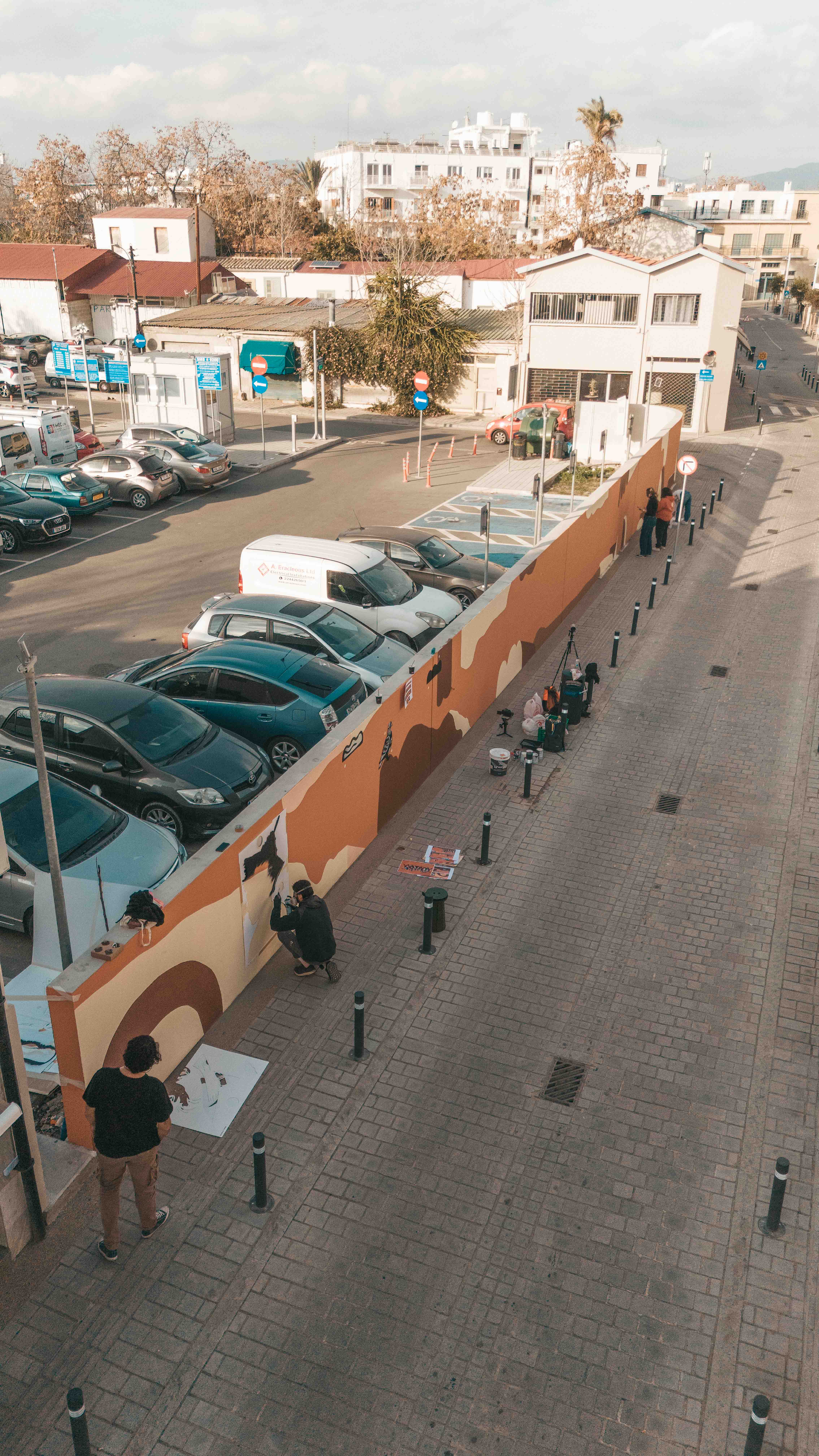
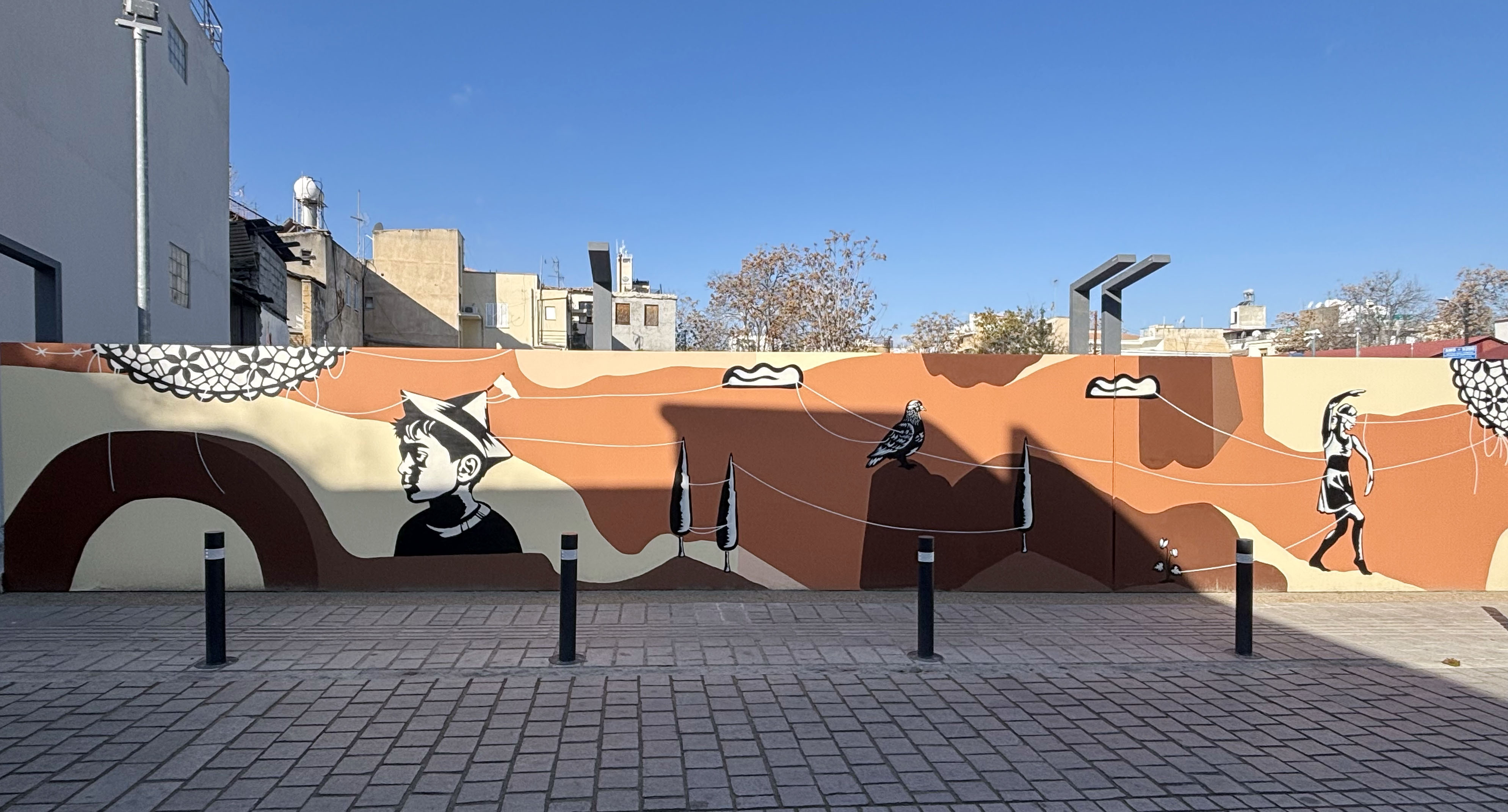
Traditional embroidery felt like an appropriate symbol for this, because it is something made collectively, fragile but also resilient. In this way, embroidery becomes an allegory of the social net, a fragile mesh that keeps people simultaneously connected and disconnected. The net does not function only as a connection, but as a network of relationships that makes escape unthinkable or excessively difficult, either because of livelihood or other needs.
You spent time speaking with people who live and work there. Did anything surprise you in how they see their neighbourhood, compared with how it is usually discussed by “outsiders”?
I also live in the same area and discussions about the old city often seem overly theoretical to me. For example, some people are afraid to walk through Trikoupi Street, a fear that is largely constructed by the media. It also surprised me, during my research, how many different layers the “inside” image has. The people who live there do not speak in terms of good or bad, dangerous or safe, development or decline. They speak about everyday life, about habit, about coexistence. “Outsiders” tend to use more general, more abstract terms. On Trikoupi Street, the street is not a concept. It is life, with its good and bad parts.
Are the figures in the work based on real people you met, or are they compositions of many different lives?
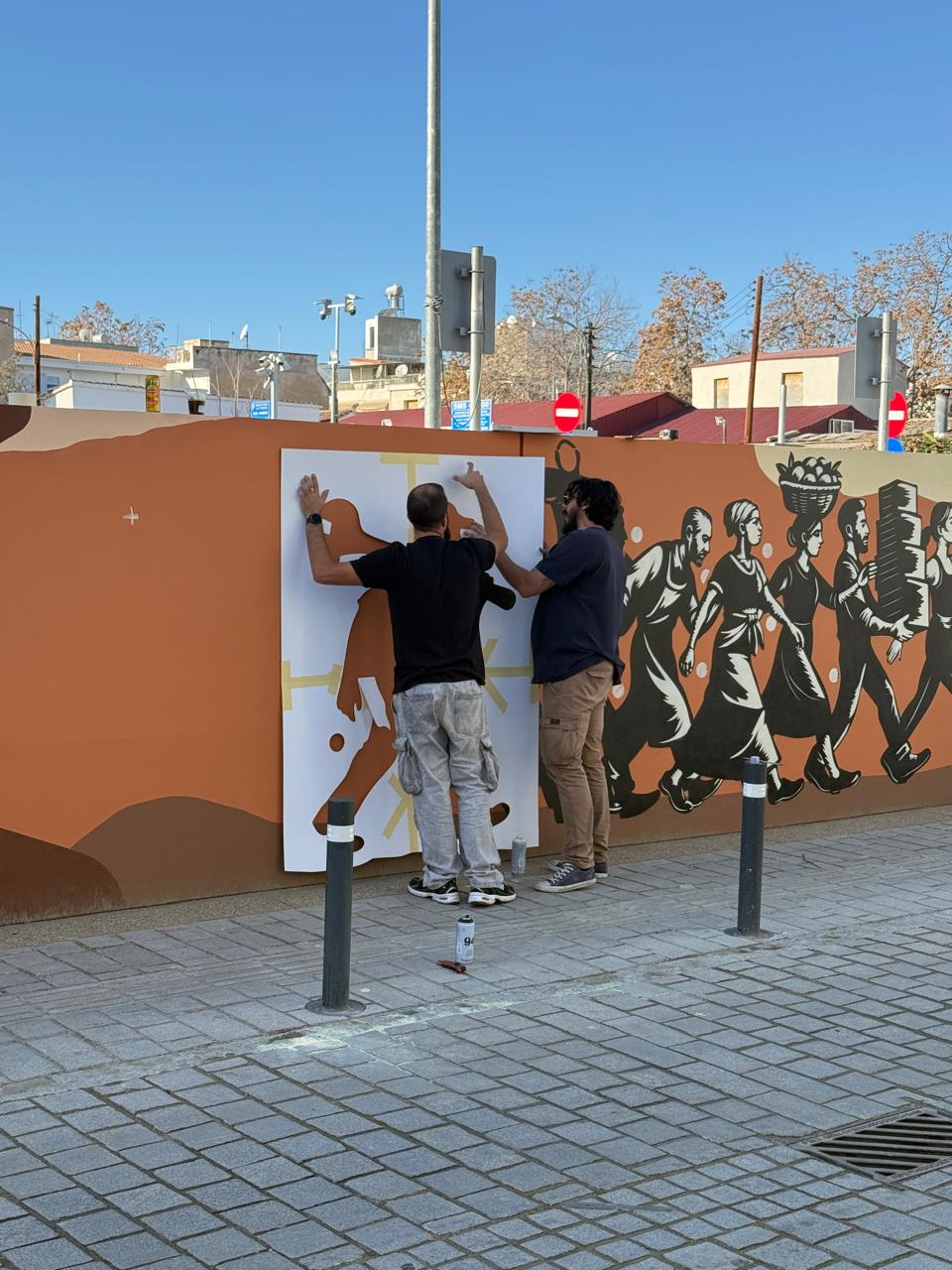
They are compositions. I did not want to create portraits, but collective figures. Each character carries elements from different people: a body posture, a gesture, a job, an emotion. I was more interested in capturing roles and experiences, not specific identities.
Some residents say the street looks more beautiful, but their daily life has not changed. When you hear this, what do you think as an artist?
I completely understand it and I consider it very honest. Art cannot directly change living conditions nor solve social problems. If it can do something, it is to create space for thought, dialogue and visibility. Making a street more “beautiful” does not automatically mean it becomes more just through a mural.
Do you see the mural as part of a “regeneration” that could lead to the displacement of existing communities? How do you think cities can manage this tension?
I think the mural inevitably becomes part of what we call “regeneration”. There is that ironic phrase within street art that first murals raise rents and then street artists talk about rising rents, and in a way we all live inside this contradiction. At the same time, I do not believe art alone causes displacement. This is a systemic crisis that concerns most contemporary cities and is linked to policy decisions, investment models, tourism pressures and a housing market that increasingly operates on profit terms. A mural, when it does not communicate something or include communities, can function as a symptom or an accelerator, but not as the cause. For me, the point is not to “clean up” this tension, but to recognise it. Many contemporary cities follow a neoliberal development model that treats the city as an investment product and not as a social space. Cities can manage this tension only if development is accompanied by real policies to protect residents: rent control, social housing, participation of communities in decision-making and protection of vulnerable groups. Otherwise, “regeneration” risks becoming simply a more beautiful name for the same old displacement mechanism.
Was there a moment when you thought, “this might upset someone”?
I believe it is a great responsibility to create a mural on a historic street like Trikoupi, and the possibility of upsetting someone is part of the process. If a work in public space does not upset anyone, it probably goes unnoticed. I consider it legitimate and expected that not everyone will like it. Public space is not neutral, and neither is art. I tried, through a situated artistic intervention, to open questions without provoking in an aggressive or superficial way.
How effective do you consider art as a tool of urban transformation, compared with economic or political interventions?
Art cannot replace political or economic interventions. Its power is more symbolic: in changing the way we see a space, in making visible things that were previously invisible, in opening dialogue and creating conversations.
How do you think cultural identity and commercial development can coexist in an area?
Coexistence is possible only if communities themselves have a voice. When cultural identity becomes simply a branding tool, it loses its meaning. It must remain something alive and not decorative.
Now that the mural has been completed, how do you see it?
I do not see it as something finished. From the moment it enters the street, it stops belonging to me. Time, weather and people will change it. I am more interested in how it lives inside the city, than how it was on the day it was completed.
The project was funded by ETAP Nicosia and implemented in collaboration with the Municipality of Nicosia. Photos: Peppinos Skoullos.