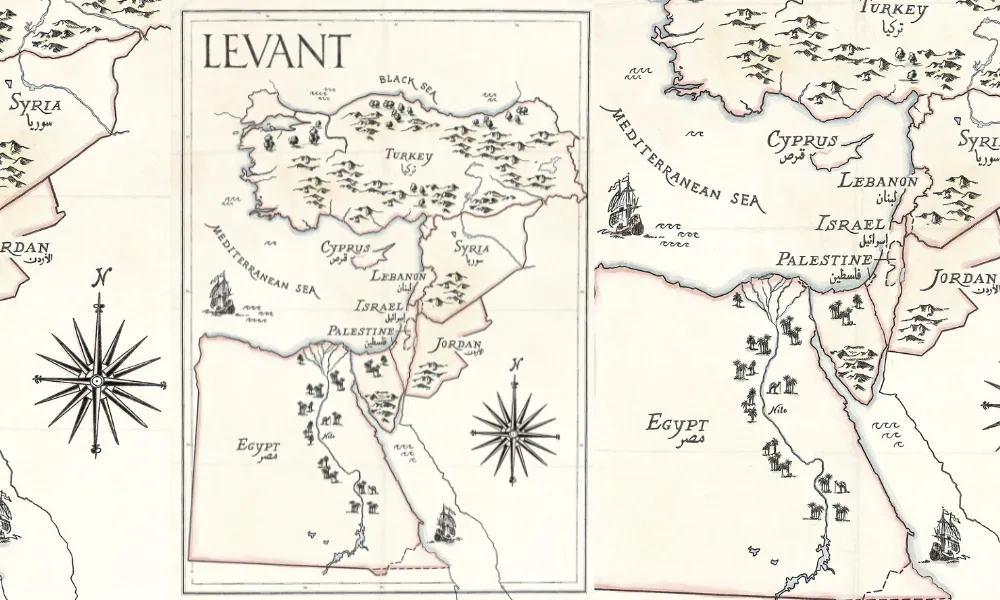

Cyprus is not merely located in the Levant, it sits at its crossroads. And this crossroads, for half a century now, has remained blocked by the unresolved Cyprus problem. As long as the island remains divided, the entire Eastern Mediterranean operates under a permanent layer of tension, mistrust, and missed opportunities. A settlement of the Cyprus issue, therefore, would not only be a vindication for Cypriots. It could transform the business and geo-economic landscape of the Levant.
Today, the region resembles an economic puzzle that refuses to fit together. We have vast energy reserves, but also deep political rivalries. We have strategic ports, but also exclusions. We have investment interest, but risk premiums that deter major initiatives. At the center of this contradiction lies Cyprus: an EU member state, yet a de facto divided island with foreign military presences.
An agreed solution would change this picture dramatically. First, it would reduce geopolitical risk. Major investments – especially in energy, infrastructure, and logistics – are not decided solely on economic models, but on stability. A reunified Cyprus would send a clear message that the Eastern Mediterranean can be a space of cooperation rather than permanent confrontation.
Second, it would genuinely open the door to regional energy cooperation. Today, natural gas reserves in the area are treated more as instruments of pressure than as a shared opportunity for development. With a settlement, Cyprus could act as a bridge between Israel, Egypt, Lebanon, Greece, and the European Union, helping to create a more structured and sustainable energy ecosystem.
Third, it would transform the logic of trade. Instead of two economies on the same island operating in parallel, there would be a single market with access both to the EU and to the Middle East. This could attract companies that currently hesitate to operate in a divided country.
Yet beyond economics, there is something deeper at stake. The Levant has learned to live with conflict. A successful resolution of the Cyprus problem would signal that even the most frozen disputes can be overcome. And that carries immense value for the investment climate.
Of course, no solution would be a panacea. The region would remain complex, marked by competition and strategic rivalries. But without a settlement, Cyprus will continue to be more of a problem than a platform for cooperation. With a settlement, it could become the centre of a new economic map in the Eastern Mediterranean.
Prospects
How much could Cyprus’s GDP increase with a solution to the Cyprus problem?
PRIO Publication (Peace Research Institute Oslo) indicates that a solution to the Cyprus problem could add approximately €18.9 billion to total GDP by 2035 compared to a scenario of continued division. This suggests a significant increase in the size of the economy, which could bring GDP to levels above approximately €50 billion a few years after a settlement, beyond the normal growth trajectory. A report funded by the World Bank and the United Nations estimates that reunification and the removal of barriers to economic activity could increase real incomes by around 7% within a decade after a settlement, boosting consumer spending and domestic economic activity. Furthermore, according to World Bank estimates, improvements in energy, transport, and water infrastructure—driven by the expected increase in economic transactions and interconnectivity—could generate around €1.1 billion in investment projects within 2–3 years of a settlement becoming a reality, which would have a multiplier effect on GDP in the medium term.
The question
The real question is not whether the Levant needs a reunited Cyprus. It is whether Cyprus can afford to remain divided in a rapidly changing world – and whether the region can afford to stay trapped in old deadlocks.
Resolving the Cyprus problem would not solve all the challenges of the Levant. But it could open the way to a new era, one in which geography is not only a battlefield, but also a bridge of collaboration.