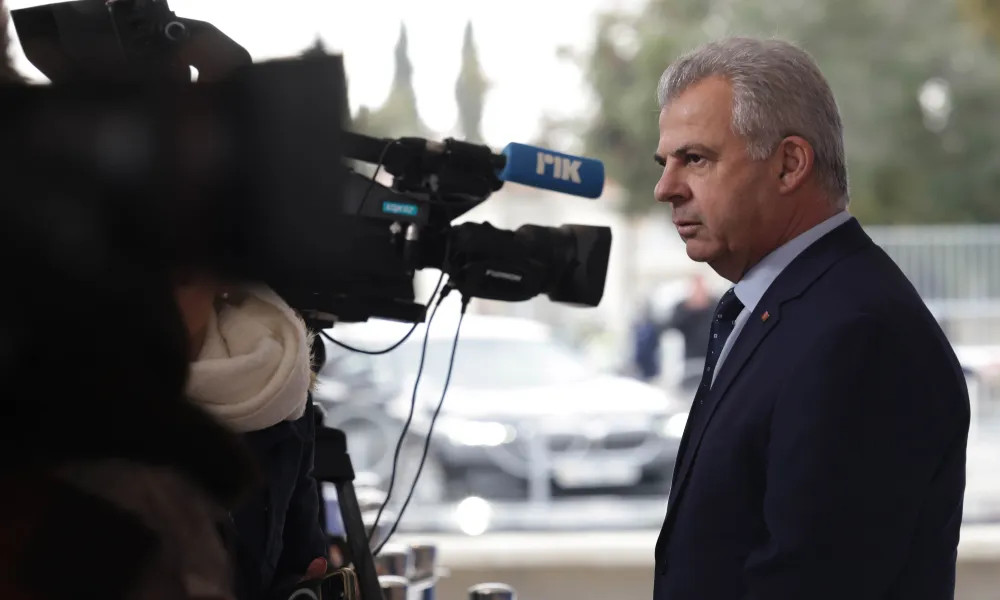
Cyprus’ Justice Minister presented a broad security and justice reform agenda centred on tackling organised crime through financial investigations, institutional restructuring and infrastructure investment. A key element is the use of EU-level asset recovery tools, described by the minister as one of the most effective methods to disrupt criminal networks.
Security strategy and institutional direction
Justice Minister Kostas Fytiris stated that his core mission is to strengthen security, arguing that public safety is a prerequisite for protecting freedom. He said the country must be able to address organised crime and corruption through coordinated actions and continuous technological modernisation, noting that criminal groups adapt quickly to new tools and methods.
The minister said authorities have a duty to convert policy announcements into concrete actions following his first weeks in office.
He also stressed that criminal cases must be supported by evidence and documentation before being referred to the justice system.
Recent public statements by the minister have also emphasised that combating organised crime remains a central government objective.
Legal framework for asset confiscation
A central measure announced is the confiscation of assets linked to criminal activity when their origin cannot be justified.
The minister said this can be implemented through the application of a European Union directive on asset recovery and confiscation.
At EU level, asset recovery measures are described as a major operational tool against organised crime because they target the financial structures supporting criminal networks.
Authorities in Cyprus have already used asset freezes and confiscations in organised crime investigations in recent years, targeting property, vehicles and financial assets connected to criminal activity.
New prison infrastructure and correctional model
The minister announced plans for new central prison facilities to be built outside urban areas.
The proposed complex will have capacity for approximately 1,250 inmates and will incorporate modern technological infrastructure. The correctional model is expected to include closed, semi-open and open prison structures, followed by reintegration into society.
The project is planned on approximately 500,000 square metres of state-owned land in central Cyprus.
The minister said recruitment and staffing processes are already under way for prison management and correctional personnel.
Previous statements by the minister indicate that construction of new prison facilities may require several years due to planning and infrastructure requirements.
Police, emergency services and EU presidency operational readiness
The minister said police-related contracts and operational frameworks will be modernised to support policing needs and ensure operational readiness during Cyprus’ EU Council Presidency.
He also announced additional support for the Fire Service, including the use of drones and other tools for wildfire management.
Maritime security and independent coast guard planning
The minister said Cyprus must strengthen protection of critical infrastructure against terrorism and other threats, including those originating via maritime routes.
He announced plans to establish an independent coast guard structure separate from the police.
Statements regarding Annie Alexoui investigations
Responding to questions about Annie Alexoui, the minister said investigations are being conducted by the police but require formal complaints, documentation and evidence before any arrests can be made.
He said the prosecution service can only proceed within the framework of law and procedure and cannot act without substantiated testimony or formal allegations.
In a separate case context, police procedures have already progressed to arrest warrants in investigations linked to public allegations made through social media platforms, according to reporting on the broader case environment.
Ongoing legal cases involving public officials
The minister said criminal cases involving Paphos Mayor Phedonas Phedonos and Pieris Gypsiotis are being handled by the Legal Service and the Police, which are assessing whether evidence supports prosecution.
Comments on police union allegations
Responding to claims made by the president of the police union ISOTITA, Nikos Loizides, regarding threats, the minister said he would welcome confirmation from the Chief of Police if Loizides had requested a transfer from headquarters in order to serve in frontline duties.