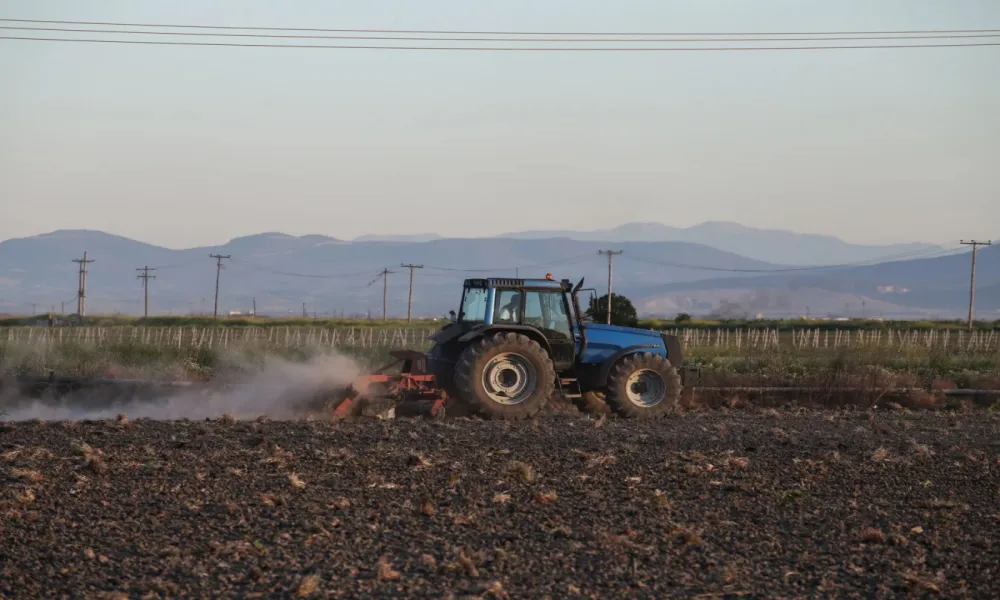
Cypriot farmers have begun mobilising ahead of a large demonstration on Thursday, gathering tractors at several points across Larnaca and the free Famagusta area in protest against the European Union’s decision to significantly reduce funding for the Common Agricultural Policy (CAP). A march toward the House of Europe in Nicosia is scheduled for 18 December.
According to Kyriakos Kailas, president of the Pan-Cyprian Organisation of Grain Producers, the protests stem from the “massive damage caused by the decision to reduce the Common Agricultural Policy by €86.5 billion”. Such a cut, he said, would devastate primary production across the EU and hit Cyprus particularly hard as “we already have the lowest average yields in the Union. This would be the tombstone of the primary sector in Cyprus”.
Tractors gather as farmers prepare for Thursday’s march
Kailas confirmed that tractors were being assembled at four to five locations in Larnaca and Famagusta, with additional farmers preparing in Nicosia. Due to distance, farmers from Limassol and Paphos are not expected to join this first mobilisation. “This is a peaceful demonstration, but we will send our message loud and clear,” he said, adding that a memorandum has already been submitted to the European Commissioner requesting cancellation of what he described as “a destructive policy”.
Beyond CAP cuts, Kailas said producers are facing a series of domestic problems. Chief among them is the continued delay in payments from the Cyprus Agricultural Payments Organisation (KOAP). “Unfortunately, these farmers look set to have black Christmas and New Year,” he said. “We will not allow this. If the problem is not resolved, others will suffer disruption too. We cannot face the same issue every single year.”
Farmers call for immediate legislative fixes
Kailas argued that two key issues could be resolved without any cost to the state and would even generate revenue. The first concerns amendments to legislation governing Turkish Cypriot properties. He noted that many refugees who were granted land in 1974 are now 85 or 90, making it impossible for them to continue cultivating it. As a result, they sublet the land to younger farmers, a practice currently deemed illegal. “It is not illegal when the farmer pays for it,” Kailas said, calling for legislative clarification.
The second issue involves the long-pending applications for the lease of state land. Some, he said, have been awaiting examination since 2002. He argued that the state would benefit directly from rent payments deducted automatically by KOAP if the system were unblocked.
A sector under strain after drought and mismanagement
Kailas also warned that without a revision of the new CAP, the consequences would be disastrous. While EU member states can provide supplementary support, he questioned the logic of Cyprus contributing to CAP financing and then shouldering an additional burden to support its own producers: “This makes no sense. Proper measures must be adopted so the primary sector can survive.”
Droughts in recent years have already made conditions extremely difficult, he added. “Let us not even begin discussing the poor handling of various issues. But today our main concern is CAP. This must be resolved. At the same time, people must be paid. We have lost our credibility. Importers give us seeds and fertilisers knowing we pay at the start of December. How will this be possible if our farmers remain unpaid?”
The farmers’ march to Nicosia is expected to be one of the most significant rural mobilisations in recent years, as producers warn that without immediate action, Cyprus risks the collapse of its primary production sector.
Source: CNA