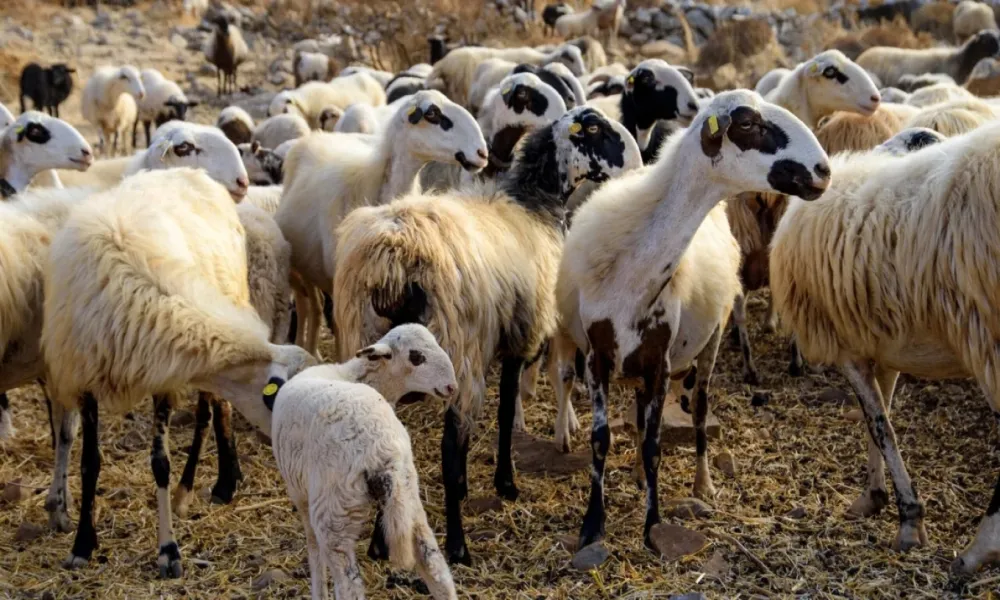
A significant blow to the Cypriot economy is expected if the competent authorities fail to contain the outbreak of foot-and-mouth disease. In a worst case scenario, the spread of the disease could lead to a substantial reduction in livestock production, milk output and dairy products.
At the same time, halloumi exports are also expected to be affected, with the possibility of job losses remaining open.
Market bodies, speaking to “Politis”, underline that the key to limiting losses and protecting the livestock sector, the food industry and the wider economy is to achieve control of the outbreak and halt its spread.
Concerns From Business Organisations
The Secretary General of the Cyprus Chamber of Commerce and Industry (KEVE), Philokypros Rousounides, stated that the Chamber is closely monitoring developments with particular concern, noting that the culling of animals will affect a productive segment of the economy and a number of businesses.
He added that supply will be affected at a time when demand remains high, especially ahead of Easter.
“Unfortunately, we will also face increased prices,” he observed. Exports, which at this stage are not affected, are expected to be impacted in the near future.
KEVE Deputy Secretary General Andreas Andreou said that the immediate priority is to contain the spread of the disease.
“If the Republic of Cyprus and the stakeholders involved manage to achieve this, then the impact will be minimal. If it spreads, unfortunately, the consequences cannot be calculated and will be significant.”
According to Mr Andreou, the neighbouring areas of Livadia, Aradippou and Athienou are traditional livestock regions with substantial animal production.
“If the problem spreads, there will be consequences for production, exports and, by extension, jobs.”
He estimated that farms affected would require around two years to resume operations.
“For now, we are making assumptions as we do not have specific data before us. If the situation is controlled and does not expand, then the impact will be relatively manageable and milk, dairy and halloumi production will continue without major disruption,” said the Director of Business Development at the Employers and Industrialists Federation (OEB), Paris Anastasiou.
“The challenge is to control the situation and ensure cooperation from all stakeholders. If it escalates, there will certainly be consequences for milk production, dairy products and exports, and the livestock sector will be significantly affected,” he stressed.
According to Mr Anastasiou, solutions exist should the problem expand further. He also noted that the developments present an opportunity to resolve the long standing issue of veterinary checks within the British Bases.
Serious Situation For Dairy Sector
The Executive Secretary of the Cyprus Cheese Makers Association, Michalis Koullouros, said that while it is difficult to speak in specific figures, there will be repercussions for production due to the culling of animals, affecting milk and halloumi output.
Initial indications, provided there is no further spread of the virus, suggest that there will be no embargo on halloumi exports, with key markets such as the United Kingdom, Australia and Canada expected to continue importing without interruption.
According to statistical data, halloumi ranks second among the country’s export products, with a value of €201 million in the first half of 2025.
Mr Koullouros reassured the public that there is no cause for concern, stating that products are safe, as foot-and-mouth disease does not threaten human health nor is it transmitted to humans through food.
In a statement, the Cyprus Cheese Makers Association described the situation as particularly serious, requiring responsibility, calm, coordination and immediate action.
The outbreak of foot-and-mouth disease is not merely a veterinary issue, the Association underlined, but directly affects agricultural production, cheesemaking, exports and the broader economy. In this context, it called on the Veterinary Services to apply all necessary containment measures with maximum operational efficiency, strengthening inspections, surveillance and the strict implementation of biosecurity protocols.
Increased Demand For Meat
The Secretary General of the Pancyprian Retail Trade Association (PASYLE), Marios Antoniou, stated that orders are currently being delivered as normal, noting that if the disease does not spread further, the market is not expected to be affected.
However, he said that if it spreads to additional livestock units, problems will arise in the market.
According to Mr Antoniou, customer traffic increased over the weekend compared to previous weekends, as many consumers rushed to purchase meat due to concerns about potential shortages.