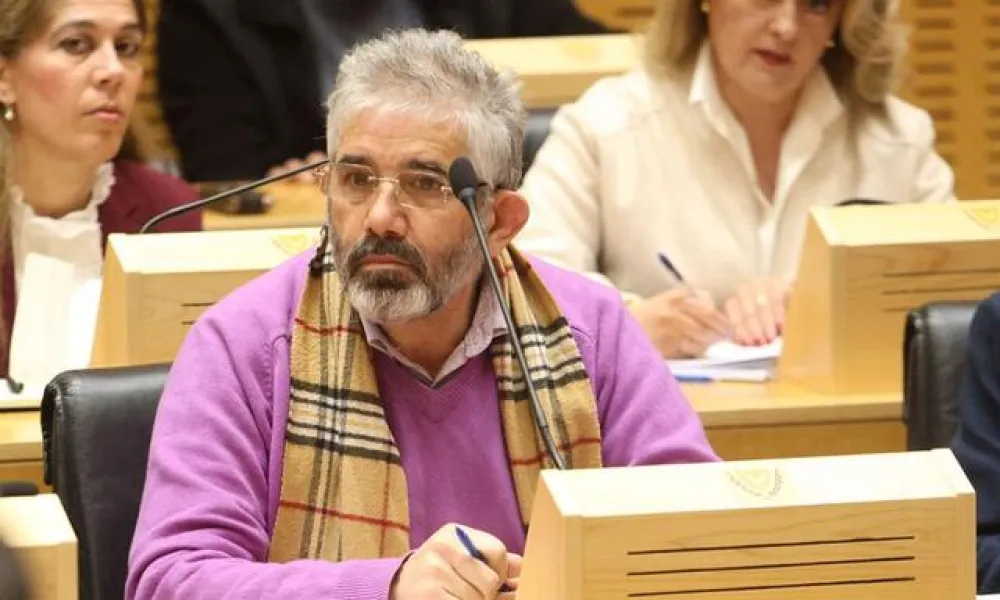
Tensions ran high during a session of the House Agriculture Committee on the management of the foot-and-mouth disease crisis, with MPs, livestock farmers and agricultural organisations directing criticism at state authorities over what they described as a lack of preventive measures.
The Director of Veterinary Services, Christos Pippis, faced sustained questioning. MPs requested detailed information on inspections carried out at livestock units from 16 December 2025, when cases of the virus were detected in the north, until today.
AKEL MP Giannakis Gavriel asked Mr Pippis to submit in writing the checks conducted during that period. The request followed remarks by AKEL MP Andreas Pasiourtides, who said that based on a public statement by the Veterinary Services, no inspections had been carried out in the past 15 days. Mr Pippis rejected that interpretation.
MPs pointed out that Mr Pippis had previously referred to indications that the virus may have been present on farms for 15 days without the Veterinary Services being informed. He responded that those references reflected reports from livestock farmers. When MPs read out his previous statements, he attributed responsibility to the media, stating that “everyone writes whatever they want”.
“Patients Go To Hospitals”
Defending the handling of the situation, Mr Pippis stated that the Service was informed on 19 February by only one unit in Livadia.
When DIKO MP Zacharias Koulias asked why preventive checks were not carried out at neighbouring farms, Mr Pippis replied that each livestock farmer has a private veterinarian who is responsible for informing the Veterinary Services of any problem. He added: “The services of the Ministry of Health do not go to every sick person, patients go to hospitals.”
The remark prompted strong reactions.
When Charalambos Theopemptou sought clarifications on preventive measures that should have been taken, Mr Pippis responded: “Tell me, since you know better, what measures we should have taken and did not.”
Mr Pasiourtides then raised an issue of respect, to which Mr Pippis replied: “It does not mean that because you are MPs you have more rights than the rest of us.”
Responsibility For Preventive Measures
When Mr Gavriel asked what preventive measures were being taken in other districts or whether authorities were waiting for each farm veterinarian to act, Mr Pippis stated that it is not the responsibility of the Veterinary Services to take preventive measures for farms, and that livestock farmers must take such measures themselves.
Asked whether the Services provide guidance to farmers, he replied that guidance is always available and that since December he has repeatedly explained what needs to be done.
DISY MP Kyriakos Hadjiyiannis criticised the absence of the Auditor General and the Chief of Police from the session. DISY MP Prodromos Alampritis said that some livestock farmers had complained that they had not received information from state services regarding the measures they should adopt.
Farmers Reject Being Blamed
Tasos Gapanis, Secretary General of Panagrotikos, stated that measures decided upon after the detection of cases in the north had not been faithfully implemented. He said that livestock farmers should not be portrayed as responsible for the crisis and attributed responsibility to the state for actions it did not undertake.
He referred to livestock areas where disinfection ramps had not been installed and said that some farmers had covered such costs themselves. He also questioned what border guards had done and who monitors veterinarians travelling to the north.
Christos Papapetrou, speaking on behalf of PEK, said that once the virus was detected in December in the north, state authorities should have closed the “gap” with reinforced border controls.
Complaints Over Police Statements
George Demetriou, a livestock farmer and owner of an affected farm, accused the Director of Veterinary Services of targeting his family and two farms.
He said that when they were informed on Saturday that their animals would have to be culled, instead of receiving psychological support, a police team was sent to take statements. He suggested this may have been part of an attempt to shift responsibility from the state mechanism.
“I am not obliged to prove that I am not an elephant,” he said, adding that Veterinary Services employees even requested protective suits from the farmers in order to carry out their work. His remarks were met with applause from fellow farmers present in the chamber.
Removal Of Contaminated Milk
Further criticism concerned the handling of contaminated milk. A livestock farmer from Oroklini stated that the Services had instructed them to dispose of the milk in the sewage system, which he said was not feasible due to volume constraints. For that reason, from Monday they requested that a tanker be sent to collect milk from all affected units in the area. According to the farmer, this had not occurred by Tuesday afternoon.