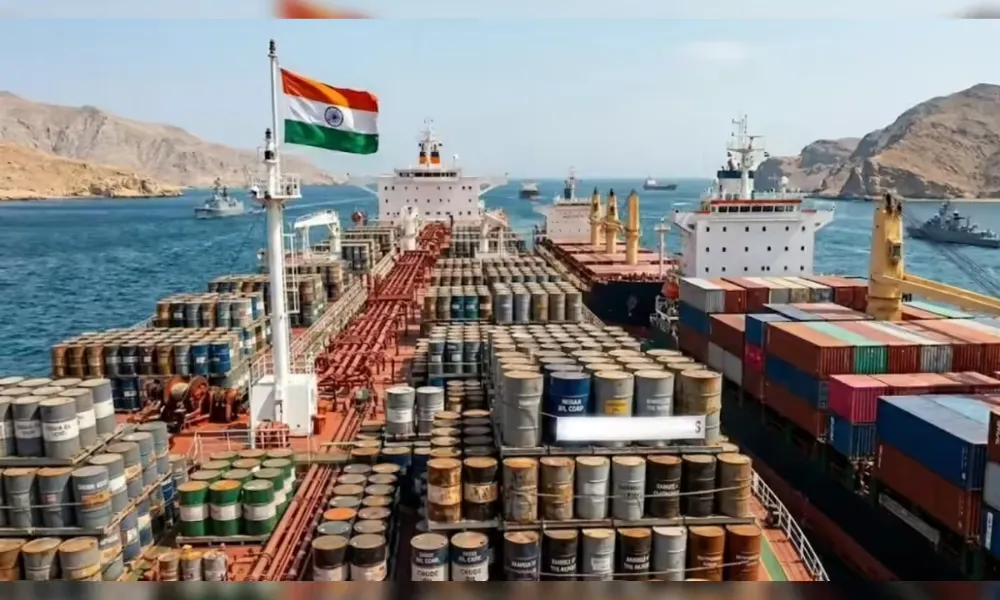
The United States is preparing to impose a naval blockade on Iranian ports, a move that marks a sharp escalation in the conflict following the collapse of direct negotiations between Washington and Tehran over the weekend. The announcement comes amid renewed instability in the Middle East and immediate reactions from global markets, where oil prices surged past $100 per barrel after the diplomatic breakdown.
The blockade follows the failure of marathon talks held in Islamabad, Pakistan, where U.S. and Iranian delegations negotiated for 21 hours in an attempt to reach a broader agreement covering a ceasefire, Iran’s nuclear program and the security of the Strait of Hormuz.
Naval blockade to begin Monday
According to the U.S. Central Command (CENTCOM), the blockade will begin Monday at 17:00 Greek time and will target maritime traffic to and from Iranian ports and coastal areas.
The measure will apply to ships of all nationalities entering or departing Iranian ports, including ports along the Arabian Gulf and the Gulf of Oman.
U.S. authorities said vessels simply transiting through the region, particularly those passing through the Strait of Hormuz without heading to Iran, will be allowed to continue their routes.
At the same time, Washington warned that U.S. naval forces will destroy any Iranian units that attack American vessels and will intercept ships found to be paying transit fees to Iran.
21 hours of talks end without agreement
The blockade announcement came shortly after the collapse of negotiations between the two sides in Islamabad.
U.S. Vice President J.D. Vance, who led the American delegation, confirmed the failure of the talks shortly before departing Pakistan.
“We will return to the United States without a deal,” Vance said during a brief press conference.
He stated that Washington had presented what he described as its “final and best offer”, but negotiations failed because the United States did not receive a clear commitment from Iran to abandon its nuclear ambitions.
“The fact is that we need an official commitment that Iran will not pursue nuclear weapons and will not obtain the capability to build them quickly,” Vance said.
He added that the collapse of the negotiations was “worse news for Iran than for the United States.”
Tehran rejects U.S. demands
Iranian officials confirmed that the negotiations ended without agreement but blamed Washington for the breakdown.
According to Iran’s state broadcaster IRIB, Tehran described the American proposals as “unreasonable demands.”
The Iranian delegation was led by Mohammad Bagher Ghalibaf, speaker of Iran’s parliament, who said that Iran would not yield to threats.
The talks were considered one of the most significant direct diplomatic contacts between the two countries since the 1979 Islamic Revolution.
They followed a two-week ceasefire announced earlier in the week, which negotiators hoped could evolve into a permanent truce.
Strait of Hormuz at the center of tensions
During the negotiations, discussions reportedly focused on several critical issues, including the future of the Strait of Hormuz, Iran’s nuclear program, the lifting of sanctions and the possibility of a lasting end to hostilities.
The Strait of Hormuz is one of the world’s most important energy chokepoints, with a large portion of global oil exports passing through the narrow waterway.
Since the start of the conflict involving the United States, Israel and Iran, shipping through the region has faced significant disruption, raising concerns about energy supply and global economic stability.
Iran’s Islamic Revolutionary Guard Corps warned that any military vessel approaching the strait could be treated as a violation of the ceasefire, raising the risk of further confrontation.
U.S. naval forces move into position
The U.S. military said two American destroyers have already entered the Strait of Hormuz to begin preparatory operations aimed at clearing naval mines reportedly deployed in the area.
“We are sweeping the strait,” U.S. President Donald Trump told reporters.
Trump also suggested that the diplomatic outcome would not change Washington’s strategic position.
“Whether we reach a deal or not, the United States has already won,” he said.
Oil prices surge above $100
Global markets reacted quickly to the developments.
During early trading in Asia, oil prices jumped by about 8 percent, pushing crude back above the $100-per-barrel threshold.
Analysts warn that prolonged instability in the Persian Gulf could trigger further increases in energy prices, renewed inflationary pressures worldwide, and additional disruptions to global supply chains.