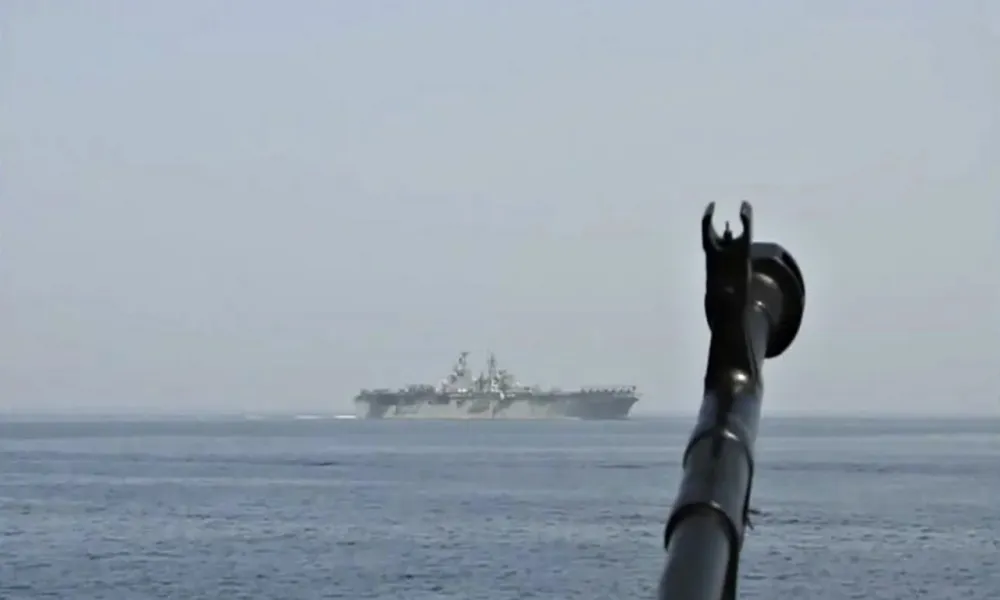
The conflict in the Middle East has transformed into a “double stranglehold”, with both sides weaponising control of the Strait of Hormuz while efforts to restart talks between the United States and Iran continue, according to international relations expert Charalambos Chrysostomou.
Speaking to CNA, Chrysostomou – head of the Research Service at the Cyprus University of Technology (CUT) – said the confrontation has shifted primarily into an energy and economic war, with military action taking a secondary role.
He warned that the ceasefire, set to expire on 24 April, remains fragile and could collapse into renewed hostilities at any moment, adding that the region remains far from a comprehensive settlement.
Chrysostomou said pressures are mounting “from all sides, at all levels and in all directions”. He explained that the US naval blockade in the Strait of Hormuz aims not only to force Iran to accept Washington’s terms in negotiations, but also to exert pressure on other powers, particularly China. Despite this, he noted, global markets continue to feel the strain.
He also pointed to growing internal pressure on US President Donald Trump, who by 28 April will need congressional approval to continue military action against Iran if hostilities exceed 60 days. He added that rivalries within the Trump administration further complicate the management of the conflict.
A ‘double stranglehold’ over energy flows
Chrysostomou said the US decision to block the Strait of Hormuz and Iranian ports mirrors the strategy Iran has employed since the start of the war, restricting the passage of vessels it considers hostile, including those linked to Western, US, Israeli and European interests.
Throughout much of the conflict, Chinese and Iranian vessels continued to pass through the Strait, allowing Iranian oil exports to flow with limited disruption and generate crucial revenues. “Now the US is doing exactly the same to Iran, closing the Strait and Iranian ports with a naval blockade to impose the same form of economic strangulation,” he said.
“It is as if two people are fighting, each holding the other by the throat – a double stranglehold from both sides,” he added.
While Washington currently has the capability to enforce such a blockade, Chrysostomou questioned how long it can be sustained. He said Iran would face enormous economic and energy pressure under prolonged restrictions, noting that Tehran’s willingness to continue negotiations suggests the tactic may be having an effect.
He said both sides are now exploiting the Strait of Hormuz to impose energy suffocation on their opponent, confirming a shift in the nature of the conflict away from the battlefield.
Global economic pressures intensifying
Chrysostomou warned that the economic impact of the war is likely to intensify. “The assessment is that, energy-wise, April will be worse than March,” he said, adding that prolonged disruption to oil and gas trade will slow any recovery.
He said global markets will continue to experience volatility as oil prices fluctuate, with conditions worsening as energy reserves decline and inflation becomes entrenched.
Asked whether the US blockade also serves as leverage against other powers, Chrysostomou said China will inevitably come under pressure if its vessels face restrictions. “Pressure is now being channelled towards China, so that it can use its influence on Iran to reach a deal,” he said, stressing that the key issue remains when – or if – an agreement can be reached.
“If negotiations collapse, neither side will be able to justify refraining from renewed strikes after the 24th,” he said, describing it as positive that talks have not yet broken down. “What matters is whether there is at least a prospect of an agreement, even if not a final one.”
Critical dates and Trump’s domestic pressures
Chrysostomou said both Tehran and Washington have portrayed themselves domestically as victors, leading to maximalist negotiating positions. He said Trump has set a particularly tough condition for lifting the blockade: Iran must surrender its entire stockpile of 450 kilogrammes of enriched uranium – a demand he described as extremely difficult for Tehran to accept.
Beyond the talks themselves, Chrysostomou highlighted two crucial dates. The first is 24 April, when the ceasefire expires. The second is 28 April, marking 60 days since the start of hostilities.
“Under the US Constitution, military action beyond 60 days requires congressional approval,” he explained. “If there is no ceasefire extension or meaningful progress towards an agreement, Trump will need Congress’s backing to continue strikes.”
He expressed doubt that such approval would be granted, citing narrow political margins and damage to Trump’s domestic standing. He also referred to internal power plays within the administration, noting that Vice President J.D. Vance led negotiations with Iran and returned without a breakthrough. “This effectively saddled him with the failure,” Chrysostomou said.
He added that developments in parallel conflicts, including Israel’s operations in southern Lebanon, could also influence the durability of the Iran-US ceasefire.
Despite the truce, Chrysostomou concluded that the Middle East remains highly volatile. “We have a ceasefire that could turn into open conflict at any moment, while both sides are playing a high-stakes game of economic and energy pressure,” he said.
Source: CNA