


Exposure to pesticide substances has been linked to neurological disorders, certain forms of cancer and reduced IQ in children. The European Union has set a target of reducing pesticide use by 50 percent by 2030.
Cypriot scientists are calling for stricter controls by supermarket chains and for the prescription of pesticides exclusively by licensed agronomists, arguing that current practices leave significant regulatory gaps.
Retail pressure and transparency
At present, only one supermarket chain in Cyprus operates its own strict residue testing programme for pesticide traces in the products it sells and publicly discloses the results, despite not being legally obliged to do so. Within this framework, it informs producers that it will not accept products exceeding specific pesticide thresholds.
At the same time, the Health Services of the Ministry of Health conduct periodic inspections and take action when maximum residue levels are exceeded.
These issues were highlighted by Menelaos Stavrinides, Associate Professor at the Department of Agricultural Sciences, Biotechnology and Food Science at the Cyprus University of Technology, during a conference held in Nicosia on 19 February. The event was jointly organised by the Cyprus International Institute for Environmental and Public Health of Cyprus University of Technology and PAN Europe.
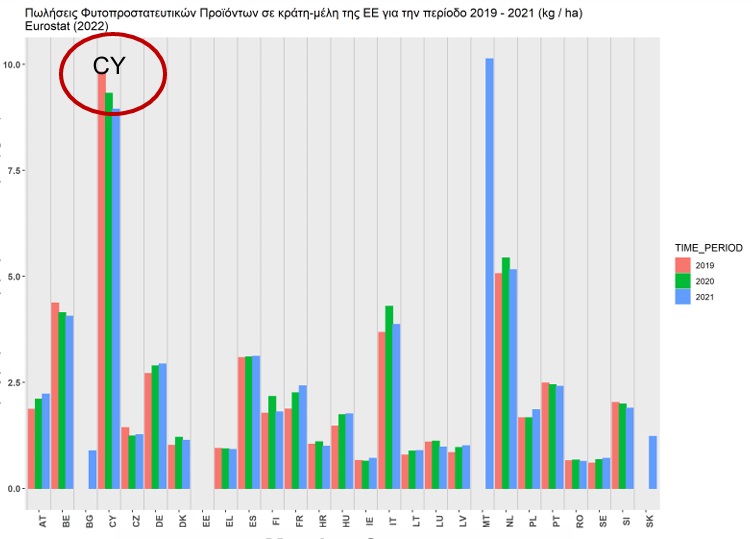
Stavrinides stressed that the adoption of strict and transparent policies by retailers could act as a strong incentive for Cypriot farmers to reduce pesticide use. According to Eurostat data, Cyprus has in recent years ranked among the worst performers in the EU in this area, a practice that carries implications for both human health and the environment.
Since 2022, Cyprus has been among the top EU member states in pesticide sales, at roughly 9 kilograms per hectare. Studies also place the country among the highest in Europe for the percentage of fruit and vegetables containing residues above maximum permitted levels, with around 10 percent of products exceeding legal limits.
Prescription and accountability
A second pillar for a more sustainable agricultural model is accountability in pesticide use. Stavrinides told Politis that the prevailing model in Cyprus allows farmers to purchase pesticides directly from points of sale without the mediation of a licensed agronomist.
An agronomist, he argued, could advise whether pesticide use is necessary, in what quantities and whether alternative, more sustainable solutions are available.
He underlined the need for transparent, responsible and documented prescription of pesticides by licensed agronomists. He also described the absence of a national registry of pesticide use at farm level, linked to sales points, as a serious gap.
“Written prescription of pesticides would enable meaningful control of sales, significantly reducing unnecessary applications, which financially harm farmers and negatively affect the environment and public health,” he said.
A deeply rooted culture
Konstantinos Makris, Professor at the Cyprus International Institute for Environmental and Public Health at Cyprus University of Technology, described pesticide use in Cyprus as an entrenched culture shaped over decades.
“It is very difficult to change this mindset. With all the pressure farmers are already facing, including water cuts, if you also raise pesticide issues, there will be resistance,” he said. He called for a strategic and gradual transition by the state towards integrated farming systems in line with EU policy.
Makris stressed that this does not mean eliminating pesticides entirely, but using them sparingly and cautiously. He added that the state should support farmers financially during the transition, as reduced production in the initial stages could result in income losses.
Health implications
Stavrinides noted that plant protection products are chemical substances used to protect crops from insects, fungi and other organisms. Their use since the 1940s has contributed to significant increases in agricultural production.
However, he warned that human exposure to these substances has been associated with neurological conditions, various forms of cancer and reduced IQ in children. While agricultural workers face the highest levels of exposure, pesticide residues in fruit and vegetables represent a significant route of exposure for all consumers.
Reducing excessive use is therefore not only an environmental issue but a public health priority.
Regenerative farming and technology
As a third avenue, Stavrinides highlighted farmer education in organic agriculture, regenerative farming and precision agriculture through smart technologies.
Organic farming in Cyprus has shown steady growth. European data indicate that while organic cultivation covered around 3 percent of agricultural land in 2012, it reached approximately 9 percent in 2023.
He also referred to the use of beneficial insects and technologies such as satellites, robots, smart traps and smart sprayers to reduce chemical inputs.
Public awareness was identified as another critical factor. Consumer demand for products with residue levels below legal limits can exert additional pressure on the supply chain.
EU policy and controversy
Two policy initiatives currently promoted by the European Commission have sparked concern among scientists and environmental organisations, who warn of potential relaxations in the EU’s strict pesticide framework.
The first concerns the pending trade agreement between the EU and the Mercosur bloc in South America. Farmers argue that the deal will flood the market with cheaper imports, potentially produced using pesticides banned in the EU.
The second relates to a proposed simplification package on food and feed rules, which would remove the requirement for periodic renewal of most pesticide approvals, limiting reviews to cases where justified scientific concerns arise.
Brussels estimates that the reform could save around €1 billion in compliance costs and boost competitiveness in the agricultural sector. Environmental groups, however, warn that such changes risk rolling back decades of progress in food safety and environmental protection.
Scientific pressure and threats
Concerns over Mercosur also focus on the import of products treated with substances prohibited in the EU due to health risks. Makris noted that some of these banned pesticides are cheaper and more effective in eliminating crop pests but are highly dangerous to human health.
As coordinator of a global scientific network on pesticides and health under the umbrella of the International Society for Environmental Epidemiology, he relayed accounts from colleagues in Latin America studying the health impacts of such substances in countries including Brazil, Mexico and Costa Rica.
He described protests against what some call “chemical colonialism”, pointing out that certain banned pesticides are manufactured in Europe but exported to countries where they remain legal.
Makris recounted the case of a professor in São Paulo whose colleague, after publishing research on the health effects of these chemicals, received serious threats and eventually relocated to Europe. She now lives in France.
Against this backdrop, the EU’s 50 percent reduction target by 2030 under the Farm to Fork strategy remains ambitious but, as Stavrinides concluded, not unattainable.