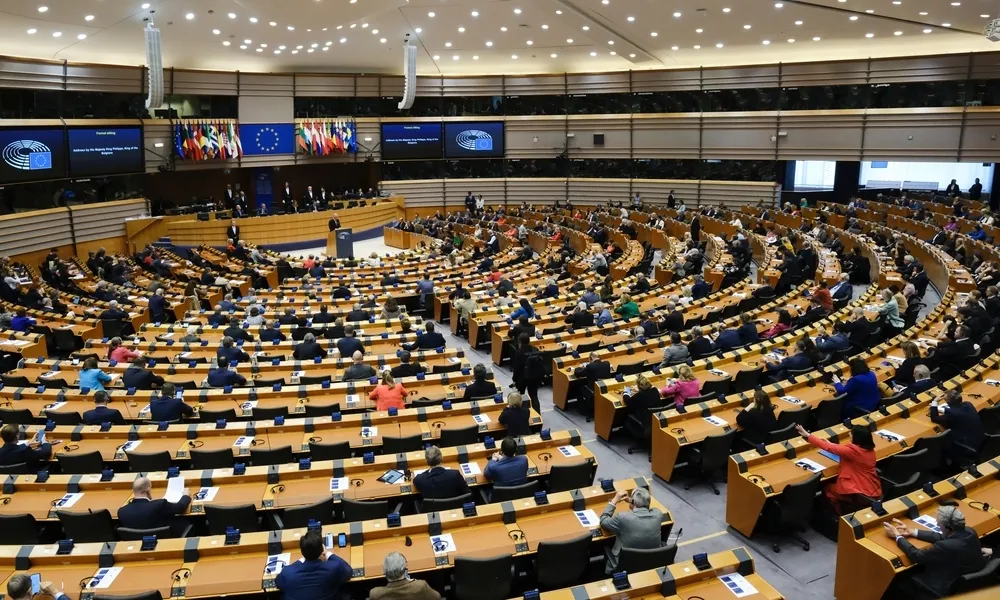

The European Union’s long-term budget for 2028–2034, developments in the Middle East and the war in Ukraine are expected to dominate the agenda of the European Parliament plenary session taking place this week in Strasbourg.
Members of the European Parliament (MEPs) will also address economic resilience, labour market interventions, digital regulation and fundamental rights across the Union.
EU long-term budget negotiations
On Tuesday, MEPs are expected to define the Parliament’s position on the next Multiannual Financial Framework (MFF) for 2028–2034.
The proposal sets the budget at €1.78 trillion in 2025 prices, an increase of €175.11 billion compared with the European Commission’s proposal. The amount corresponds to 1.27% of the EU’s gross national income.
Debt servicing linked to the Recovery Fund will be excluded from the spending ceilings.
MEPs consider the proposed level to be the minimum necessary financing and are calling for stronger support for key European programmes.
The Parliament’s position will form the basis for negotiations with Member States, which will begin once the Council adopts its common position. Approval of the Multiannual Financial Framework requires the consent of the European Parliament.
Guidelines for the 2027 budget
On Thursday, MEPs are expected to approve guidelines for the EU’s 2027 budget, which will be the final budget under the current financial framework.
The Parliament’s approach prioritises a stable budget that supports competitiveness, defence and security, as well as the green and digital transitions.
Other priorities include affordable housing, infrastructure development, climate action and humanitarian aid.
Middle East crisis and energy implications
Developments in the Middle East will be discussed in plenary on Wednesday in the presence of representatives from the Council and the European Commission.
The debate will focus on the impact of the crisis on energy markets and the wider economy.
Particular attention is expected to be given to developments in Iran and the strategic importance of the Strait of Hormuz for global oil supply, as well as the consequences for energy prices and production costs.
Possible support measures for households and businesses will also be examined.
Ukraine and accountability for attacks on civilians
Ukraine will also feature prominently on the plenary agenda.
On Tuesday, MEPs will hold a debate on accountability for Russia’s attacks against civilians, while a vote on a related resolution is expected on Thursday.
At the same time, discussions are ongoing on the establishment of an international compensation mechanism for damages caused by the war.
On Wednesday, MEPs will also debate concerns over potential normalisation of relations with Russia.
Economic measures and labour market support
In the economic field, the Parliament will examine labour market interventions through the European Globalisation Adjustment Fund, which supports workers affected by redundancies and corporate restructuring.
MEPs are also expected to call for stronger protection of the EU single market from unfair competition from third countries, particularly in the field of e-commerce.
Rights, rule of law and media freedom
In the area of rights, the Parliament is expected to urge the European Commission to present a proposal for a common EU definition of rape based on the absence of consent.
The initiative is accompanied by calls to strengthen victim protection and improve access to justice.
MEPs will also assess the state of fundamental rights and the rule of law in 2024 and 2025. Relevant reports highlight concerns related to judicial independence, corruption and media freedom.
New regulatory initiatives
On the regulatory front, the Parliament is expected to approve a unified methodology for calculating greenhouse gas emissions in the transport sector.
The measure aims to improve transparency and prevent misleading practices.
New legislation on the protection of dogs and cats is also advancing, introducing common standards for breeding, treatment and registration.
In addition, MEPs are expected to call for a stricter framework to address online bullying and harassment, with greater emphasis on the responsibility of digital platforms and closing existing legal gaps.