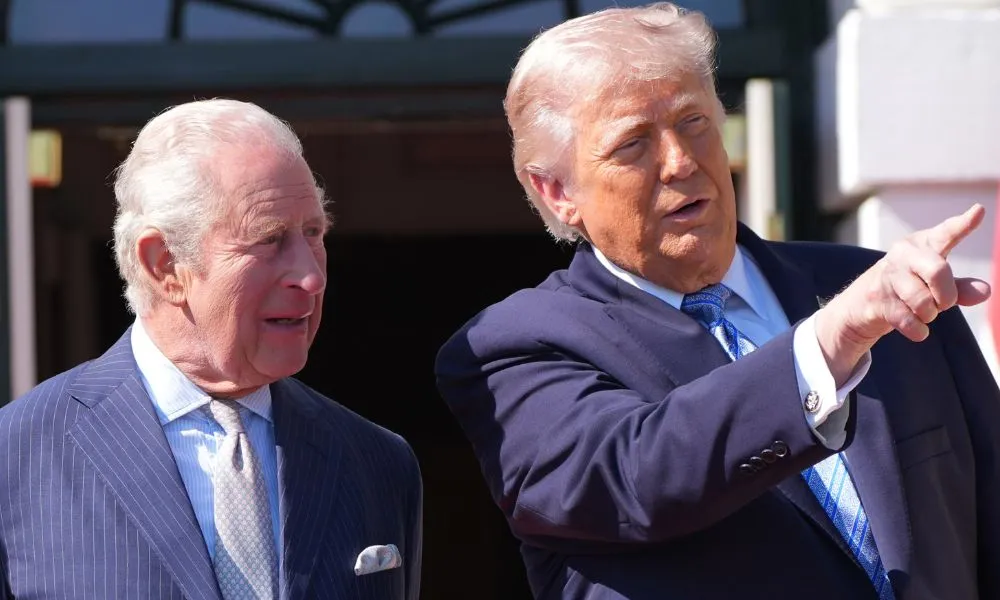


King Charles III addressed a joint meeting of Congress in Washington on Tuesday and did something no one quite expected: he made them laugh. Both sides of the aisle, in a chamber more accustomed to gridlock and grievance than shared mirth, rose repeatedly to applaud a 77-year-old monarch who arrived at the most fraught moment in US-British relations since the Suez Crisis and proceeded to work the room like a seasoned performer.
250 years ago
Charles opened with a reference to Washington as "a city which symbolizes a period in our shared history, or what Charles Dickens might have called 'A Tale of Two Georges'" before pausing for the laughter to settle. "The first president, George Washington, and my five-times great-grandfather, King George III," he clarified, adding: "Please rest assured I am not here as part of some cunning rear-guard action." He noted that the American colonies had declared independence "250 years ago, or as we say in the United Kingdom, just the other day." He asked Speaker Mike Johnson whether there were "any volunteers" to be held hostage at Buckingham Palace, as Westminster tradition technically demands when a king addresses Parliament, a joke whose punchline carried rather more historical weight than it let on: the custom dates to the reign of Charles I, who was beheaded at the end of a civil war.
Beneath the easy demeanour and the well-timed pauses lay a speech of considerable diplomatic precision, delivered at a moment when President Donald Trump has publicly mocked British Prime Minister Keir Starmer and criticised NATO allies for failing to contribute more to the war in Iran. The King never named Trump. When he invoked Magna Carta, the document wrested from King John in 1215 as a check on despotic rule, and hailed the importance of democratic foundations including the separation of powers and the legislative process, the chamber rose to its feet. The standing ovation came at a moment when Congress has, by most assessments, surrendered significant authority to the executive, with Republican lawmakers ceding spending powers to the president as he imposed tariffs and cut federally funded programmes.
"Persuasive and incredibly sly"
The subtext was clear enough that a column in Australia's Sydney Morning Herald praised the address as "persuasive and incredibly sly" for telling Trump what his many critics felt he needed to hear. Former British ambassador to Washington Nigel Sheinwald told Reuters that Charles had used the rare platform to highlight the web of bilateral ties across culture, security, defence and technology, and would "hope that some of it will have an enduring impact on his audiences, which are much wider than the administration and will go on much longer than the administration."
The speech's emotional centrepiece came when Charles invoked his mother. "When my mother visited in 1957, not the least of her tasks was to help put the 'special' back into our relationship after a crisis in the Middle East," he said at the White House state dinner. "Nearly seventy years on, it is hard to imagine anything like that happening today," he added, drawing laughter, though the parallel to the current moment in the Middle East and the current strains in the alliance was anything but accidental. He closed with a statement of personal conviction that, in another speaker's mouth, might have read as platitude: "I believe with all my heart that the essence of our two nations is a generosity of spirit and a duty to foster compassion, to promote peace, to deepen mutual understanding, and to value all people of all faiths and of none." In the context of the day, and of the administration sitting in the front row, it read as a rebuke dressed in the language of aspiration.
Senior British officials were, by accounts, delighted. "The king is a masterful diplomat," one senior government official told Reuters. Diplomats noted that the visit was never intended to repair the political relationship between London and Washington overnight, but to keep channels open and remind the American public of what the alliance represents beyond any single administration. That broader mission, the appeal over Trump's head to Congress and to the American people, may prove to be the speech's most consequential effect. Charles will not be remembered for the tariff negotiations or the Iran briefings. He will be remembered for the jokes, the timing, and the moments in between when he said something that mattered.
Sources: Reuters, The New York Times