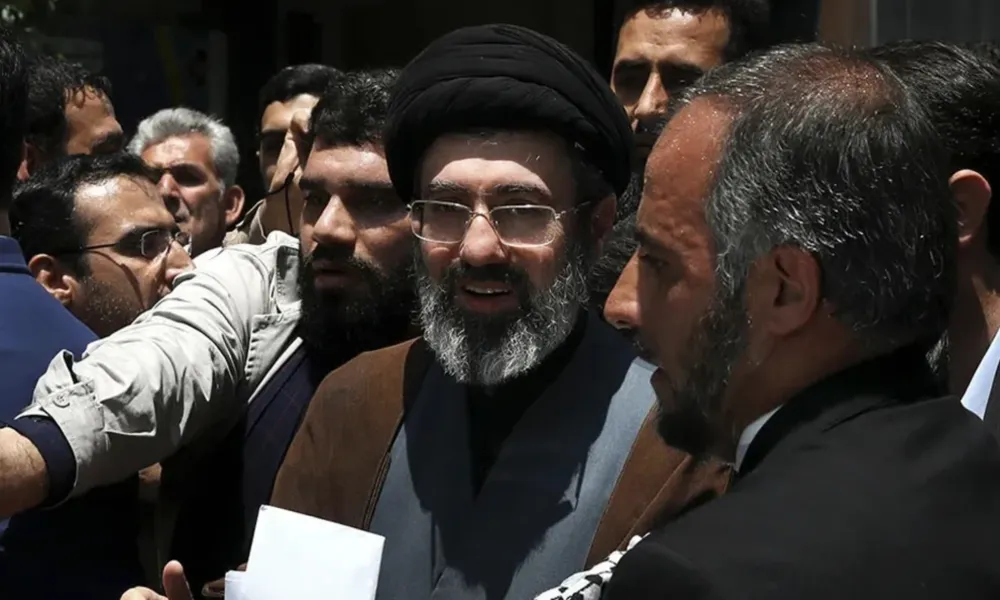
Mojtaba Khamenei spent years in the background while his father governed and has rarely appeared in public over the past decades.
His sudden emergence as supreme leader during wartime, combined with uncertainty about his condition, evokes imagery deeply rooted in the mythology of the Islamic Republic and the Shia Islam theology on which it is based.
Historian Arash Azizi notes that the “iconic assassination” of the late Khamenei has provided the regime with powerful Shiite symbolism.
“Of course they will try to use the same themes around Mojtaba, whose status as the son of a ‘martyred imam’ who was wounded resembles that of Shiite saints from the Battle of Karbala,” said Azizi, a lecturer and historian at Yale University.
Iran’s political culture has also been shaped by decades of war and crises. Just one year after the establishment of the Islamic Republic of Iran in 1979, Saddam Hussein invaded Iran, triggering an eight-year conflict that claimed hundreds of thousands of lives and reshaped the country’s political landscape.
So far, supporters of the regime have not publicly expressed significant concern over the absence of the new leader. Instead, they appear to be awaiting his eventual appearance while recognising the constraints imposed by wartime conditions.
The system behind the throne
“The regime can endure for some time without public appearances,” Sanam Vakil, director of the Middle East and North Africa programme at Chatham House said according to Skai Gr.
“His absence does not necessarily undermine his legitimacy in the short term, particularly if the main institutions continue to function and decision-making appears coordinated,” she added.
Some analysts argue that what matters most in Tehran at present is not the visible presence of the supreme leader but the cohesion of the institutions operating under his authority.
Powerful security bodies such as the Islamic Revolutionary Guard Corps are seen as shaping strategic decisions regardless of Mojtaba’s presence.
His appointment at the top of the political hierarchy may be sufficient to provide the political legitimacy required to give the military leadership the cover it needs to continue what the regime calls the “War of Ramadan”.
“They (the Revolutionary Guards) likely hold the real power in Iran, not Mojtaba,” historian Azizi said.
For now, even in his absence, Mojtaba appears to serve the regime’s purposes. The key question is what will happen once the war ends.
“After the war, the political elite—not just the public—will need clearer signals that Mojtaba is capable of exercising authority,” Vakil said.
For the time being, his location remains secret and few openly question why. Most understand that the new supreme leader is a target for both the United States and Israel.