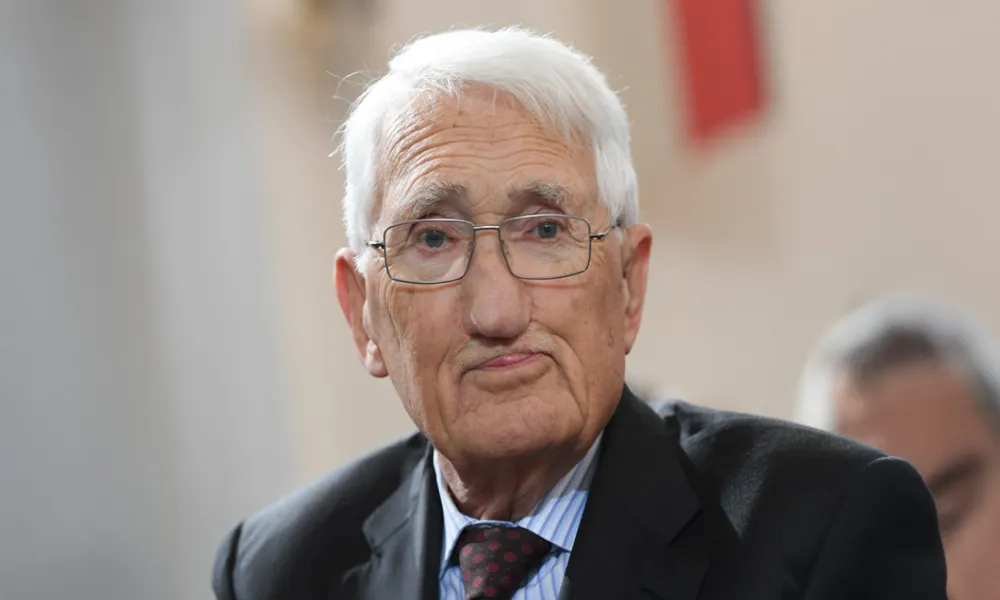
Jürgen Habermas, the renowned German philosopher and sociologist whose work shaped modern democratic thought, has died in Starnberg near Munich, where he had lived since 1971. The news was announced by the publishing house Suhrkamp.
One of the most influential thinkers of the 20th century, Habermas remained active well into old age and was among the few German public intellectuals who regularly intervened in political debates. Throughout his career he defended the idea of an open and cosmopolitan democracy.
EU integration
During the 2015 refugee crisis he supported the right to asylum, and in later years he advocated stronger European integration as a counterweight to rising nationalism and right-wing populism.
Habermas received numerous international honours, including the 2007 Holberg Prize. Even in his nineties he continued publishing major works. In 2019, shortly after turning 90, he released the two-volume This Too a History of Philosophy, a sweeping study of the development of human rationality.
Born in Düsseldorf in 1929, Habermas studied philosophy, economics and German literature before earning a doctorate in Bonn in 1954. His 1961 study The Structural Transformation of the Public Sphere became a landmark work examining the role of public debate and opinion in democratic societies.
Foundation of democracy
His work drew the attention of thinkers of the Frankfurt School, including Theodor W. Adorno and Max Horkheimer, who sought to understand how modern societies had descended into fascism despite the ideals of the Enlightenment.
Habermas later succeeded Horkheimer as professor of philosophy and sociology at the University of Frankfurt. His theories emphasised the importance of open discussion and rational communication as the foundation of democracy.
In his influential 1981 work The Theory of Communicative Action, he argued that social progress depends on public dialogue in which citizens freely exchange arguments and seek consensus.
In later years he applied these ideas to the European Union, warning that European integration would fail if political leaders did not involve citizens more directly in debates about the continent’s future.