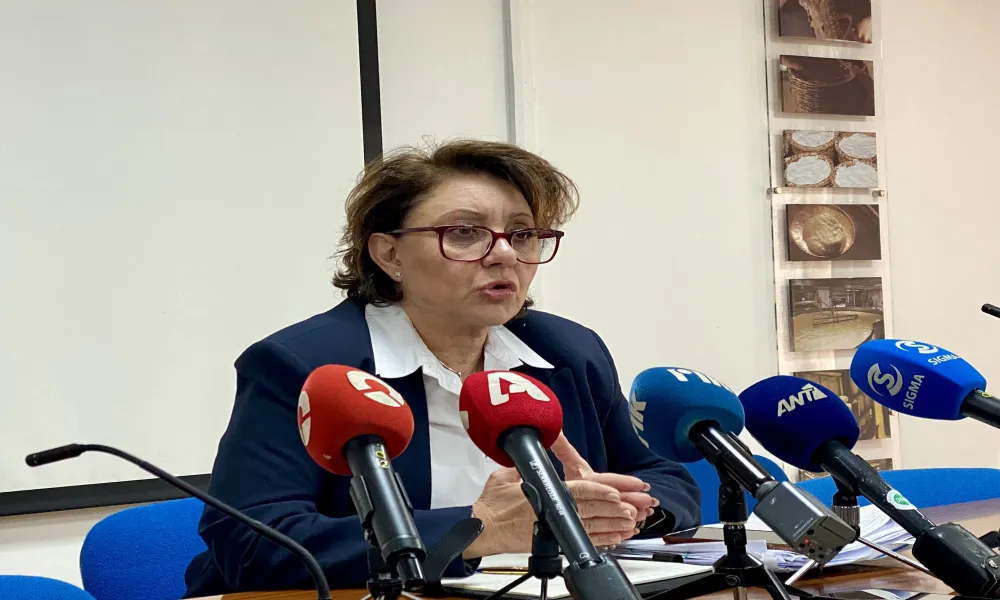
“We cannot save the tree and lose the forest,” Sotiria Grigoriadou said on Saturday during a press briefing on developments in the fight against Foot-and-Mouth Disease, stressing the need for the measures already announced to be fully implemented by all involved.
Grigoriadou, a senior official of the Veterinary Services, warned that if the measures are not applied consistently it will be impossible to estimate when normal conditions can be restored in the livestock sector.
She highlighted in particular the problems caused by a lack of cooperation from some livestock farmers with veterinary authorities, as well as delays resulting from resistance to the culling of animals at farms where infections have been detected.
According to Grigoriadou, the lack of cooperation has also resulted in accidents involving veterinary officials while attempting to carry out their duties. At least two officials have filed complaints with the police over the treatment they faced, she added.
Outbreak situation in Larnaca
Meanwhile, Grigoriadou announced on Saturday that the number of livestock farms with confirmed cases in the Larnaca District remains at 38.
“Sampling and tracing of animal movements are continuing to determine whether there are additional outbreaks elsewhere,” she said.
“So far things are progressing well, but that does not mean they will continue to do so, especially after the various gatherings of livestock farmers and the obstruction of the Veterinary Services’ work. If we do not cull the animals, we have a source that continues to release the virus, and the longer we delay, the worse it will be for our livestock sector,” she noted.
Responding to a journalist’s question about a protest by livestock farmers against the culling of animals in Larnaca on Saturday morning, she said veterinarians were not in a position to confront crowds and that such actions constitute obstruction of the competent authorities’ work.
She added that farmers whose units were affected had been informed from the outset that the culling of animals would be necessary. In response to another question, she said there is agreement on this approach with private veterinarians as well.
So far, 14,000 sheep and goats and 1,100 cattle have been culled, while another 10,000 animals remain awaiting culling.
Vaccination efforts
Grigoriadou also said that inspections are continuing in all districts, alongside vaccination efforts.
Vaccinations have so far covered 73 per cent of cattle farms and around 35 per cent of sheep and goat farms. The campaign is being implemented across Cyprus, beginning at the perimeter of infected farms and focusing particularly on areas near the Green Line.
At the same time, vaccination efforts are underway in Paphos, Limassol and Famagusta District, starting with cattle, followed by sheep and goats around pig farms and then the remaining small livestock.
She explained that this strategy is applied because cows are far more sensitive to the disease, develop strong clinical symptoms and release the virus through respiration. Authorities then move to protect pig farms, where the virus may be released without visible symptoms, she said.
Compensation efforts
Grigoriadou also noted that the advisory committee on compensation for livestock farmers, established on 5 March by decision of the Council of Ministers of Cyprus, has already held its first meeting.
The committee includes representatives from the Department of Agriculture Cyprus, the Agricultural Research Institute Cyprus and agricultural organisations.
Individual files will be created for each farmer, based on livestock numbers, tax declarations and other data, in order to prepare compensation payments.
As an initial relief measure, a small payment of up to €50,000—depending on livestock numbers—has been approved for farmers whose animals have been culled, allowing them to continue operating until the full compensation procedures are completed.
At the same time, the agriculture ministry is working with farmers to facilitate the import of high genetic value livestock from various European countries so that farms can restart operations once affected areas have been cleared, disinfected and approved following inspections by veterinary authorities.
Imports and biosecurity measures
Responding to a question, Grigoriadou said authorities are in continuous contact with Spain and France regarding livestock imports.
“The animals are there. The issue is when we will be able to reactivate the farms,” she said, explaining that new animals cannot be introduced until all livestock in the affected areas have been culled and disinfection procedures completed.
She also stressed that no permits are issued for animals from infected farms to be sent to butcher shops. Permits that are issued allow transport only on Fridays, and animals must be taken directly to slaughterhouses.
Checks on vehicles moving to and from livestock units are continuing, while a new decree also imposes restrictions on sheep shearing, requiring the use only of tools that remain within each farm in order to avoid the spread of the virus.
Additionally, the transport of wool and animal hides from slaughterhouses and shearing locations has been prohibited.
Situation in the north
Asked whether authorities have a clear picture of the spread of foot-and-mouth disease in areas not under the control of the Republic of Cyprus, Grigoriadou said information is relayed through the bicommunal committee when it convenes.
“What we know as citizens, based on what is being reported, is that a small number of animals have been culled and vaccinations have taken place,” she said, noting that the Veterinary Services cannot exercise control in those areas.