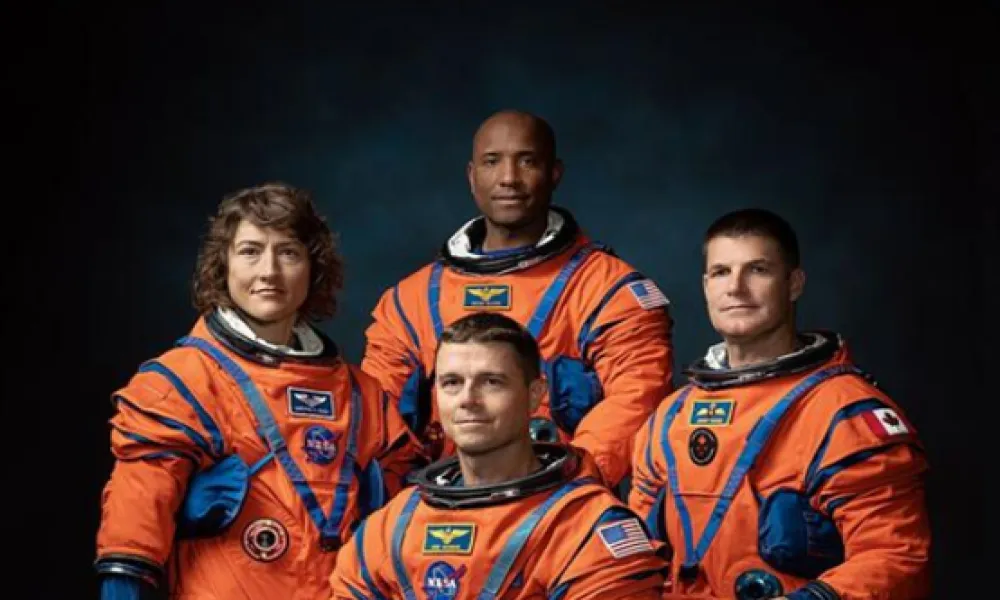

As the Artemis II mission prepares for its historic journey around the Moon, astronauts will face far more than the technical challenges of deep space travel. Beyond navigation systems, propulsion and lunar trajectories, there is a far more human question to solve: how to live day-to-day inside a spacecraft for nearly two weeks.
From what astronauts eat and drink to how they maintain hygiene and even how they go to the toilet, life aboard the Orion spacecraft requires practical adaptations that may seem unusual to anyone used to life on Earth. Yet every detail has been carefully designed by engineers and scientists at NASA to ensure the crew remains healthy, comfortable and efficient throughout the mission.
The Artemis II mission, the first crewed flight of the Artemis programme, will send astronauts around the Moon aboard the Orion spacecraft, marking humanity’s return to lunar exploration for the first time since the Apollo era.
Food In Space: Freeze-Dried Meals And Carefully Planned Menus
Eating in space is less glamorous than one might imagine, but it remains essential for astronaut health and performance. The Orion spacecraft will carry mostly freeze-dried and dehydrated meals, specially prepared so they can be stored safely for long periods and consumed in microgravity.
Each astronaut will have a personalised 11-day menu, carefully designed to meet nutritional needs while also taking into account individual preferences. Maintaining morale and comfort during long missions is just as important as meeting dietary requirements.
Food is heated using a compact metal food warmer, roughly the size of a small suitcase. The device slowly heats meals over the course of about an hour before they are ready to eat. While this may sound slow by Earth standards, the process is efficient and reliable for spacecraft operations.
Astronauts typically eat using specially designed containers and utensils that prevent food particles from floating freely inside the cabin. In microgravity, even a small crumb drifting through the spacecraft could potentially damage equipment or interfere with instruments.
Water Supply: Carefully Managed Hydration
Water is another critical resource during space missions. The Orion spacecraft will carry four water tanks containing a total of around 240 kilograms of water. This supply will be used both for drinking and for rehydrating freeze-dried meals.
Even though astronauts move less physically in microgravity, proper hydration remains vital. Space travel affects the human body in many ways, including fluid distribution and cardiovascular function. Ensuring astronauts drink enough water helps maintain normal bodily functions during the mission.
The Most Asked Question: How Do Astronauts Go To The Toilet?
Perhaps the most common question about life in space concerns the bathroom.
In microgravity, the simple act of using the toilet becomes surprisingly complex. The Orion spacecraft uses a vacuum-based waste system, similar in principle to the toilets used on commercial airplanes.
Astronauts must secure themselves in place by fastening their feet to restraints so that they do not float away while using the system. Urine is collected through specialised tubes, while solid waste is captured in dedicated containers.
Unlike the systems used aboard the International Space Station, which recycle urine into drinking water, the Orion spacecraft uses a simpler waste storage system. All waste will remain onboard throughout the mission and return to Earth with the spacecraft.
The design reflects the relatively short duration of Artemis II, which will last approximately 11 days, making full recycling systems unnecessary.
Personal Hygiene Without Showers
Daily hygiene also requires adaptation in space. Traditional showers are impossible in microgravity because water would float freely inside the cabin.
Instead, astronauts rely on wet wipes, no-rinse soap and no-rinse shampoo to keep clean. These specially formulated products allow astronauts to wash themselves without needing large amounts of water.
Brushing teeth also works differently. Astronauts use water and toothpaste as usual, but instead of rinsing into a sink they typically spit into a towel or swallow small amounts of water. The goal is to prevent loose liquid from floating through the spacecraft.
While these routines may seem unusual, astronauts quickly adapt to them. Over decades of human spaceflight, these procedures have become standard practice.
Why These Details Matter
Although discussions about food, hygiene and toilets may seem mundane compared to rocket engines and lunar trajectories, these systems are essential for mission success.
Human spaceflight is not only about reaching distant destinations. It is also about ensuring that astronauts can live safely and comfortably in extreme environments where even the simplest daily tasks must be redesigned.
The experience gained during Artemis II will help prepare engineers and astronauts for longer missions in deep space, including future expeditions to the Moon’s surface and eventually to Mars.
In many ways, the Orion spacecraft represents a bridge between everyday human needs and the extraordinary reality of living beyond Earth. Every meal, every drop of water and every carefully engineered bathroom system is part of the effort to make deep-space exploration possible.