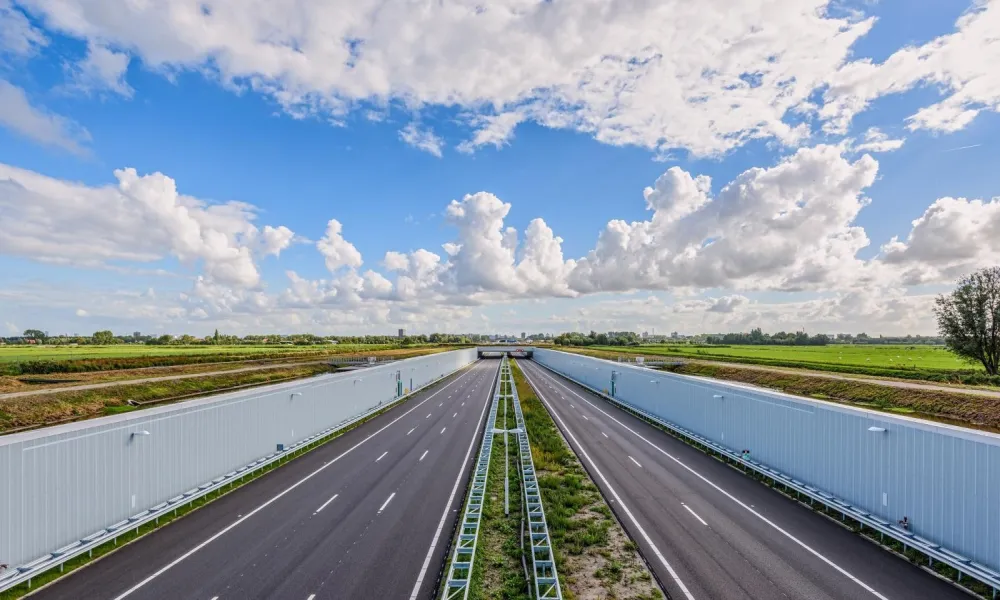

A section of motorway in Germany, about 18 kilometres long, was completed 12 years ago, yet it remains closed to this day for an unusual reason.
For a country traditionally associated with planning, efficiency and reliability, such a case appears particularly paradoxical.
The case concerns a 17.6-kilometre stretch of the A4 motorway, which was completed in 2014 and was ready to be integrated into the German Autobahn network. Asphalt, signage, bridges and technical works were delivered exactly as planned, yet traffic never began.
The reason was not related to technical faults or construction problems. Instead, it stemmed from a decision to expand a nearby mining site, which overturned the original spatial planning of the area. As a result, the newly built motorway was left without any connection to active traffic routes, effectively turning it into infrastructure with no practical role in the country’s road network.
Instead of opening to vehicles, the motorway section was left unused, with nature gradually reclaiming the space.
Given that the mining operation is not expected to end before 2040, the prospect of the 17.6 kilometres of the A4 Autobahn ever becoming part of Germany’s active road network is considered highly unlikely.
After the mine’s closure, the area currently used for extraction is expected to flood and form a large artificial lake, which would become Germany’s second-largest lake by area, after Lake Constance, located on the border with Switzerland and covering 536 square kilometres.
The video below, published on YouTube, explains what happened in the case of Germany’s unused motorway section.