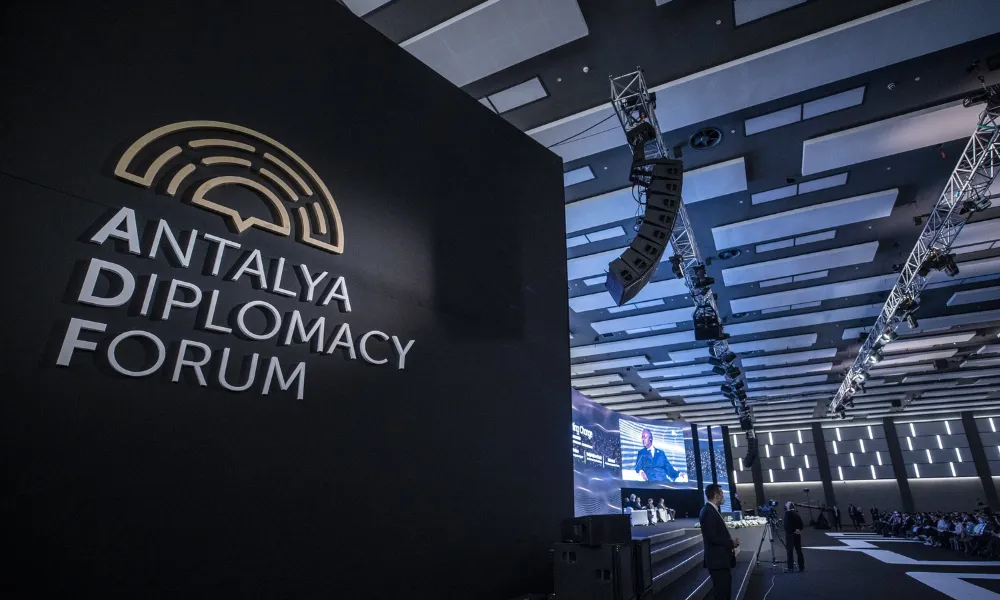
The fifth Antalya Diplomacy Forum 2026, held under the theme “Mapping Tomorrow, Managing Uncertainties,” was not merely another diplomatic gathering. It was a reflection of a world in transition. More than 150 countries, dozens of heads of state and government, over 50 foreign ministers, and nearly 5,000 participants converged in Antalya. The scale was impressive. The intent was more significant.
At a time when global governance structures appear strained, alliances are increasingly transactional, and conflicts overlap geographically and politically, Antalya positioned itself as a venue where competing narratives could coexist, if not converge. Hosted by Hakan Fidan and presided over by Recep Tayyip Erdoğan, the forum sought to do something many traditional platforms struggle with today: maintain dialogue across dividing lines.
From conference to diplomatic instrument
Launched in 2021 under former foreign minister Mevlüt Çavuşoğlu, the Antalya forum has evolved rapidly. What began as a post-pandemic diplomatic experiment has matured into a structured, recurring instrument of Turkish foreign policy.
Unlike classical summits, ADF does not rely solely on formal communiqués. It blends high-level speeches, leader panels, bilateral meetings, and informal exchanges. This hybrid structure allows Ankara to operate simultaneously on multiple diplomatic tracks. It is not a neutral venue in the Geneva sense. It is a curated space where Türkiye projects access, relevance, and connectivity.
That distinction is crucial. In a multipolar environment, influence increasingly belongs not to those who dominate institutions, but to those who can convene actors that otherwise do not speak to each other. Antalya is Türkiye’s answer to that reality.
Managing uncertainty, not eliminating it
The theme of uncertainty was not rhetorical. It captured the strategic condition of 2026. From the war dynamics involving Iran to the ongoing Gaza crisis, from tensions in Ukraine to instability in the Eastern Mediterranean, global politics has entered a phase where predictability is scarce.
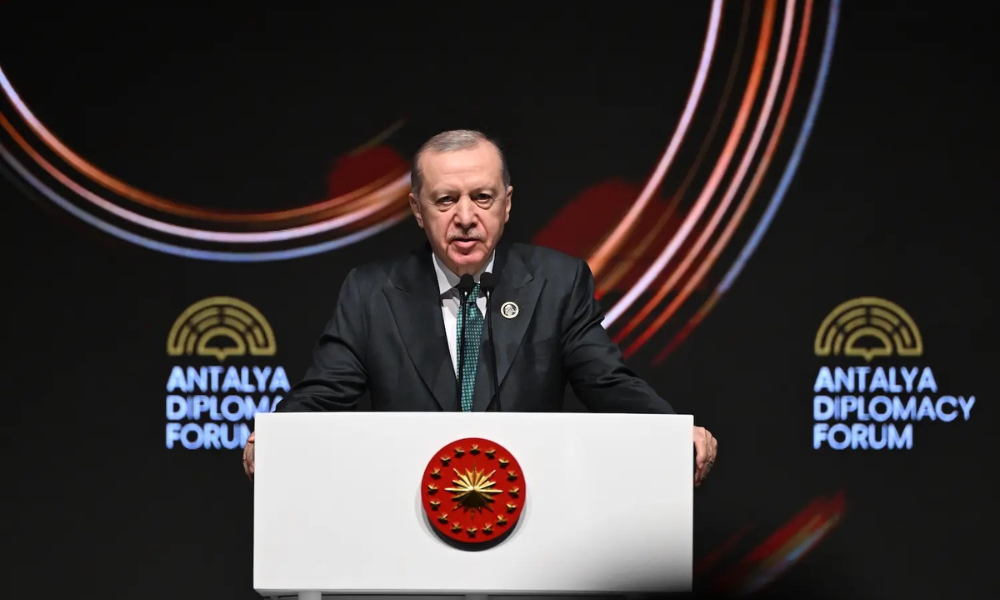
Erdoğan’s opening remarks reflected this diagnosis. He described the international system as facing a moral and functional crisis, particularly in relation to Gaza and broader regional conflicts. The emphasis was not only on instability, but on the erosion of trust in institutions meant to manage it.
Fidan complemented this framing with a more operational message: diplomacy must adapt. His call to “put out the fire” in the Middle East, alongside cautious optimism about U.S.–Iran de-escalation, underscored Ankara’s effort to position itself as an active crisis manager rather than a passive observer.
A platform of parallel diplomacies
What distinguishes Antalya is not a single breakthrough, but the density of diplomatic activity. The forum hosted multiple formats simultaneously: Balkans Peace Platform meetings, coordination among Türkiye, Egypt, Pakistan and Saudi Arabia, Gaza-focused discussions, and sessions involving the Organization of Turkic States.
Foreign Minister Fidan held talks with counterparts from Russia, Ukraine, and several European and Central Asian countries. President Erdoğan engaged leaders from the Middle East and beyond. These interactions did not produce immediate agreements, but they sustained channels that are increasingly rare elsewhere.
In an era when diplomacy is often fragmented by sanctions regimes, alliance constraints, and political polarization, simply keeping communication alive has become a strategic function. Antalya performs that function with increasing consistency.
Cyprus: From frozen conflict to active file
Few issues illustrated Antalya’s evolving role better than Cyprus. Tufan Erhürman used the forum to deliver a direct and unambiguous message: “No one can ignore the Turkish Cypriots on this island.”
This was not a rhetorical flourish. It was a strategic positioning. Erhürman emphasized that all steps on the Cyprus issue are coordinated daily with Ankara and that this coordination would intensify. The message was clear: the Turkish Cypriot side is both autonomous in representation and structurally aligned with Türkiye.
That alignment was reinforced by Erdoğan’s own intervention. Against the backdrop of regional militarization linked to the Iran war, he warned that foreign troops deployed to Cyprus “should not remain for long.” The concern is not immediate escalation, but gradual entrenchment. In Ankara’s view, temporary deployments risk becoming permanent fixtures, altering the island’s balance without political consent.
The Pyla tensions and broader buffer zone disputes further highlighted how technical issues can quickly evolve into sovereignty questions. Cyprus is no longer merely a negotiation file. It is becoming a strategic node in a wider geopolitical competition.
Expanding diplomatic space: The Aliyev factor
Erhürman’s sideline meeting with Ilham Aliyev added a distinctly strategic dimension to the Antalya proceedings, moving beyond protocol into the realm of calibrated geopolitical signaling. According to statements issued after the meeting, Aliyev was unambiguous, emphasizing that “Azerbaijan has always stood by the Turkish Republic of Northern Cyprus and will continue to do so.” In diplomatic language, such phrasing is not casual. It signals continuity rather than episodic support and frames the relationship as political, not merely cultural or symbolic.
Tufan Erhürman responded with equally deliberate messaging. He expressed appreciation for Azerbaijan’s consistent backing while stressing the importance of deepening ties both bilaterally and within broader multilateral frameworks. His emphasis was not simply on gratitude, but on institutionalization. By situating the relationship within the framework of the Organization of Turkic States, Erhürman effectively elevated the encounter from a bilateral exchange to part of a wider geopolitical alignment.
The presence of senior officials on both sides reinforced this interpretation. Azerbaijani Foreign Minister Ceyhun Bayramov and presidential aide Hikmet Hajiyev joined Aliyev, while "Foreign Minister" Tahsin Ertuğruloğlu and senior advisers accompanied Erhürman. This was not an incidental corridor exchange but a structured and intentional engagement.
Substantively, the talks focused on strengthening Azerbaijan and Turkish Cypriots' relations, enhancing cooperation across the Turkic world, and exploring avenues to expand the TC’s international outreach. Aliyev’s reaffirmation of support was paired with a broader signal: that the Turkish Cypriot side should not remain outside emerging regional platforms where Turkic cooperation is gaining momentum.
This is where the meeting moves beyond symbolism. While Azerbaijan has not formally recognized the TRNC, the trajectory of engagement is shifting. The TC’s observer status in the Organization of Turkic States, combined with high-level contacts such as this, contributes to a gradual layering of political legitimacy. It operates below the threshold of formal recognition but above the level of rhetorical solidarity. In effect, it represents incremental normalization within a defined geopolitical sphere.
For Greek Cypriot diplomacy, the optics are difficult. Its longstanding strategy has relied not only on legal non-recognition but also on maintaining practical diplomatic isolation. High-level engagements with leaders such as Aliyev complicate that framework. Even without formal recognition, repeated visibility alongside influential regional actors begins to erode the perception of exclusivity.
For Ankara and Lefkoşa, however, the meeting fits into a longer strategic trajectory. Türkiye has been encouraging a gradual expansion of the TC’s diplomatic space, particularly within Turkic and Global South networks. The Antalya forum, with its dense diplomatic activity and flexible format, provides an ideal environment for such engagements. It allows politically sensitive contacts to occur within the broader legitimacy of multilateral dialogue.
Erhürman’s approach appears to complement Ankara’s state-level positioning with diversified outreach. His insistence during the forum that “no one can ignore the Turkish Cypriots on this island” gains greater weight when paired with visible international engagement. The meeting with Aliyev thus becomes part of a coherent strategy: combining assertive political messaging with incremental diplomatic expansion.
In that sense, Antalya functioned not merely as a venue, but as an enabling mechanism. The forum created the conditions in which visibility itself became a diplomatic outcome. The significance lies not in a single meeting, but in the pattern it represents: a gradual widening of the TRNC’s international engagement, conducted carefully within existing constraints but increasingly difficult to ignore.
Gaza, Iran, and the regional fireline
The forum also addressed the broader regional crises shaping global politics. Gaza featured prominently in Erdoğan’s critique of the international system’s moral failure. Türkiye sought to rally wider support for ceasefire efforts and humanitarian access, leveraging its ties with regional actors.
At the same time, the shadow of the Iran conflict loomed large. Discussions ranged from Lebanon’s fragility to maritime tensions in the Gulf. While no single initiative dominated, Antalya facilitated multiple overlapping conversations aimed at de-escalation.
Türkiye’s role here is nuanced. It is not a neutral mediator in the classical sense. It is a regional actor with its own stakes, attempting to manage instability while advancing its strategic interests. Antalya allows Ankara to do both simultaneously.
The return of middle-power diplomacy
The rise of ADF reflects a broader structural shift in international relations. As great power competition intensifies, middle powers are seeking greater agency. Türkiye is positioning itself within this space as a connector state, bridging Europe, Asia, and the Middle East.
This approach aligns with what might be called “revisionist multilateralism.” Unlike Western-led forums that often exclude certain actors, Antalya deliberately includes a wider spectrum, from Iran and Venezuela to European and NATO members. The aim is not ideological alignment, but functional engagement.
Such inclusivity enhances Türkiye’s diplomatic reach, but it also carries risks. Balancing relations across rival blocs requires constant recalibration. Antalya showcases the ambition of this strategy, but also its complexity.
Soft power and strategic branding
Beyond diplomacy, ADF serves as a soft power instrument. By integrating academia, media, business, and civil society, the forum extends Türkiye’s influence beyond state-to-state relations. Institutions such as TİKA and other development agencies reinforce this outreach, particularly in Africa and the Global South.
The rotating themes, high visibility, and broad participation contribute to a narrative in which Türkiye presents itself as a proactive architect of emerging global arrangements. This narrative is not uncontested, but it is increasingly visible.
Limits and realities
Despite its growth, Antalya’s impact should not be overstated. Forums facilitate dialogue, but they do not resolve structural conflicts. Türkiye continues to face constraints in its relations with the European Union, the United States, and regional actors.
Moreover, access does not automatically translate into influence. The ability to convene must eventually be matched by the ability to shape outcomes. This remains an ongoing challenge for Ankara.
A map for an uncertain future
Yet, within these limits, ADF 2026 demonstrated its value. It did not eliminate uncertainty. It organized it. It created a space where multiple crises could be discussed within a single diplomatic ecosystem.
From Cyprus to Gaza, from Ukraine to the Gulf, Antalya functioned as a map room for a world in flux. It allowed Türkiye to project itself as a state capable of engaging across divides, maintaining channels, and shaping conversations.
In a global system where rules are contested and alignments are fluid, that role is not insignificant. Antalya may not yet define outcomes, but it increasingly defines the space in which those outcomes are negotiated.