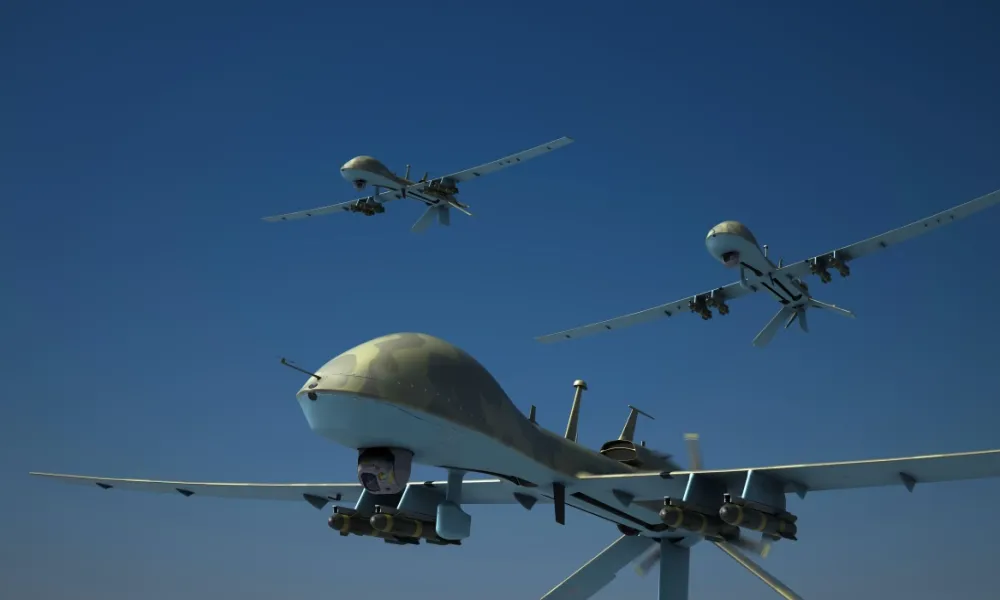
The European Commission presented its Action Plan to counter the increasing threats posed by drones to EU security on Wednesday.
A Commission press release noted that in recent years, “the EU has faced growing and multi-faceted challenges relating to drones and meteorological balloons, including hostile overflights, airspace violations, disruptions to airports, as well as risks to our critical infrastructure, external borders and public spaces.”
It described the Action Plan to counter threats posed by malicious drones as an “ambitious blueprint for stronger EU cooperation and solidarity”.
The current challenges facing Europe include:
· The threat from a wide range of actors.
· Sophisticated threats that blur the lines between civilian and military domains.
· The cross-border nature of threats.
· A legal framework not adapted to security threats.
· A multitude of authorities involved in the response.
· Limited industrial readiness for preparedness and response.
“We have seen that anything can be used as a weapon against us. Drone and anti-drone capabilities are central components in defending Europe and securing critical infrastructure,” said Henna Virkkunen, Commissioner for Tech Sovereignty, Security and Democracy.

Andrius Kubilius, Commissioner for Defence and Space said: “To achieve true defence readiness, Europe must be able to protect its borders and critical sites with a sophisticated, multi-layered shield that can detect and neutralise any threat in real-time.”
The aim of the Action Plan is to support EU member states through coordinated actions that complement national measures. The key priorities are enhancing preparedness, boosting detection capacities, coordinating responses and strengthening the EU's defence readiness.
Enhancing preparedness and resilience against drone incidents
To improve EU preparedness, efforts include:
- Investments to scale-up the production of drones and counter-drones’ systems.
- A Drone Security Package in 2026 to improve identification and registration of drones.
- Risks assessments to avoid high risk suppliers with a view to develop a drone and counter-drone security toolbox.
- EU trusted drone label to strengthen the trust of drones placed on the market.
- A drone and counter-drone industrial forum to bring together civil and defence stakeholders and providers of technologies.
- EU counter-drone centre of excellence to boost testing capacity.
To safeguard critical infrastructure, the Commission will provide clear guidelines for operators, launch a pilot project to improve maritime surveillance, and help member states defend against high-altitude threats, such as meteorological balloons launched from outside the EU.
Leveraging technologies and 5G networks to better detect drones
Detecting, tracking and identifying malicious drones is crucial to counter threats. This demands an enhanced situational picture, helping to differentiate friends from foes. To that end, the Action Plan previews measures that will support the emergence of single air display systems, integrating all relevant data to identify legitimate drones, and explore with member states the progressive set up of a Drone Incident Platform.
Detecting malicious drones relies on a multi-sensors approach, mixing several technologies powered by AI software. The Commission notes it will continue supporting leading technological development in detecting drones.
Faced with the current threat landscape, and especially the increasing use of drone swarms, 5G networks must urgently be leveraged for detection of drones, both connected and not.
“These 5G networks offer precise, real-time tracking of flying objects, which is essential for keeping our skies safe, and protecting internal security,” said the Commission.
Reinforcing responses to malicious drone activity
While Member States are primarily responsible for measures to respond to drone threats, the EU can deliver clear added value in supporting these ongoing efforts. The Commission will launch a call for interested countries to join forces in the public procurement and deployment of counter-drone systems. It will also support the development of sovereign European, AI-powered 'Command and Control' systems and look into creating Rapid Counter-Drone Emergency Response teams for increased solidarity between Member States.
The Commission proposes also that a yearly large scale EU counter-drone exercise is organised to stress test cross border cooperation and civilian and military synergies. Additionally, it will continue providing Frontex – the EU's borders and coasts guard agency – with the drones and technology needed for border surveillance. Frontex will provide practical guidance on layered deployment models and cross-border incident handling.
Strengthening Europe's defence readiness against drone threats
The Commission notes that the Action Plan will complement and support Member States in boosting Europe's military readiness through innovation and industrial cooperation, including in the area of securing a supply of critical raw materials. Brussels will boost support to build a stronger drone ecosystem, fostering closer ties between governments and industry through the Drone Alliance with Ukraine, according to the plan.
The Commission will continue to support Member States financially through various instruments as well as through the European Defence Industry Programme and SAFE loans.
“With today’s Action Plan, we have more arrows in our quiver to counter threats to our security and use this technology as an advantage, including by launching a new Counter-Drone Centre of Excellence, establishing an EU Drone Incident Platform and spending €400 million on drone and counter drone technology,” said Magnus Brunner, Commissioner for Internal Affairs and Migration.