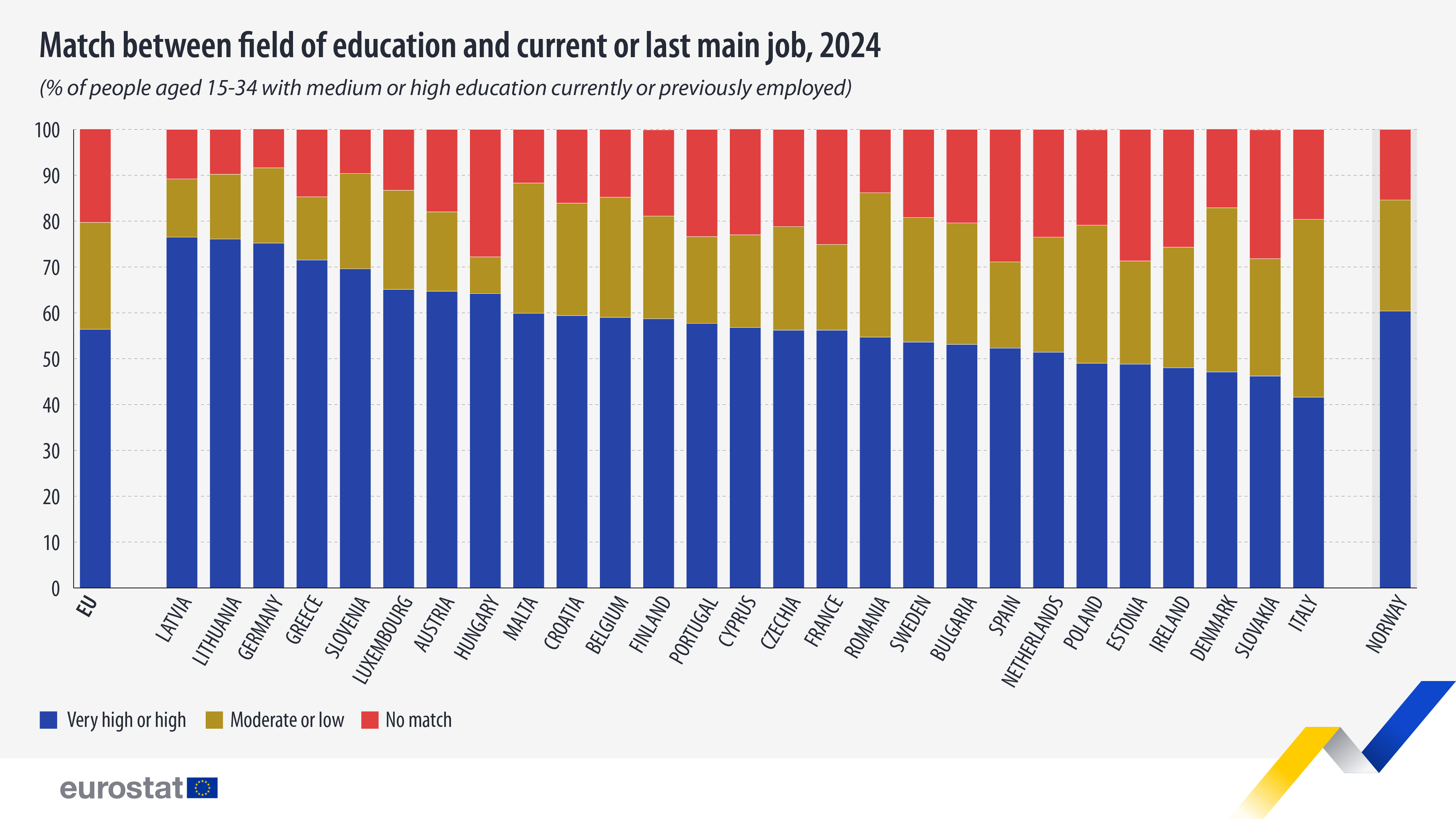
Across the EU, 56.4% of people aged 15 to 34 with medium or high levels of education reported a very high or high match between their field of education and the requirements of their current job.
Breaking this down further, 46.1% of those with medium-level education and 68.1% of those with tertiary education reported a strong alignment between what they studied and what they do professionally.
Health and ICT lead in matching rates
The strongest alignment was recorded in health and welfare, where 80.6% of highly educated graduates said they work in a field closely related to their studies.
Information and communication technologies followed at 77.0%, while education ranked third at 73.6%.
Arts and social sciences face greater mismatch
By contrast, graduates in arts and humanities were among the most likely to experience a mismatch. According to the data, 52.2% of highly educated young people who studied in this field reported difficulties in finding work related to their studies.
High levels of mismatch were also recorded among graduates in social sciences, journalism and information (59.1%) and services (59.3%).
The picture in Cyprus
In Cyprus, 56.8% of young people aged 15 to 34 with medium or high levels of education reported a very high or high correspondence between their field of study and their job.
At the same time, 23% said their employment does not match their level of education.