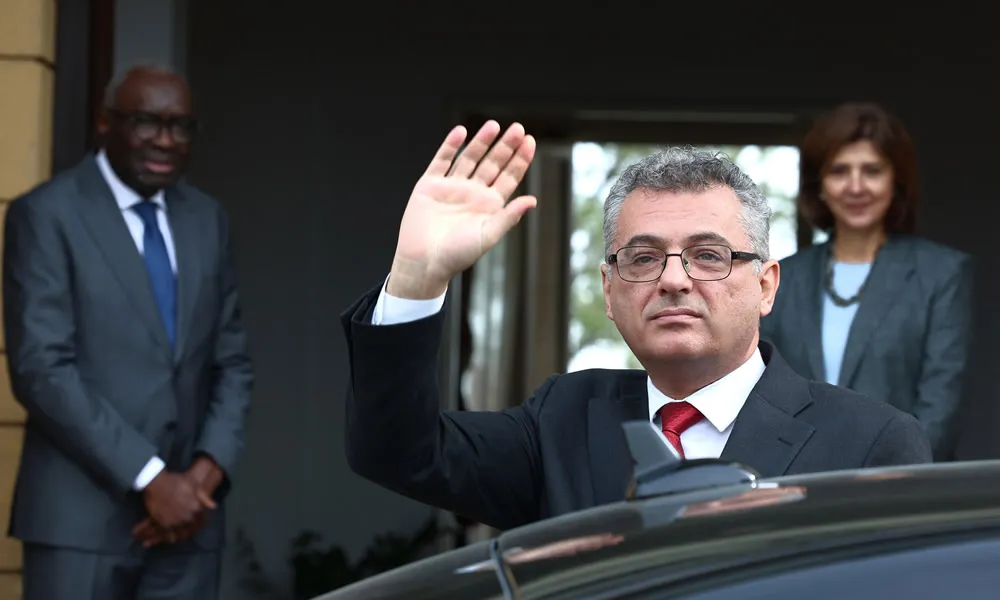
ISTANBUL — Turkish Cypriot leader Tufan Erhürman signaled a recalibrated approach to the Cyprus problem this week, declaring that his side would not “sit at the negotiating table merely for the sake of negotiations,” as he outlined a four-point methodology aimed at breaking what he described as a cycle of inconclusive talks.
Speaking at the 35th session of the long-running Bab-ı Ali Meetings in Istanbul, Erhürman delivered one of his most comprehensive assessments since taking office four months ago. His message was direct: the will of the Turkish Cypriot people for a settlement remains intact, but the framework and conditions of engagement must change if negotiations are to yield results.
Political equality at the core
At the center of Erhürman’s remarks was political equality. Without it, he argued, there can be no viable solution.
He reminded the audience that the Turkish Cypriot side has consistently demonstrated its commitment to settlement efforts, most notably during the 2004 Annan Plan referendum and the 2017 Crans-Montana talks. Yet, nine years after the collapse of Crans-Montana, the island remains divided and the status quo entrenched.
Erhürman framed the impasse not as a lack of dialogue but as a structural problem. According to him, the Greek Cypriot leadership has been unwilling to share governance on an equal footing. That reluctance, he suggested, lies at the heart of repeated breakdowns.
“The Turkish Cypriot people will never accept minority status,” he stressed, underlining that sovereignty and decision-making must be genuinely shared.
Beyond institutions: A broader sovereignty claim
Erhürman emphasized that the rights of the Turkish Cypriot people extend beyond the institutions of the north. He argued that while it has its own state apparatus, parliament, government and judiciary, Turkish Cypriot rights also stem from joint sovereignty over the island.
He listed security, maritime jurisdiction zones, hydrocarbon resources, energy corridors, international trade routes and European Union citizenship as areas derived from partnership rights under the 1960 constitutional framework.
In contrast, he criticized what he described as unilateral actions by the Greek Cypriot side, particularly security agreements with countries such as the United States, Israel and India. These steps, he said, proceed “as if there were no Turkish Cypriots on the island.”
The reference implicitly touched on the evolving security architecture in the Eastern Mediterranean, where bilateral defense and energy partnerships have multiplied amid regional tensions.
“We cannot share authority, yet we share the risk”
One of the most striking elements of Erhürman’s address concerned regional security risks. He recalled statements by Iranian officials suggesting that British bases on the island could be targeted in the event of escalation between Israel and Iran.
The comment served to illustrate what he called an imbalance: “We cannot share authority, yet we share the risk.”
This formulation highlights a broader Turkish Cypriot grievance. While excluded from decision-making on security and energy matters, they nonetheless bear the geopolitical consequences of decisions taken by others. In Erhürman’s view, such asymmetry reinforces the urgency of a settlement based on structured equality.
The four-point methodology
Erhürman revealed that his team has presented United Nations Secretary-General António Guterres with a four-point methodology designed to prevent another open-ended and ultimately fruitless process.
The framework includes:
• Securing political equality before formal negotiations begin
• Ensuring that talks do not restart from zero
• Introducing a time limit
• Preventing a return to the current status quo if the table is abandoned
Each point addresses a weakness of previous rounds. Pre-negotiation clarity on equality aims to avoid semantic disputes. Continuity prevents endless recycling of agreed texts. A time limit introduces discipline. And a “no return to status quo” clause seeks to deter tactical withdrawal.
Erhürman made clear that there is currently no formal negotiation table, only a dialogue process. Confidence-building measures, he said, remain open for discussion.
Energy geometry and EU tensions
Energy politics formed another layer of the speech. Erhürman referred to the planned undersea electricity interconnector linking Israel, Greece and Cyprus, supported by the European Union.
Even within Greek Cypriot circles, he noted, some question the project’s economic feasibility. He argued that the most rational and cost-effective energy route in the region would involve Türkiye.
Here the issue transcends infrastructure. For Ankara and the Turkish Cypriots, exclusion from regional energy planning reflects political marginalization. For Brussels, the project aligns with diversification strategies. The divergence illustrates how energy diplomacy intersects with the unresolved Cyprus dispute.
Continuity with Turkish Cypriot positions
Erhürman’s remarks align closely with long-standing Turkish Cypriot demands for effective participation and rotating presidency in any federal arrangement. However, his tone suggested neither rejectionism nor passivity. Instead, he positioned his approach as structured realism.
He reiterated that Türkiye remains guarantor for the entire island under the 1960 arrangements and that Turkish Cypriots possess equal partnership rights across the whole territory.
The invocation of Rauf Denktaş, whose legacy remains influential in Turkish Cypriot political discourse, underscored continuity with earlier assertions of sovereign equality.
Strategic implications
Erhürman’s intervention comes amid shifting regional alignments and renewed UN engagement. If the proposed methodology gains traction, it could reframe negotiations from process-driven to outcome-oriented.
However, the response from the Greek Cypriot side will be decisive. Any resistance to pre-negotiation guarantees on political equality may reproduce familiar deadlock. Conversely, structured parameters could provide clarity long absent from talks.
For international actors, particularly the United Nations and the European Union, the speech serves as a reminder that procedural momentum alone does not constitute progress. Political symmetry remains the central unresolved question.
A measured but firm signal
In diplomatic language, Erhürman’s message was both measured and firm. The Turkish Cypriot side, he signaled, is not abandoning negotiations. It is redefining the conditions under which they would proceed.
Whether this marks the beginning of a more disciplined negotiation phase or another chapter in the island’s long stalemate will depend on how the other parties respond.
For now, the message from Istanbul is clear: talks must aim at resolution, not repetition.