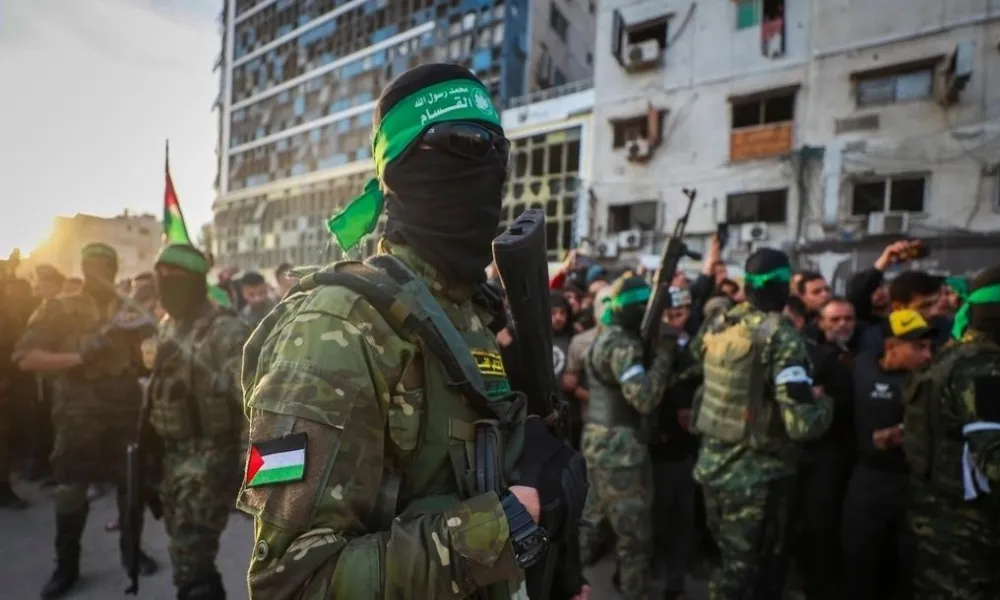

Hamas announced on Friday evening that it accepts some elements of US President Donald Trump’s 20-point proposal to end the war in Gaza, including the release of hostages and the handover of the enclave’s administration, but insisted that many other terms require negotiation.
A copy of the group’s statement, obtained by Reuters, came in response to Trump’s ultimatum that Hamas accept or reject the plan by Sunday. The US president has not clarified whether the conditions are negotiable, as Hamas has requested.
One of the most sensitive issues, the disarmament of Hamas, a core demand of Israel and Washington, was left deliberately vague in the group’s response.
In its statement, Hamas said it “appreciates the Arab, Islamic and international efforts, as well as those of US President Donald Trump, calling for an end to the war in Gaza, the exchange of prisoners and the immediate entry of aid.” The group confirmed its agreement to “the release of all prisoners of the occupation, living and dead, according to the exchange framework included in Trump’s proposal, under the necessary conditions on the ground for its implementation.”
The group added: “In this context, the movement affirms its readiness to engage, through mediators, in negotiations to discuss the details.”
Speaking to Al Jazeera, a senior Hamas official described the proposal to release all hostages within 72 hours as “theoretical and unrealistic.”
Hamas also said it is ready to hand over governance of Gaza to “a body of independent Palestinian technocrats, based on national consensus and backed by Arab and Islamic support.” The official clarified that the future of Gaza would be discussed within a broader Palestinian framework, of which Hamas is a part, but signalled openness to negotiations on “all issues concerning the movement and its weapons.”
Qatar confirmed its mediators had received Hamas’ formal reply.
Water supply partially restored in central Gaza
Meanwhile, the Palestinian Water Authority (PWA) said on Friday that water supply from Israel has been partially restored on a trial basis to central Gaza, after more than nine months of complete disruption.
The pipeline, operated by Israel’s state company Mekorot, serves several towns in the middle of the enclave, where tens of thousands of people displaced by the war are sheltering. Due to restrictions on access, AFP said it could not independently verify that water has begun flowing again.
Israel cut off water supplies at the start of the war triggered by Hamas’ unprecedented attack on 7 October 2023. Authorities later claimed partial reconnection in the north, though residents reported the flow was inconsistent.
The water crisis, severe even before the war, has since worsened dramatically. With over 80% of infrastructure damaged, residents now rely largely on water trucks or temporary taps installed by NGOs in displacement camps.
The PWA said it coordinated repairs with Israeli authorities, warning that the area remains “dangerous due to the heavy military presence.” It thanked organisations including UNICEF for support.
Israel’s defence ministry body COGAT, which oversees civilian matters in the occupied territories, did not respond to AFP’s request for comment. Last month, COGAT said water pipelines were under repair.
“The restoration of the pipeline network, which has suffered massive damage, is a Sisyphean task, every time it is repaired, it risks being destroyed again,” a UN official told AFP.
The PWA, part of the Palestinian Authority, continues to operate in Gaza despite Hamas seizing control of the territory in 2007. For the past year, it has worked to restore water supplies across the enclave.
CNA - AMNA