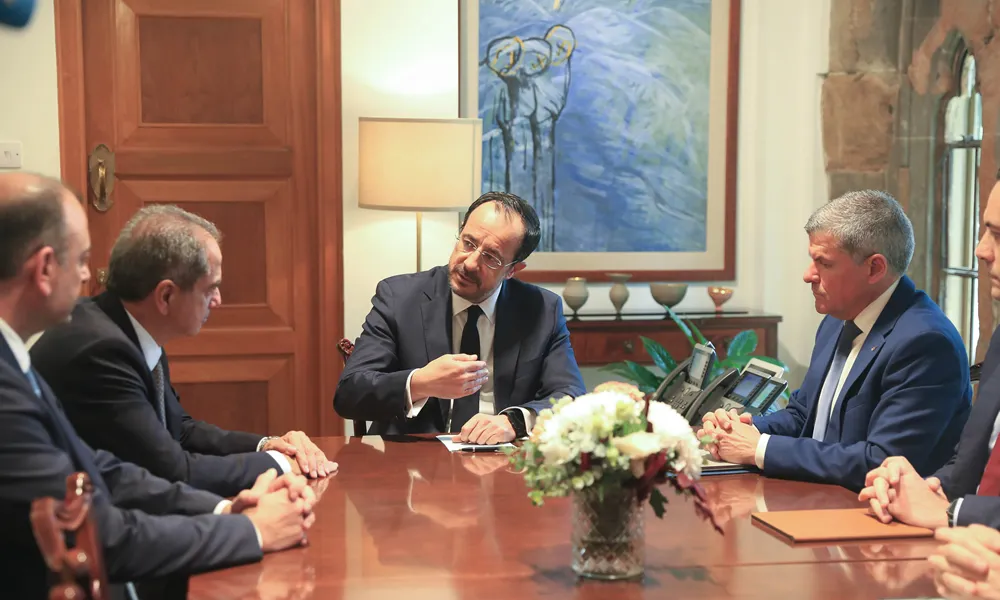

Lebanese Minister of Energy and Water Joe Saddi discussed the possibility of an electricity interconnection between the two neighbouring countries during talks with President Nikos Christodoulides and Energy Minister George Papanastasiou in Nicosia on Monday.
He also suggested the long-awaited revised Exclusive Economic Zone (EEZ) agreement between the two countries would not need parliamentary ratification to come into effect, noting that approval by Lebanese President Joseph Aoun would suffice.
Electricity interconnection
Speaking after the meeting, Saddi said Lebanon needs to increase electricity supply to its economy and population, and at a lower cost, while ensuring security of supply.
To this end, the Lebanese government is working on many fronts to attract private sector investment in conventional and renewable power generation, to ensure the modernisation of the transmission grid and its interconnection to the region, he said.
“I was very happy to meet with my counterpart in Cyprus, to discuss ways to cooperate in terms of electricity and interconnection, and we also agreed to establish working technical groups to pursue the initiative,” said Saddi.
For his part, Papanastasiou said the latest collaboration between the two countries is a result of the relationship developed between the two presidents, noting that Christodoulides was the first leader to visit the country when Aoun took office.
He added that the Lebanese minister came to Cyprus with ideas for cooperation so Lebanon can develop its electricity network, creating a reliable system, but also to facilitate the exchange of know-how to achieve electricity autonomy.
Speaking to Politis to the point, Papanastasiou said electricity interconnection with Lebanon is a much easier task than connecting with Greece, noting the differences in distance and depth alone. While laying an electricity cable to Greece from Cyprus would require a length of 987km at a depth of up to 3000m, a cable to Lebanon would reach some 200km with a maximum depth closer to 500m.
However, he noted, that did not mean the Lebanon connection would happen before those planned with Greece and Israel, as planned under the beleaguered Great Sea Interconnector project.
However, if the World Bank gets involved, undertaking a study on the interconnection with Lebanon, it’s possible the project gets fast-tracked, he noted.
As for implementation funding, this will be decided in future though it could potentially come from other Arab countries or through some form of EU assistance, said the Cypriot minister.
Asked whether Cyprus had enough surplus electricity to offer Lebanon, Papanastasiou replied that the reason Cyprus had to switch off photovoltaic energy supplies at times was because consumption often did not meet production, resulting in instability in the grid and blackouts.
EEZ agreement to see the light in coming weeks
Regarding the recently revised bilateral EEZ agreement with Cyprus, the visiting Lebanese energy minister was asked if it would require parliamentary approval to come into effect.
When the two countries had initially signed a maritime boundary agreement in 2007, based on the principle of the median line, under the UN Convention on the Law of the Sea (UNCLOS), the deal lingered in limbo for almost two decades, pending Lebanese parliamentary approval. The issue came to the foreground again after Lebanon reached an informal agreement with Israel on their maritime boundary in 2022. Lebanon was keen to attract big energy companies to its waters by establishing stable and clear maritime zones. Following new negotiations, Cyprus and Lebanon came to agreement on a revised EEZ, which was adopted by the Lebanese cabinet last month.
Saddi suggested on Monday that the latest EEZ agreement would not suffer the same fate as the original. Instead, the Lebanese president would endorse the agreement directly in the coming weeks, putting an end to this chapter.
“My information is that the President has the authority to go ahead and sign it or have one of the ministers sign it,” he said.
According to sources, the signing ceremony will likely take place on November 26, after which the Cypriot parliament will ratify the agreement and the two countries will exchange the instruments of ratification, bringing the maritime delineation into effect.
Papanastasiou described the fact the two countries have an agreed maritime border as “very positive”, noting that hydrocarbons can be found everywhere, even on maritime borders. “In the next stage, there will have to be a joint exploitation agreement," he said.
The ‘3+1’ group and new energy networks
Asked if recent developments have brought the proposed ‘EastMed’ pipeline from Israel to Greece via Cyprus back on track, Papanastasiou replied in the negative, noting however that it could mean connecting Israel and Cyprus through gas networks.
"You understand that natural gas, which is located in our exclusive economic zone, can be used as a supplement to the pipelines located in the vertical corridor, and the vertical corridor starts in Alexandroupolis and essentially branches out through Bulgaria, Romania, and Hungary to Ukraine," he said.
Referring to the recent ‘3+1’ meeting in Athens of the energy ministers of Greece, Cyprus, Israel and the USA, Papanastasiou said American interest was primarily in this vertical corridor.
“But the Eastern Mediterranean is a point that essentially has this energy potential. Soon we will also have natural gas produced within our own exclusive economic zone. Moreover, Israel has the large Leviathan field and other smaller fields. And so Israel says that there is interest in connecting its natural gas network with the country that makes the most sense, which is essentially Cyprus," he said.
"This does not mean a revival of EastMed, but it could mean any other connection of Israel's natural gas network with Cyprus," Papanastasiou noted.
On his return from Athens, Israeli Energy Minister Eli Cohen told The Jerusalem Post last week that “very significant progress” had been made on the possibility of building a gas pipeline to Europe.
“This is an idea that was discussed in the past, and now it’s back in play. The Americans are now willing to take on a major role.”
Cohen said the Trump administration considered energy a matter of national security, giving the project’s feasibility a boost.
“The goal is to build an infrastructure corridor that provides an alternative to the Russian energy route and bypasses the Houthis as well,” he said. “For the Europeans, the goal is, of course, to reduce prices.”
LNG export terminal not on the cards
Speaking to Politis to the point, the minister echoed the view that the Trump administration puts natural gas as a priority, as opposed to the EU which looks more to renewables as part of the ‘Green Transition’. This American focus on natural gas is opening new possibilities.
With over 20 trillion cubic feet (tcf) of gas already believed to have been found in Cyprus’ EEZ, along with considerable quantities in Israeli maritime waters, could the idea of a ‘Cyprus gateway’ return, that would liquefy gas in Cyprus and export it around the world as LNG?
Papanastasiou played down the prospect, noting that times have changed and energy companies want quick returns on gas projects. If Cyprus were to discover a huge gas reservoir, taking its findings closer to 35-40 tcf or Israel decided not to sell its Leviathan gas to Egypt but send it to Cyprus, a move he described as unlikely, then the LNG export terminal could come back on the agenda.
EU-Lebanon strategic agreement
Speaking at their meeting at the Presidential Palace, Christodoulides spoke of the excellent relations between the two countries, noting that Lebanon is the closest country to Cyprus.
In view of Cyprus’ upcoming EU Presidency, he said: “We are working hard to achieve positive developments in EU-Lebanon relations.”
The president added: “We want to see tangible positive developments and are working with other EU member states to start discussions on a comprehensive strategic agreement between the EU and Lebanon."