
The latest survey by the Cyprus Broadcasting Corporation (CyBC) on political culture and electoral behaviour, published Thursday evening, paints a picture of a society in low spirits economically but rethinking its place in a turbulent region.
Cypriots are split over whether the country’s international standing has strengthened or weakened but are overwhelmingly in favour of the latest maritime delimitation deal with neighbour Lebanon and with the trilateral cooperation of Cyprus, Greece and Israel.
Israel has dramatically overtaken Greece as Cyprus’ preferred defence partner, while on NATO, public sentiment is cautiously positive but also sceptical. Many favour membership, yet most doubt it would really protect Cyprus from Turkey. At the same time, trust in the EU is rising, signalling that Brussels – rather than Washington or Moscow – is increasingly seen as a reliable anchor.
On the Cyprus problem, the popularity of the UN Personal Envoy has halved, while Mehmet Ali Talat proved to be the most popular Turkish Cypriot politician over time.
The survey was conducted in January 2026 – on behalf of the Cyprus Broadcasting Corporation (CyBC) – by MRC Cypronetwork Ltd through telephone interviews with 1,213 respondents from across Cyprus, aged 18+ and with the right to vote.
International standing
More people feel the country’s strength internationally has grown, but more people also think it has become weaker. Specifically, 26% of respondents said in January 2026 that Cyprus has become more powerful internationally (compared to 10% in May 2024), while 29% say it has become weaker (compared to 23% two years ago) and 43% who believe its international strength has not changed – a drop from 61% in May 2024.
Negative vibes dominate
Asked to express their feelings about the current situation in the general political climate, eight out of 10 respondents expressed a negative sentiment, with only one in 10 showing optimism. Specifically, 31% of respondents expressed ‘disappointment’ (compared to 36% in May 2024), 18% Anxiety/Stress (23% two years ago), 18% Rage/Resentment (15% before), 10% Shame (2% before) 9% Hope/Optimism (7% before), 6% indifference (no change), and 4% Sadness/Distress (6% before).
Majority struggling economically
Regarding the change in personal income from October 2022 to January 2026, the majority of those asked said they are living through hard times with 39% experiencing ‘difficulty’ (compared to 32% in 2022) and 14% experiencing ‘great difficulty’ (down from 27% in 2022). Meanwhile, 31% said they are ‘managing’ (compared to 29% before), and 15% are living ‘comfortably’ (compared to 11% four years ago).
Cyprus-Lebanon EEZ deal well received
On foreign policy, respondents were asked their opinion on the delimitation of the Cyprus-Lebanon Exclusive Economic Zone (EEZ) agreement, with 68% finding it ‘positive’, only 11% ‘negative’ and 21% had no opinion.
Talat most popular while Akıncı not well liked
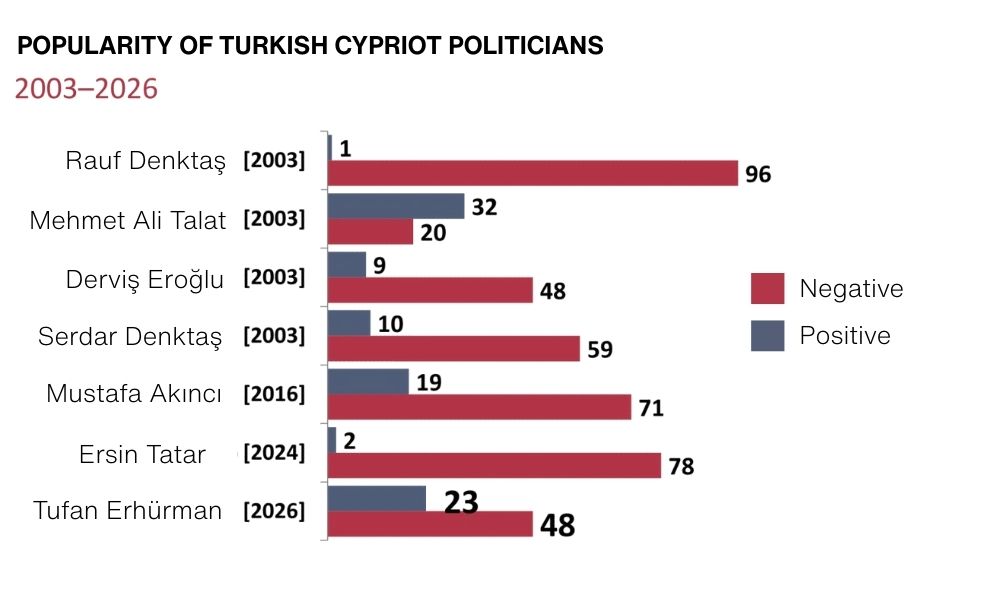
A question on the popularity of Turkish Cypriot politicians from 2003 to 2026 came up with some surprising results. Perhaps predictably, the late Rauf Denktaş was the most unpopular figure by far with 96% of respondents declaring a negative sentiment (compared to 1% positive). Ersin Tatar came second in the unpopularity stakes with 78% negative towards him (compared to a lowly 2% positive).
However, the pro-reunification leader and former sparring partner of Nikos Anastasiades, Mustafa Akıncı, came third, with a 71% negative rating (and only 19% positive). Son of Rauf, Serdar Denktaş, had a 59% negative rating (10% positive), while incumbent Turkish Cypriot leader Tufan Erhürman came fifth with a 48% negative rating (23% positive) along with Derviş Eroğlu on 48% negative rating (but only 9% positive). The least unpopular and most popular Turkish Cypriot politician on the list with a 20% negative rating and 32% positive, was Mehmet Ali Talat.
Holguín’s popularity drops by half
As for the UN Secretary-General’s Personal Envoy on Cyprus, María Ángela Holguín Cuéllar, who has spent 15 months on the job in the last two years, her popularity has dropped by half, from a 49% positive rating in May 2024 to 23% in January 2026. The share of those who feel negative about her has meanwhile increased during that period from 22% to 29% while so too has the percentage of those who have no opinion on her – from 29% to 48%.
Israel leapfrogs Greece as Cyprus’ best defence ally
A significant change in sentiment regarding geopolitical relations was also recorded when respondents were asked the following: “Generally speaking, in your opinion, is there a country that Cyprus can rely on to strengthen its defence?”
Israel was considered Cyprus’ best ally for its defence, chosen by 41% of respondents, compared to only 9.5% in May 2024. Greece came second with 27% (a significant drop from 45% two years ago). USA came third with 16.5%, (rising from 11%), while Russia doubled its popularity coming fourth with 14% (compared to 7% previously). The EU saw a drop in ratings from 19% in 2024 to 13.5% today, as did France from 14% to 12%, and the UK from 2.5% to 1.5%. Meanwhile, 4.5% said Cyprus can only rely on its own defences (compared to 8% in 2024), and 16.5% said simply there is no country Cyprus can rely on to strengthen its defence (compared to 19% previously).
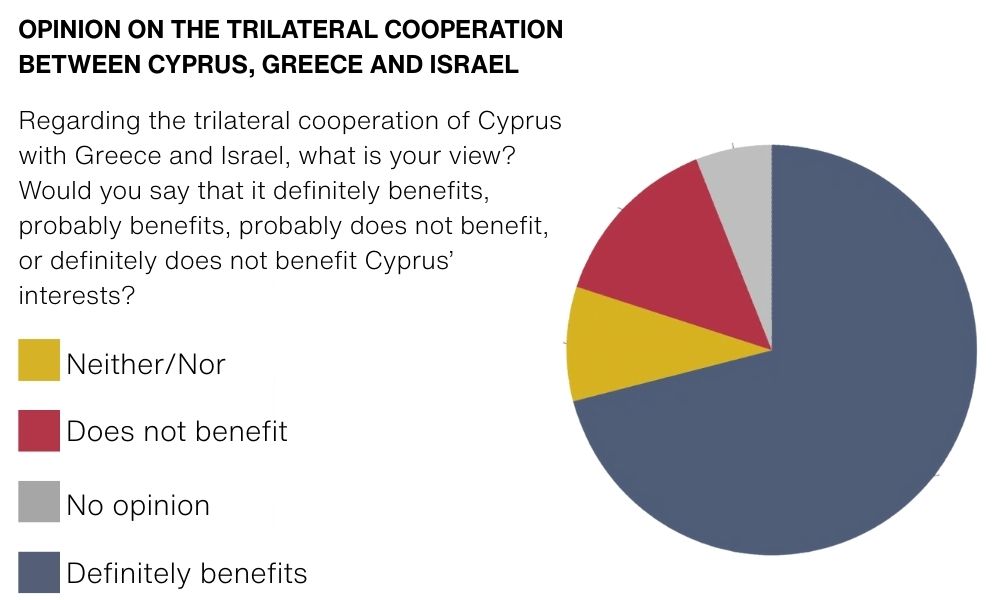
Israel’s rising popularity in Cyprus was also reflected in a question on the Cyprus-Greece-Israel trilateral cooperation, with 71% seeing it as ‘beneficial’ to Cyprus’ interests, compared to 14% who say it is ‘not beneficial’, 9% who say it ‘neither beneficial nor not beneficial’ and 6% with ‘no opinion’.
Electricity interconnector viable
Asked to comment whether the electricity interconnector project between Cyprus and Greece is viable or not, 48% replied it is viable, 32% that it’s not viable while 20% had no opinion.
Rising sentiment for NATO membership but not starry eyed
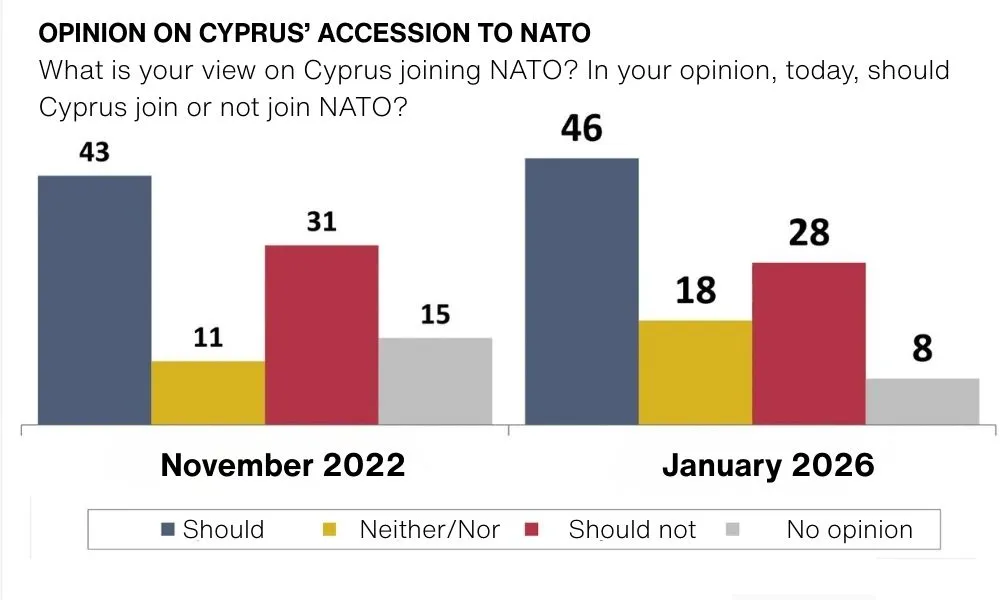
Asked to give their opinion on Cyprus joining NATO today, 46% of respondents said it should join (compared to 43% in November 2022), 28% said it shouldn’t (compared to 31% four years ago), 18% replied ‘neither yes nor no’ (11% previously) while 8% had no opinion (15% in 2022).
At the same time, Cypriots did not seem hopeful on how much Cyprus’ accession to NATO could protect Cyprus against Turkey. In total, 49% of respondents replied ‘little/not at all’ (from 42% in November 2022), 40% said ‘a lot/adequately’ (compared to 38% four years ago), and 11% had no opinion (compared to 20% previously).
Rising sentiment for EU and its institutions
Cypriots also recorded a rise in trust in EU institutions, with 34% saying they ‘tend to trust’ the European Commission (compared to 29% in April 2024), and 41% saying the same for the European Parliament (compared to 31% two years ago).
Asked whether Cyprus has benefited or not from EU membership, 73% said it has, compared to 65% in April 2024 and 58% in May 2019. In parallel, the share of those who believe Cyprus has not benefited from accession has dropped to 14% currently, from 22% in April 2024 and 23% in May 2019.
New political parties welcome
Regarding democracy and the domestic political scene, respondents were asked what they think about the establishment of new parties. The majority, 46%, said new parties strengthen democracy by offering more choices, 29% believed new parties create instability and make decision-making harder, while 17% neither one nor the other and 8% had no opinion.
Voting intentions for 2026 parliamentary elections
Asked who they will vote for in this May’s parliamentary elections, and comparing answers from January 2026 and November 2025, DISY came top with 17% (same as before), AKEL second with 16% (a small drop from 17%), ELAM 11% (from 11.5%), ALMA 9% (up from 6%), Direct Democracy 6.5% (from 4.5%), DIKO 6% (from 7.5%), EDEK 2.5% (same), Ecologists 2.5% (from 2%), VOLT 2% (from 1.5%), Animal Party 1.5% (from 1%), Democratic Alignment (DIPA) 1% (same), Hunters’ Movement 1% (from 1.5%), and Other 0.5% (same).
In the January 2026 poll, 4% said they would cast a Blank/Invalid vote, 5.5% would Abstain, 9.5% were Undecided and 4.5% would not answer.
Party voter retention
Regarding party voter retention or mobilisation, based on the party respondents voted for in the 2021 parliamentary elections, ELAM comes out on top with 86%, AKEL second with 76%, DISY 55%, DIKO 54%, EDEK 37%, Ecologists 34% and DIPA 31%.
Compared to party retention in November 2025, only ELAM and DIPA managed to mobilise supporters in the two months that followed, recording an increase in retention ratings in January 2026 of 7% and 3% respectively. The others all saw a drop, with DIKO dropping 14%, DISY, EDEK and Ecologists dropping 5% and AKEL 1%.
According to MRC Cypronetwork, the survey has a 95% confidence interval, with the standard error estimated at ± 2.9%.