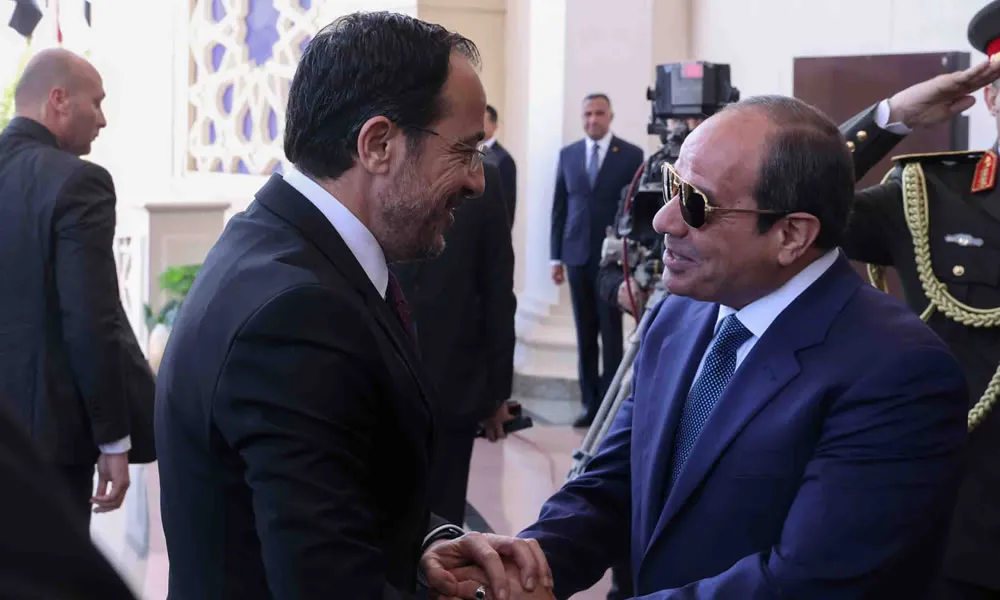

President Nikos Christodoulides and his Egyptian counterpart Abdel Fattah el-Sisi were all smiles on Monday at the launch of the three-day international energy conference and exhibition ‘EGYPES 2026’ in Cairo.
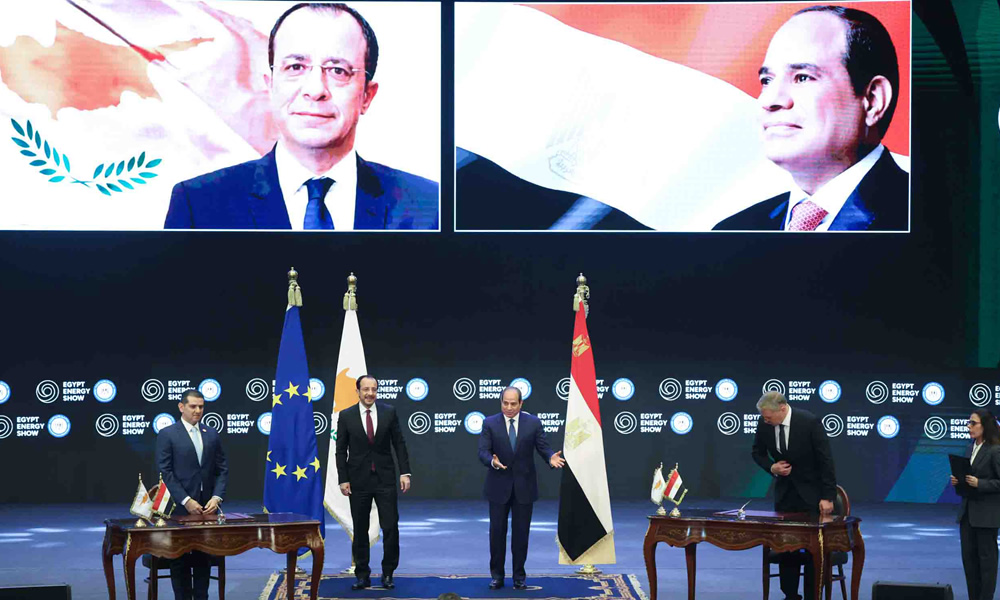
The two held a bilateral meeting before the conference and oversaw the signing of a non-binding framework agreement between the two countries on the development of deposits in Cyprus’ Exclusive Economic Zone (EEZ), including the Cronos and Aphrodite fields, signed by their respective energy ministers.
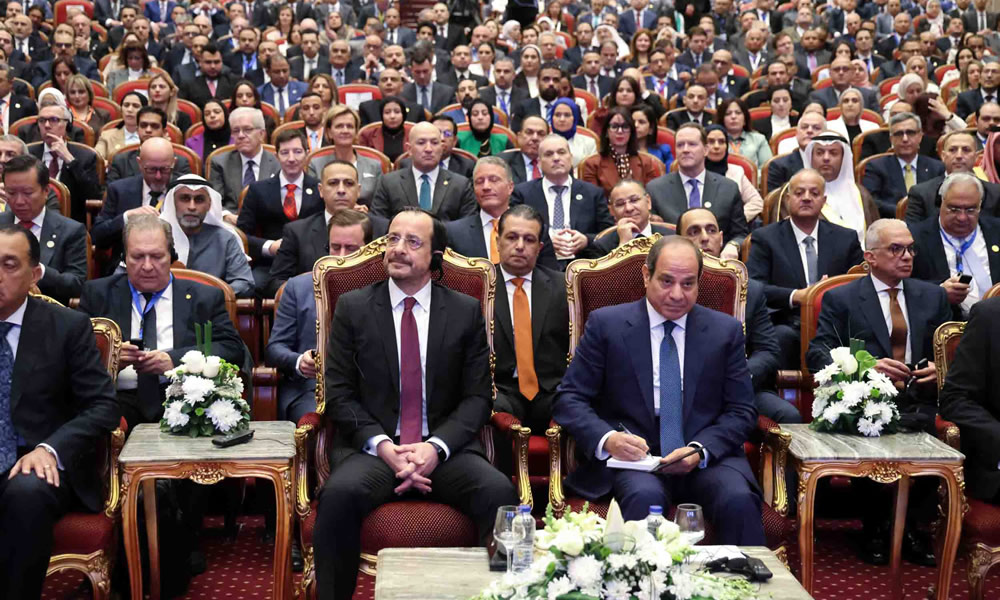
While the two leaders welcomed the agreement, industry sources argue it is much ado about nothing and will not bring the commercialisation of Cypriot gas through Egypt any closer. What many had expected to take place in Cairo was an announcement by Italian energy giant Eni on a Final Investment Decision (FID) on the exploitation of its 3.1 trillion cubic feet (tcf) Cronos gas field. Eni is the operating partner – with TotalEnergies – of the Block 6 concession in Cyprus’ EEZ, where Cronos was discovered.
Eni ‘pauses’ FID on Cronos
According to industry specialist publication MEES, the Italian energy company has pressed “pause” on plans to take the FID due to a dispute with Cyprus over contractual liabilities.
FID is the key decision that would commit the company to develop the Cronos field. It effectively tells the market that Eni has done its calculations, signed the relevant agreements and decided that the project will meet its return on investment.
Before leaving for Egypt, President Christodoulides told reporters on Sunday: “We are on the right track for the exploitation of Cypriot natural gas, with the goal of achieving the first sale to Europe through Egypt in 2027 or 2028.”
Given ongoing delays in exploiting Cyprus’ first discovery – the Chevron-operated 3.7tcf Aphrodite gas field – the President was clearly referring to monetising Cronos within that period. However, in a first quarter earnings call in 2025, Eni’s Chief Operating Officer for Global Natural Resources Guido Brusco stated that from the moment the FID is taken on Cronos, the company expects an execution time of between two and two and a half years.
An industry source told Politis that achieving first sale of Cypriot gas in 2027 is completely unrealistic now while 2028 is looking more and more tenuous.
Eni-Cyprus standoff
According to MEES, important commercial deals were signed with Egypt in 2025, paving the way for Eni to send Cronos gas to the LNG export facility at Damietta in Egypt, from which it would be exported abroad in liquified form. Eni’s development and production plan involves building a 110km pipeline from the Cronos gas field to the Eni-operated offshore Zohr facilities in Egypt’s EEZ. From there, the Cypriot gas would then be transported onshore Egypt, and to the Damietta export terminal via an additional short pipeline.
Cyprus had initially wanted to diversify gas sales between LNG exports and some sales to the Egyptian domestic market – the latter would avoid having to factor into the equation liquefaction, tolling and shipping costs, while providing more predictability on price. However, according to MEES, Eni-Total convinced Nicosia last October that the gas should go to Dameitta, with an “option” – not a commitment – for around 20% to enter the Egyptian domestic market.
Since then, the specialist publication sites several well-placed sources saying, “Cyprus has demanded that the Cronos partners shoulder any liabilities over the expected costs of the project and any liabilities related to potential failure to meet contractual gas commitments.”
In other words, Cyprus wants to ensure its share of profits from gas sales are not eaten into by any unexpected, additional production costs or commercial penalties – that is, elements not under its control, the costs of which it would normally have to share with the commercial partners before distributing profits.
MEES writes that Eni-Total, with Egypt’s backing, have so far shown no desire to shoulder this risk – and as a result, have stalled the Final Investment Decision that was expected to be announced at the Cairo conference.
Asked to comment, the President’s Press Director Victoras Papadopoulos rejected the notion of a standoff, telling Politis: “There is no dispute. There is a willingness on all sides to reach a conclusion, and they are discussing the matter to reach one."
Non-binding framework agreement
Meanwhile, in Cairo, rather than cheering the FID, Christodoulides and El-Sisi trumpeted the non-binding framework agreement signed.
Speaking at the event, Christodoulides described the agreement as “a key step towards the commercialization of our gas resources”.
The President also pointed to the current regional crisis which has shown that “energy security is not only an economic issue but also a national security, regional stability and strategic autonomy issue”.
The need to strengthen preparedness against geopolitical and energy disruptions guides Cyprus’ aim to have energy as a core pillar of the EU-Egypt partnership, he said.
According to Papadopoulos, under the framework agreement, “the two countries will negotiate – through a joint committee to be established – the sale of natural gas to Egypt or its state‑owned companies, with the aim of optimally utilising Cyprus’ hydrocarbons, including to meet Egypt’s energy needs.”
Agreement ‘nothing new’
Speaking to CNA, Energy Minister Michael Damianos said the latest agreement reaffirms Nicosia and Cairo’s political will to advance the exploitation of Cronos and Aphrodite gas through Egypt. It is mainly a political confirmation of the direction that the two countries have already chosen – that is, their strategic choice to export Cypriot natural gas to Egypt, he said.
Damianos acknowledged that the agreement is more general in nature and no different from the previous one signed. However, it explicitly refers to the two gas fields, Cronos and Aphrodite, that have been selected as the first reservoirs to be exploited through Egyptian infrastructure, he noted.
The key element of the agreement is the joint technical committee that will be created to undertake negotiations of the terms of the sale of natural gas, added the minister.
The committee will examine both commercial and technical parameters, with the aim, as noted in the official framework, of optimally utilizing Cypriot hydrocarbons and covering part of Egypt’s energy needs, said Damianos.
Ultimately, implementation depends on the companies, he said, noting, “but it seems that they are moving forward”.
During the Cairo visit, Christodoulides – along with Damianos – also met with CEO of TotalEnergies Patrick Pouyanne, a Cronos field partner.