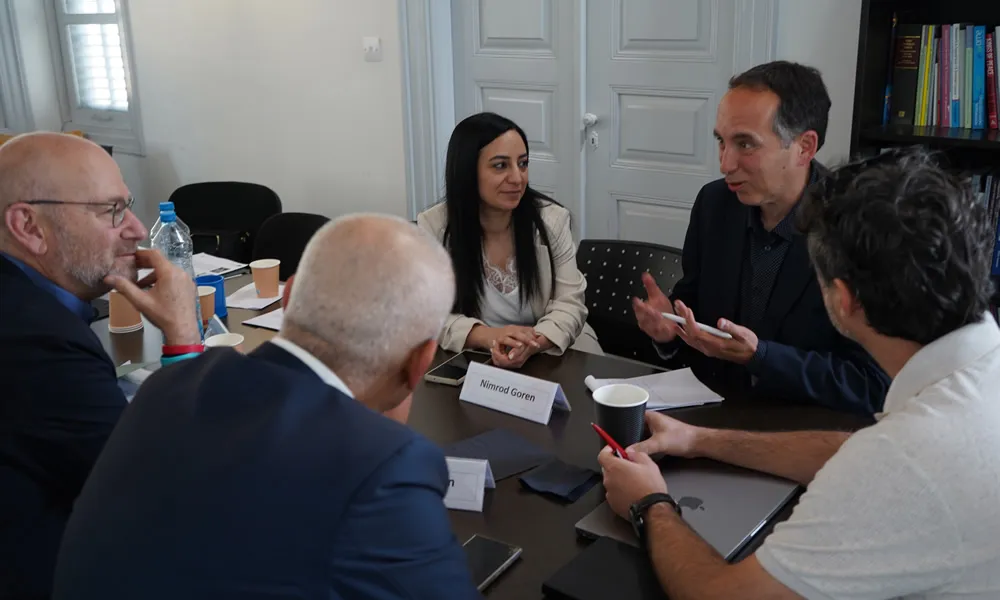

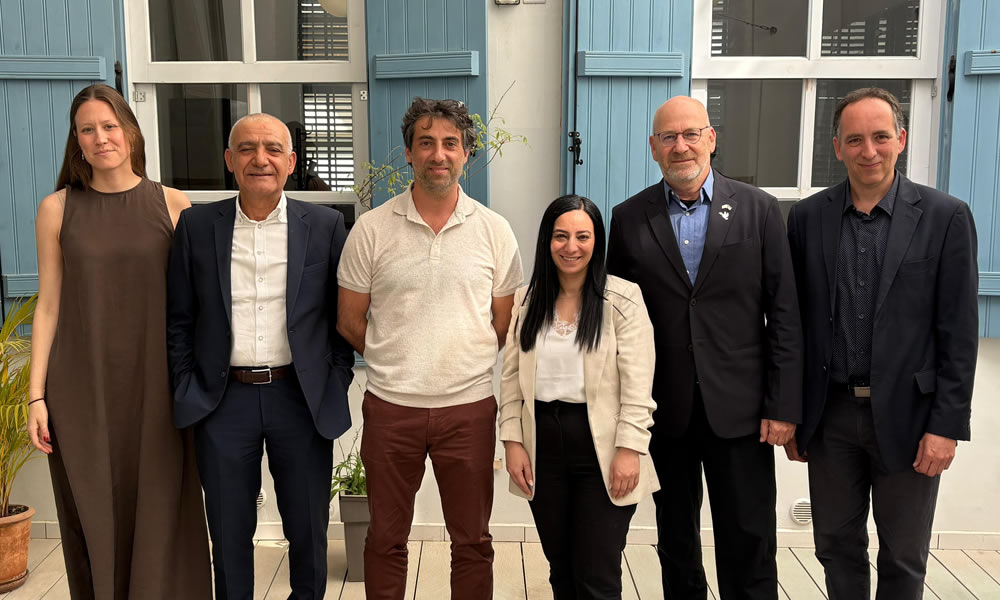
Four peacebuilders from Israel and Palestine came to Nicosia this week to advocate for Cyprus to take a more active role in pursuing a political solution to a conflict on its doorstep whose existence predates the island’s own division.
Their visit comes amid three precarious ceasefires that have left the beleaguered region on a knife’s edge. The Israeli-American war on Iran is currently on hold, as is the Israeli incursion into Lebanon while the embers of war in Gaza smoulder out of sight. The three conflicts intertwine in various ways, while their impact is felt acutely in the region and beyond. At the core, sits the Israeli-Palestinian dispute.
While Donald Trump’s Board of Peace prevaricates on the Gaza peace plan, the question is asked: what can the EU – as Palestine’s largest donor and Israel’s biggest trading partner – do to proactively focus minds on a two-state solution?
To learn more on the issue, Politis interviewed the four peacebuilders, visiting Cyprus as part of the European-Palestinian-Israeli Trilateral Dialogue initiative EPICON, co-hosted by PRIO Cyprus Centre and the Berlin-based Candid Foundation.
‘It’s not over yet’
Nadav Tamir is the executive director of J Street Israel and a former Israeli diplomat. He left the Foreign Ministry when he understood that “to be a diplomat for my government is actually going against the interest of my country. I prefer to use my diplomatic skills to help my country.”
He argues that peace is still possible for Israelis and Palestinians. “It’s not over yet.”
Whereas before, Tamir focused on the moral argument to end the occupation, after the October 7 attack, he speaks more about security and the need to join forces with the Palestinians and other Arabs in the region to get rid of the jihadists, and achieve real security, not through war, but through peace.
There is a rare opportunity to build peace in the region, with Lebanon, Syria, the Gulf states, but without including Palestinians in the equation, it will not be sustainable, he argued.
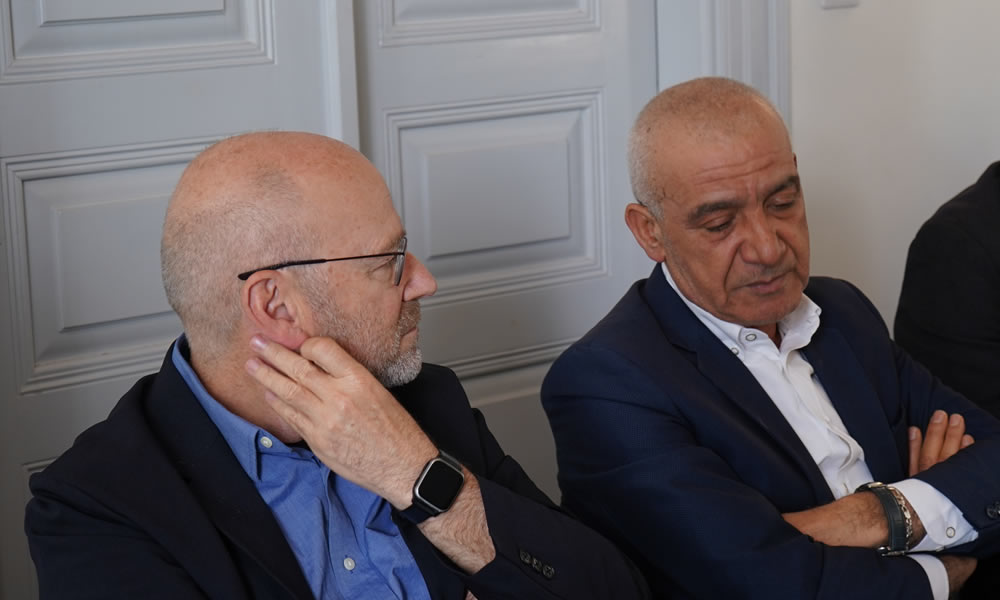
He accused Israeli leader Benjamin Netanyahu of bypassing the Palestinians with the Abraham Accords. But his policies only empowered the extremists instead of the moderates, while keeping the conflict on the boil.
Tamir’s hope is that Cyprus, which understands the meaning of occupation, and despite its close relations with the Netanyahu government, is more proactive in helping to bring about a political solution.
It can also help in Brussels where the default position is, “When the Israelis and Palestinians are ready, we will come to help them.”
According to Tamir, “This paradigm has failed because the politics in Israel and Palestine are so counterproductive right now.” With the wars in the region having multiple spillover effects, the time has come for the world to be much more proactive, he said. It cannot force a two-state solution, but it can help bring the sides to a much better place, he argued.
“My message to the world is ‘don't wait for us’. If your interest is that the Middle East will be more stable, that there will be less radicalization between Muslims and Jews in your countries, you have to act. You can't wait."
Giving up is not an option
On the challenges of working together under worsening circumstances, Rana Salman, executive director of Combatants for Peace, said: “We don't have the privilege to lose hope. We actually live there. It's our daily life, 24 hours, and we just need to continue working to change that reality.”
By joining forces, Israeli and Palestinian peacebuilders show that it’s not about choosing sides. It’s about being pro-solution for the sake of both peoples, she said.
Salman noted that Palestinians and Israelis are mostly portrayed as enemies, but the real picture is that they can also be partners and allies.
“We're on the same page, advocating for a political solution. And we know it is possible,” she said.
The four seek to put pressure on key power centres to change policies that affect their lives.
“Because decisions made in Washington and the EU actually play a role in my life back in the West Bank,” said Salman.
The EU could stop selling weapons to Israel, “because that actually supports the war machine” and impose sanctions on violent Israeli settlers in the West Bank who act with impunity, she argued.
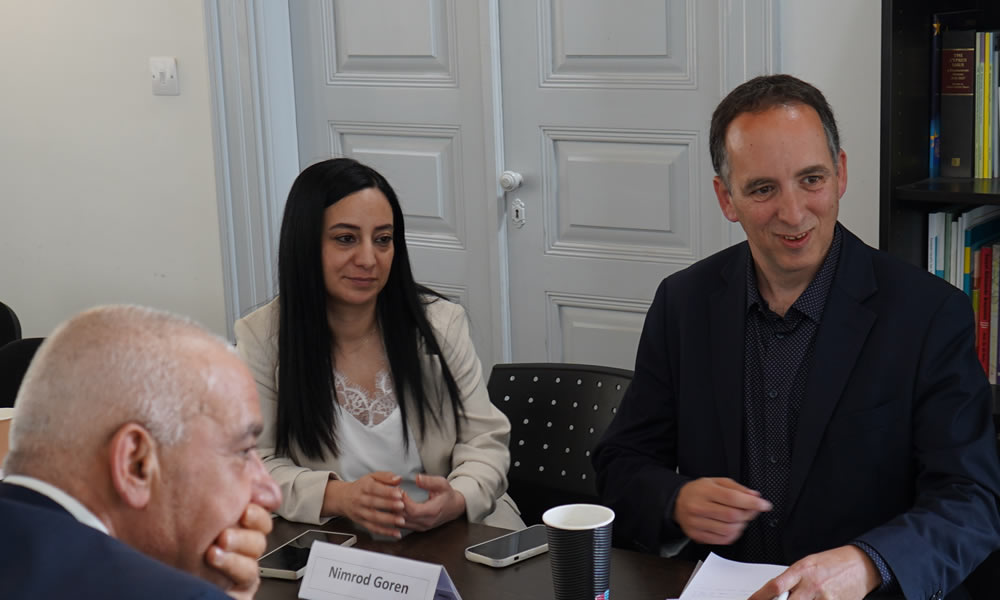
Efforts are also needed for the two sides to “rehumanise” each other. Salman said Israelis could learn what occupation really looks like and what the Nakba (Catastrophe) means for Palestinians.
“To acknowledge my narrative doesn't mean that I cancel your narrative. There is space for both.”
Younger generations don’t know each other
Dr Nimrod Goren, co-founder of Diplomeds, acknowledges that change must come from within and that no foreign country can impose a solution. But it can play a role – and the question is whether that role is positive or destructive.
Goren notes that peace activists have been interacting for years in the region but that there is a danger this will no longer happen for younger generations.
“The opportunity I had as a student to meet Palestinians wherever I wanted, in whatever European capital was hosting a dialogue meeting, it's not happening anymore.
“It means young Israelis are growing up without chances to meet Palestinians, without Palestinian friends, without understanding Palestinian needs and interests, and when they go into positions of power, they don't have someone to call on the other side. And that's why making a comeback for civil society engagement is a real priority […] and that's why Cyprus is especially important for us,” he said.
Opportunity for Cyprus
Goren argued Cyprus understands conflict, and given its proximity, can become a hub for Israeli-Palestinian meetings.
More groups come to Cyprus now after it became harder to go to Northern Ireland. “It's very sensitive now to engage with Israelis even if they come with Palestinians for a two-state solution,” he said.
The groups that visited Cyprus came back very excited. “They never anticipated so many similarities and issues of interest to be emerging from these conversations,” he said.
‘You must speak to your enemy’
Omar Shaban is the founder and director of the Gaza-based Pal-Think for Strategic Studies. Growing up in a refugee camp in Gaza with 12 members of his family, Shaban said the occupation became apparent very early on his life – restrictions on freedom and travel, Israeli soldiers searching homes, patrolling the streets.
“I love Gaza. I never thought to leave it.” Wanting a better future for his children, Shaban sought to end the occupation through a peaceful struggle.
“And we cannot do it without talking to our enemy. You need to speak to those who disagree with you.”
Engaging with Israeli politicians, even hardliners, convinced him he had to provide a counterpoint to the view that Gaza is only Hamas and that “all Gazans are terrorists”.
“Radicals love radicals because they don’t need to make any compromise,” he said.
Shaban argues, on the contrary, Israelis have real partners to make peace with, and if they do, they will find it very economically beneficial for all sides.
“It’s not all about talking to each other, it’s about how we can turn good relations into a common interest.”
There are multiple possibilities for a better future for both Israelis and Palestinians, he argued.
Practicalities of support
Shaban noted Cyprus may be small with limited resources, but it still has a role to play. Cyprus enjoys a good image as a neutral country in the Mediterranean. It can help “prepare the ground” through engagement in Track 2 diplomacy, he said.
Salman noted that Cyprus has played a role in recent years of being a “safe harbour” for young Israelis and Palestinians to meet.
Goren added that the country can play to its strength and institutionalise this role, making it a priority.
“Why shouldn't Cyprus say this is our claim to fame, we can be a hub for Israeli-Palestinian civil society or professional engagement?” he asked.
With EU support and funding, Cyprus could make it easier for Israeli and Palestinian groups to come here, scaling up the number of visits exponentially. It could utilise existing infrastructure like the Home for Cooperation in the buffer zone, and its experience in intercommunal work.
Cyprus could also ensure that “there is a Palestinian component in every regional cooperation initiative that it advances with Israel, such as on civilian protection or climate change,” said Goren.
“And don't be the substitute to (Victor) Orban and veto in Brussels,” he added.
Tamir noted: “Small countries can play a big role if they find their niche and their added value.”
Goren pointed out one limitation however: “Cyprus has a zero-sum mentality on its own conflict.”
To upgrade its role in mediation, Cyprus needs to be seen as more than just a space to meet, but as “a country that managed to make strides on its own and resolve its conflict”.