
The Vienna Talks
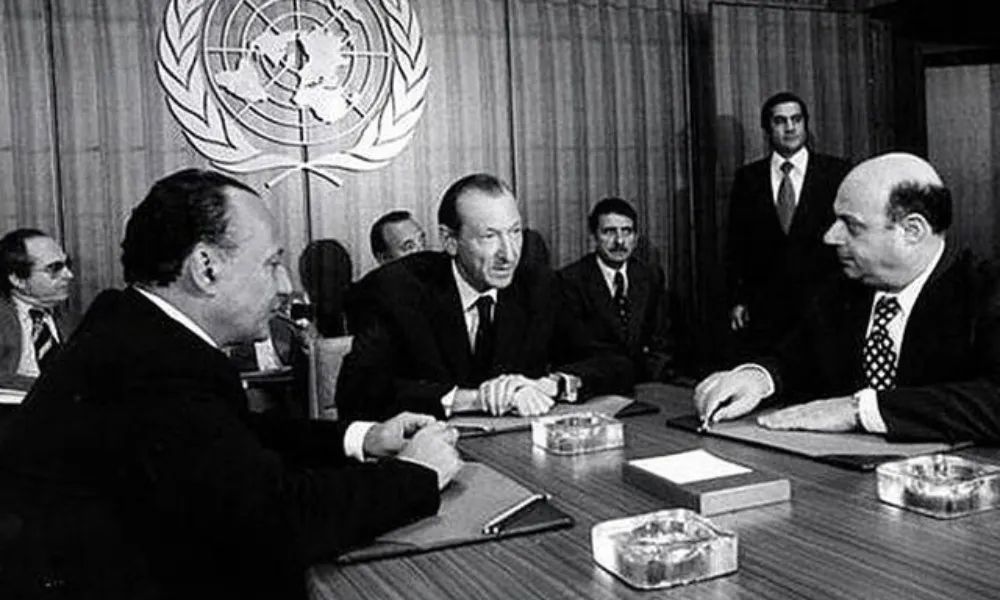
The term “Vienna Talks” refers to four rounds of negotiations on the Cyprus issue held in the Austrian capital between 1975 and 1976. These were the first substantial diplomatic efforts following the Turkish invasion of Cyprus.
Convened by Kurt Waldheim after extensive consultations, the talks were conducted under his leadership. The Greek Cypriot side was represented by Glafcos Clerides, then President of the House of Representatives, while the Turkish Cypriot side was represented by Rauf Denktaş.
Constitutional Committee
The first round began on 28 April 1975 and concluded on 3 May 1975. It resulted in the establishment of a constitutional committee of experts to examine the powers and functions of a central government. The committee began its work in Nicosia on 12 May 1975.
The second round, held on 5–7 June 1975, ended without substantive results.
The third round, from 31 July to 2 August 1975, produced agreements on humanitarian issues affecting Greek Cypriots in the north and Turkish Cypriots in the south. It was also agreed that talks would continue in New York.
The Third Vienna Agreement
This agreement, of notable political and humanitarian importance, became known as the Third Vienna Agreement (UN document S/11789). It included:
- Turkish Cypriots residing in the south would be allowed, if they wished, to move to the north with their belongings under an organised programme with UN assistance.
- Greek Cypriots in the north would be free to remain and would receive support for normal living conditions, including education, religion, medical care and freedom of movement.
- Greek Cypriots wishing to move to the south could do so without pressure.
- The UN Peacekeeping Force would have free access to Greek Cypriot villages in the north.
- Priority would be given to family reunification, which could involve population transfers.
New York Talks
A further meeting took place in New York on 8–9 September 1975, ahead of the UN General Assembly. A Turkish proposal for a Cyprus settlement was rejected by the Greek Cypriot side, while a plan submitted by Kurt Waldheim was rejected by Rauf Denktaş before being examined by the Greek Cypriots.
The talks yielded no results. This was followed by further consultations, involvement of US officials, Greece–Turkey discussions in Brussels, and renewed appeals by Cyprus to the United Nations.
From Clerides To Papadopoulos
The fourth Vienna round began on 17 February 1976 and ended four days later, with agreement to exchange written proposals. A procedural arrangement between Glafcos Clerides and Rauf Denktaş—requiring the Greek Cypriot side to submit proposals first—sparked political controversy in Cyprus and led to Clerides’ resignation.
Subsequent talks resumed in Vienna on 31 March 1977, with Tassos Papadopoulos representing the Greek Cypriot side. The process was supported by Clark Clifford, special envoy of US President Jimmy Carter.
Both sides submitted proposals—territorial from the Greek Cypriots and constitutional from the Turkish Cypriots—but the talks ended on 7 April without agreement.
The Emergence Of Bizonality
On 31 March 1977, Tassos Papadopoulos presented a map proposing a bizonal framework for Cyprus. The proposal was prepared with Stella Soulioti and Michalakis Triantafyllides, with input from Glafcos Clerides.
Papadopoulos later stated that he submitted the proposal to the UN not merely as a representative, but as chairman of the drafting committee, with the final text approved by Makarios III.
The decision to prepare a bizonal map had been taken by the National Council on 17 February 1977, with Vassos Lyssarides as the sole dissenting voice.
According to declassified British documents, Makarios III had already, informally, accepted a bizonal, bicommunal federation as early as 1975–1976, including territorial concessions of up to 25%, though without formal written commitment.
The Vienna Talks form part of the long and complex negotiation history of the Cyprus issue—an evolving process marked by shifting frameworks, recurring deadlocks, and an unresolved outcome that continues to shape the island’s political landscape.
Timeline
April 1975
First round of talks under Kurt Waldheim, then Secretary-General of the United Nations.
May 1975
Launch of a constitutional committee of experts on the powers of a central government.
June 1975
Second round of talks. Ended inconclusively.
July 1975
Third Vienna round. Agreement on humanitarian issues.
September 1975
Talks in New York. Rejection of a UN-proposed settlement plan.
February 1976
Resignation of Glafcos Clerides as representative of the Greek Cypriot side. Tassos Papadopoulos assumes the role.
March 1977
Vienna talks reach a deadlock.