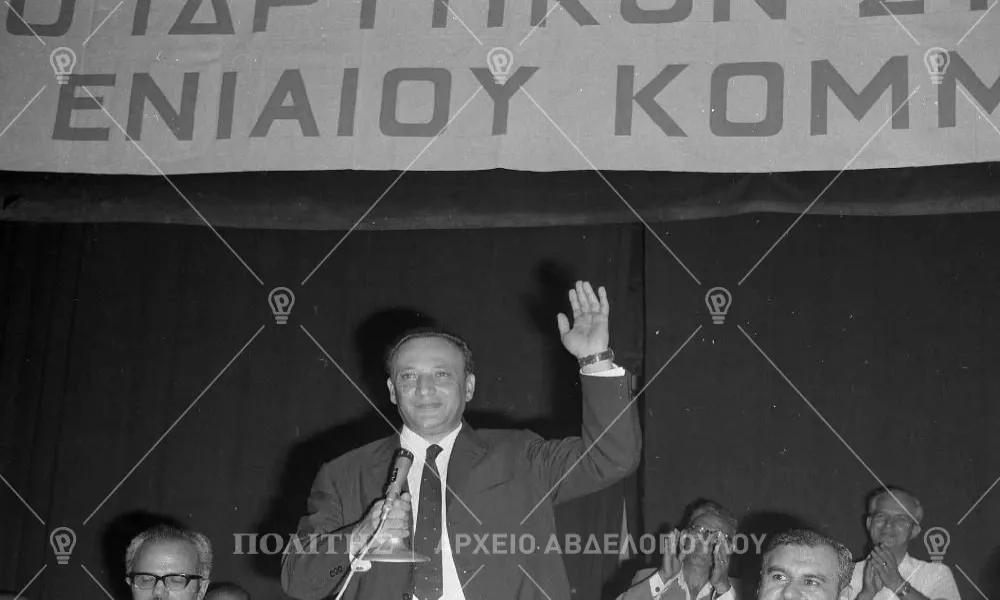

Few political figures in modern Cypriot history shaped the course of the Republic as profoundly as Glafkos Clerides. A lawyer, statesman, negotiator and wartime veteran, Clerides stood at the centre of Cyprus’ most decisive moments for more than four decades, from the final years of British colonial rule to the post-invasion era and the country’s path toward the European Union.
Admired by supporters as a pragmatic realist and criticised by opponents for the compromises he was willing to consider, Clerides remained one of the most influential and controversial personalities in Cyprus until his death in 2013. His political life mirrored the history of the Republic itself: conflict, division, diplomacy, survival and transformation.
Early life and wartime experience
Glafkos Clerides was born in Nicosia on 24 April 1919, although his family originated from the village of Agros. He was the son of politician Ioannis Clerides, a prominent public figure during the late colonial period.
He attended the Pancyprian Gymnasium before leaving for England in 1936 to pursue higher education. His studies were interrupted by the outbreak of the Second World War, an experience that would profoundly shape both his worldview and political temperament.
In 1939, Clerides enlisted in the Royal Air Force and served as a bomber pilot in missions over Germany. On 24 July 1942, during a mission above Hamburg, his aircraft was shot down. Initially reported dead, Clerides survived but was captured by German forces and remained a prisoner of war until 1945.
During his captivity, he attempted to escape three times. The experience left a lasting mark on him and contributed to the disciplined, restrained and often stoic character that later defined his political style. For his wartime service, he received decorations for distinguished conduct against enemy forces.
Legal studies and return to Cyprus
After the war, Clerides resumed his legal studies in Britain. He studied law at Gray's Inn before continuing at King's College London, where he obtained an LLB degree in 1948.
He returned to Cyprus in 1951 and began practising law in Nicosia. His legal career quickly became intertwined with the anti-colonial struggle that erupted only a few years later.
The EOKA years
During the armed liberation struggle of EOKA between 1955 and 1959, Clerides became actively involved in the movement. While not operating as a guerrilla fighter, he played a significant role through legal defence work and organisational responsibilities.
One of the most emotionally charged trials in which he participated was the defence of EOKA fighter Michalakos Karaolis, who was ultimately sentenced to death and executed by the British colonial authorities. The prosecutor in the case was future Turkish Cypriot leader Rauf Denktash, marking the beginning of a political relationship that would continue for decades across negotiating tables.
During the struggle, EOKA leader George Grivas appointed Clerides responsible for organising civil defence in Nicosia. Within the organisation he operated under the codename “Hyperides”.
The birth of the Republic
Following the Zurich and London agreements between Greece, Turkey and Britain, Cyprus moved toward independence in 1960. Archbishop Makarios III invited a broad advisory delegation to London during the final negotiations. Clerides was among those who supported the agreements that led to the establishment of the Republic of Cyprus.
During the transitional period before independence, Makarios formed his first government and appointed Clerides Minister of Justice in April 1959. At the same time, Clerides headed the Greek Cypriot delegation to the Mixed Constitutional Committee responsible for drafting the Constitution of the Republic of Cyprus, one of the most complicated constitutional arrangements in modern Europe.
Shortly before independence, parliamentary elections were held on 31 July 1960. Clerides resigned from the Ministry of Justice and contested the elections as head of the right-wing Patriotic Front coalition, which included many former EOKA fighters.
He was elected MP for Nicosia and shortly afterwards became the first President of the House of Representatives on 15 August 1960.
Between Makarios and his own father
The presidential election that preceded independence produced one of the most personal and politically sensitive episodes of Clerides’ early career.
The contest pitted Archbishop Makarios against Clerides’ own father, Ioannis Clerides. Despite the family connection, Glafkos Clerides actively campaigned for Makarios, arguing that the national interest outweighed personal loyalty.
When criticised for opposing his father politically, he reportedly responded with a classical phrase asserting that the homeland stands above both father and mother.
Makarios won the presidency and over the following years developed a close political relationship with Clerides. Under the Constitution, the President of the House of Representatives acted as interim head of state whenever the president was abroad, meaning Clerides frequently exercised presidential responsibilities during Makarios’ absences.
The intercommunal crisis
The collapse of constitutional order in December 1963 and the outbreak of intercommunal violence transformed Cyprus permanently. Clerides assumed increasingly important diplomatic responsibilities during one of the Republic’s most dangerous periods.
In January 1964, he led the Greek Cypriot delegation at the London Conference convened to address the Cyprus crisis. Later that year he also participated in discussions at the United Nations Security Council in New York City as adviser to the Cypriot foreign minister.
Over the following years he represented Cyprus in numerous international forums and undertook diplomatic missions abroad aimed at explaining the Cyprus issue to foreign governments and institutions.
Negotiating with Denktash
In 1968, under the initiative of UN Secretary-General U Thant, intercommunal talks resumed between the Greek Cypriot and Turkish Cypriot sides.
Clerides was appointed chief negotiator for the Greek Cypriot side, while Rauf Denktash represented the Turkish Cypriots. The two men, despite deep political disagreements, developed a relationship characterised by mutual familiarity and long-term engagement.
The negotiations gradually progressed and by the early 1970s several issues appeared close to agreement. However, developments inside both Cyprus and Greece destabilised the political environment.
Internal divisions and political turbulence
The late 1960s and early 1970s were marked by severe political tensions among Greek Cypriots, fuelled in part by the policies of the military dictatorship in Greece.
Clerides became one of the targets of the far-right underground organisation National Front. At the same time, he found himself politically connected to the controversial figure of Polycarpos Georkadjis, his political ally and co-founder of the Unified Party.
The period was also overshadowed by the so-called Georkadjis crisis, linked to an assassination attempt against Greek dictator Georgios Papadopoulos involving Greek resistance figure Alekos Panagoulis.
Clerides attempted to mediate the resulting tensions between Cyprus and the Greek junta, but relations deteriorated further.
The 1974 coup and Turkish invasion
The most defining chapter of Clerides’ political life came in July 1974.
Following years of escalating confrontation between supporters and opponents of Makarios, the military junta in Athens orchestrated a coup against the Cypriot president on 15 July 1974. Five days later, Turkey launched a military invasion of Cyprus.
After the collapse of the coup regime and the resignation of coup-installed leader Nikos Sampson, Clerides assumed the leadership of the Republic at one of the darkest moments in Cypriot history.
Critics later accused him of procedural and political irregularities during this transitional period, including the manner in which he assumed office while Makarios remained alive in exile. Clerides defended his actions by arguing that the Republic faced imminent collapse and required immediate institutional continuity.
Geneva and the collapse of negotiations
Following the initial ceasefire, Clerides participated in the Geneva negotiations aimed at preventing further escalation. The talks ultimately failed amid Turkish demands that the Greek Cypriot side considered unacceptable.
On 14 August 1974, Turkey launched the second phase of the invasion, resulting in the occupation of approximately 37 per cent of Cypriot territory.
The invasion produced one of the greatest humanitarian crises in the island’s history: mass displacement, missing persons, prisoners of war and divided communities.
Clerides remained acting President until Makarios returned to Cyprus on 7 December 1974. He then resumed his positions as President of the House of Representatives and chief Greek Cypriot negotiator in intercommunal talks.
Resignation and the birth of DISY
The post-invasion negotiations generated growing criticism against Clerides from political opponents who accused him of excessive concessions during talks, particularly after the Vienna negotiations of 1976.
Amid mounting pressure, he resigned both as negotiator and as President of the House.
The political turbulence also led to the dissolution of the Unified Party. On 11 July 1976, Clerides founded the Democratic Rally, widely known as DISY, which would become one of the dominant political parties in Cyprus.
Although the party initially suffered from the electoral system and failed to win parliamentary seats in 1976 despite a strong vote share, it rapidly evolved into the island’s principal centre-right political force.
Electoral defeats and political endurance
Throughout the 1980s, Clerides repeatedly sought the presidency but initially failed to secure victory.
In the 1983 presidential election he lost to Spyros Kyprianou, who was backed by the Left.
In 1988, Clerides again reached the second round but narrowly lost to George Vassiliou.
Despite these defeats, DISY continued growing electorally and emerged as Cyprus’ strongest political party by the mid-1980s.
Author, witness and political chronicler
Between 1988 and 1990, Clerides published his major memoir series, My Deposition, in three volumes. The work offered an extensive personal account of the Cyprus issue and the island’s political history over four turbulent decades.
In later years he also published Documents of an Era, 1993–2003, focusing on his presidency, while his long conversations with Turkish Cypriot academic Niyazi Kizilyurek were published in Glafkos Clerides: The Course of a Country.
These works reinforced his image as both participant and chronicler of modern Cypriot history.
Presidency and European direction
In February 1993, after decades in opposition, Clerides was elected President of the Republic of Cyprus.
Initially trailing incumbent George Vassiliou in the first round, Clerides secured victory in the runoff with the backing of the Democratic Party.
His presidency focused on two central strategic objectives: Cyprus’ accession to the European Union and the strengthening of Cyprus’ defence doctrine through cooperation with Greece under the Joint Defence Doctrine.
During his presidency, accession negotiations with the European Union accelerated significantly, laying the foundations for Cyprus’ eventual EU membership in 2004, shortly after his departure from office.
Relations with Denktash and the Annan Plan era
Clerides continued pursuing negotiations over the Cyprus issue under UN auspices and held numerous meetings with Rauf Denktash during the 1990s.
Most talks failed to produce breakthroughs due to fundamental disagreements between the two sides. Nevertheless, Clerides remained committed to a negotiated settlement.
His second presidential term, beginning in 1998, became dominated by diplomatic efforts surrounding the UN-backed Annan Plan proposed by Secretary-General Kofi Annan.
Believing decisive developments were approaching, Clerides sought re-election again in 2003, requesting what he described as a limited renewal of his mandate in order to conclude the negotiations process.
He was defeated by Tassos Papadopoulos in the first round.
Legacy and final years
Glafkos Clerides died on 15 November 2013 at the age of 94.
By the time of his death, he had become one of the last surviving central figures of the generation that experienced colonial rule, the EOKA struggle, independence, intercommunal conflict, the 1974 catastrophe and Cyprus’ European transition.
Supporters remembered him as a pragmatic statesman willing to confront political realities rather than ideological absolutes. Critics argued that his approach involved excessive compromise on national issues. Yet few disputed the scale of his influence on modern Cyprus.
Over the course of his career he received numerous honours and distinctions, including the Grand Cross of the Order of the Redeemer of the Hellenic Republic and distinctions associated with the Vatican.
The international airport of Larnaca was later named in his honour, further cementing his place in the political memory of Cyprus.
Sources: Great Cypriot Encyclopedia, Polignosi.