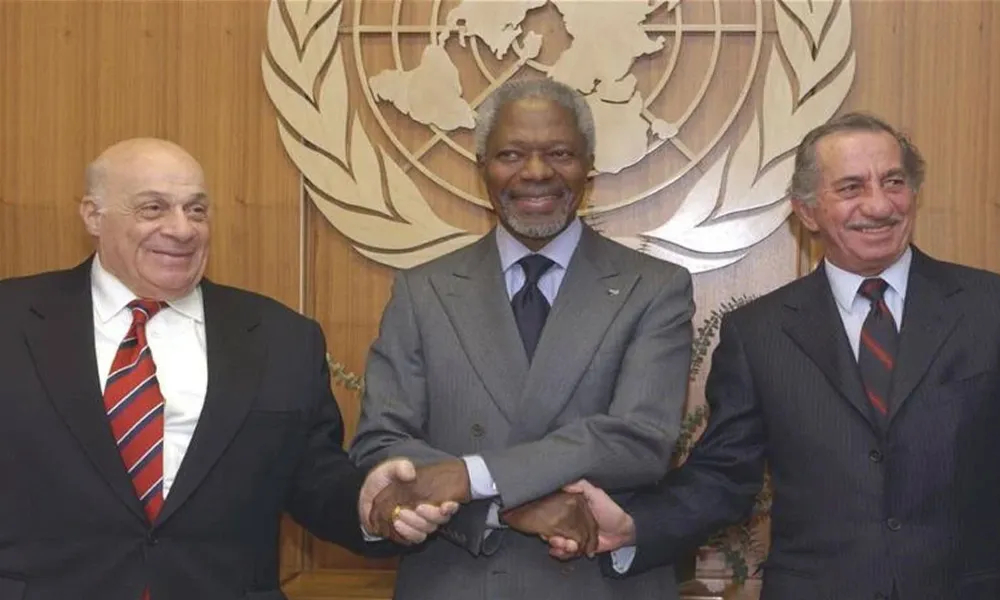
Few political figures in the history of the Republic of Cyprus left as deep and divisive an imprint as Tassos Papadopoulos. Lawyer, EOKA member, minister, negotiator and eventually the fifth President of the Republic, Papadopoulos stood at the centre of nearly every major political turning point in modern Cyprus.
For supporters, he was a determined defender of the Republic and one of the architects of Cyprus’ European course. For critics, he embodied a rigid and confrontational political approach that deepened divisions at crucial historical moments. Yet even his opponents acknowledged his intelligence, political instincts and extraordinary influence over public life for more than five decades.
His political career stretched from the final years of British colonial rule to Cyprus’ accession to the European Union and the turbulent years surrounding the Annan Plan referendum.
Early life and family background
Tassos Papadopoulos was born in Nicosia on 7 January 1934. He was the eldest of three children born to Nikolaos Papadopoulos, a schoolteacher, and Angeliki Papadopoulou, a homemaker.
In 1972 he married Fotini Papadopoulou, with whom he had two children, Nicolas and Anastasia.
Papadopoulos grew up during a period when Cyprus remained under British colonial administration and nationalist politics increasingly shaped public life. Like many of his generation, his political identity was deeply influenced by the anti-colonial movement that emerged in the 1950s.
Studies in London and the creation of EFEC
After graduating from the Pancyprian Gymnasium, Papadopoulos travelled to Britain to study law at King's College London and later at Gray's Inn.
His years in London proved politically formative. He shared accommodation with several future leading political figures of Cyprus, including Spyros Kyprianou, Lellos Demetriades, Dimitris Liveras and Andreas Mavrommatis.
Together, the five students founded the National Federation of Cypriot Students, known as EFEC. Kyprianou served as president, Papadopoulos as secretary and Demetriades as treasurer. The organisation became an important voice among Cypriot students abroad during the final years before the EOKA struggle.
Return to Cyprus and involvement in EOKA
Papadopoulos returned to Cyprus on 20 March 1955, only ten days before the beginning of the armed struggle of EOKA against British colonial rule.
While establishing his legal career in Nicosia, he simultaneously became deeply involved in the liberation movement. He founded his own law office, which later developed into one of the largest and most influential legal firms in Cyprus.
Within EOKA, Papadopoulos held a significant operational role. He served as Nicosia sector leader and was responsible for PEKA, the political organisation linked to EOKA’s underground network.
In 1959, Archbishop Makarios III invited Papadopoulos to London as part of the advisory delegation present during discussions surrounding the Zurich and London agreements that established the framework for Cypriot independence.
Papadopoulos was among the very few delegates who openly opposed the agreements and rejected their acceptance. His opposition to the constitutional arrangements of 1960 would later become one of the defining characteristics of his political worldview.
Minister at the age of 25
Despite his reservations regarding the agreements, Papadopoulos was appointed Minister of the Interior by Makarios in the transitional government formed in April 1959.
At the same time, between 1959 and 1960, he served on the constitutional committee responsible for drafting the Constitution of the Republic of Cyprus.
Immediately after independence, Makarios appointed the 25-year-old Papadopoulos Minister of Labour and Social Insurance, making him one of the youngest ministers in the history of the Republic.
In that role, he represented Cyprus at numerous international conferences and helped establish some of the Republic’s earliest institutional structures.
One of his most significant domestic reforms came in November 1964, when he introduced and implemented Cyprus’ first comprehensive social insurance system.
Multiple ministries during the intercommunal crisis
The intercommunal violence that erupted in December 1963 dramatically altered the structure of the Cypriot state. Following the withdrawal of Turkish Cypriots from government institutions, Papadopoulos assumed additional ministerial responsibilities.
Alongside the Labour Ministry, he temporarily served as Minister of Agriculture and Natural Resources between 1964 and 1966, replacing Turkish Cypriot minister Fazil Plumer. He later also served as Minister of Health.
In January 1964, amid escalating tensions on the island, Papadopoulos participated in the London Conference on the political future of Cyprus.
Throughout the 1960s he remained one of Makarios’ closest political allies and advisers during a period marked by instability, diplomatic pressure and repeated crises.
The post-invasion years and negotiations
Following the Turkish invasion of Cyprus in 1974, Papadopoulos entered a new phase of political influence.
He served as adviser to Glafkos Clerides during the intercommunal negotiations and later replaced him after Clerides resigned from the negotiating role in April 1976.
That same year, Papadopoulos briefly served as President of the House of Representatives.
The post-invasion negotiations and political realignments of the 1970s transformed the Cypriot political landscape, and Papadopoulos gradually emerged as one of the central figures of the political centre.
Parliamentary career and the Centre Union
Papadopoulos was first elected to parliament in 1970 under the banner of the Unified Party.
In the parliamentary elections of September 1976, he contested as an independent candidate and was elected to the House of Representatives once again.
Ahead of the 1981 elections, he founded his own political party, the Centre Union. The party failed to secure parliamentary representation, obtaining only 2.7 per cent of the vote under the proportional electoral system.
By the late 1980s, however, Cyprus’ political centre underwent consolidation. In 1989, Papadopoulos’ Centre Union merged with the Democratic Party led by Spyros Kyprianou.
Under DIKO, Papadopoulos was elected MP in 1991 and re-elected in 1996.
Following Kyprianou’s withdrawal from politics, Papadopoulos was elected unopposed as leader of DIKO in October 2000, placing him at the head of the third-largest political party in Cyprus.
Rise to the presidency
On 16 February 2003, Tassos Papadopoulos was elected President of the Republic of Cyprus from the first round of voting.
His victory ended the ten-year presidency of Glafkos Clerides and reflected a broad coalition of political forces. His candidacy was supported by DIKO, Progressive Party of Working People (AKEL), Movement for Social Democracy (EDEK) and the Ecologists and Environmentalists Movement.
Before assuming the presidency, Papadopoulos had chaired the parliamentary Committee on European Affairs, which worked extensively on harmonising Cypriot legislation with European law ahead of EU accession.
Cyprus and the European Union
One of the most consequential chapters of Papadopoulos’ presidency was Cyprus’ accession to the European Union.
Although accession negotiations had accelerated under Clerides, Papadopoulos became the president who formally signed and oversaw Cyprus’ entry into the EU.
On 16 April 2003 in Athens, he signed the Treaty of Accession following the Copenhagen Summit decision of December 2002.
On 1 May 2004, Papadopoulos represented Cyprus at the official enlargement ceremony in Dublin marking Cyprus’ entry into the European Union alongside nine other states.
During his presidency, Cyprus also withdrew from the Non-Aligned Movement and pursued integration into the European Monetary Union.
These efforts culminated in Cyprus adopting the euro as its national currency on 1 January 2008.
The Annan Plan and the defining ‘No’
The defining political moment of Papadopoulos’ presidency came with the referendum on the Annan Plan in 2004.
The UN-sponsored proposal, named after Secretary-General Kofi Annan, sought to reunify Cyprus before the island’s accession to the European Union.
Papadopoulos ultimately rejected the plan and delivered one of the most consequential speeches in modern Cypriot political history on 7 April 2004.
In an emotional televised address, he called on Greek Cypriots to reject the proposal with what he described as a “resounding no”.
The referendum held on 24 April 2004 resulted in overwhelming rejection by Greek Cypriots, while Turkish Cypriots voted in favour.
Internationally, the outcome produced serious diplomatic consequences for the Greek Cypriot side. Many foreign governments and international observers blamed the Greek Cypriot leadership for the collapse of reunification efforts.
The rejection also allowed Turkey to begin accession negotiations with the European Union later that same year, after signing the Ankara Protocol relating to Cyprus-related obligations, although implementation of the protocol never fully materialised.
Repairing Cyprus’ international image
Following the referendum, Papadopoulos focused heavily on countering the international criticism directed at the Greek Cypriot side.
His administration argued that the Annan Plan contained major security, governance and functionality concerns that could not guarantee the long-term viability of the Republic.
Despite the political fallout surrounding the referendum, Cyprus’ EU accession proceeded normally, and Papadopoulos became permanently associated with one of the most transformative periods in the Republic’s international standing.
However, during the remainder of his presidency, substantial progress on the Cyprus issue remained limited despite continued diplomatic contacts and initiatives.
Defeat in 2008
Papadopoulos sought re-election in February 2008 but lost after AKEL decided to field its own candidate, party leader Dimitris Christofias.
Christofias eventually won the presidency, bringing Papadopoulos’ five-year term to an end.
The defeat marked the conclusion of one of the longest continuous political careers in the history of the Republic.
Controversies and criticism
Alongside his political career, Papadopoulos maintained close links with the legal profession.
His law firm, “Tassos Papadopoulos & Co”, grew into one of the largest legal offices in Cyprus. However, it also became associated with controversies and allegations that generated significant public criticism.
The most prominent case involved offshore companies linked to Yugoslav interests accused of violating international sanctions against Yugoslavia and facilitating money laundering connected to the family of Serbian leader Slobodan Milosevic.
The controversy intensified following a report published by the Financial Times on 25 July 2002, leading to major legal and political disputes.
Although the allegations remained politically damaging, Papadopoulos and his supporters strongly rejected accusations of wrongdoing.
Death and the theft of his remains
Tassos Papadopoulos died on 12 December 2008.
One year later, Cyprus was shocked by one of the most disturbing incidents in its modern history. On 11 December 2009, his grave was desecrated and his remains stolen.
The case triggered national outrage and intense police investigations.
On 8 March 2010, authorities located the remains buried in a nearby cemetery after receiving information linked to the case. Police arrested an Indian national who reportedly provided the initial lead.
The bizarre and macabre incident added an unexpected final chapter to the story of one of Cyprus’ most consequential political figures.
Legacy
Tassos Papadopoulos remains one of the most debated personalities in modern Cypriot political history.
Supporters remember him as a determined defender of state sovereignty, a skilled negotiator and a leader who refused to accept what he considered dangerous compromises on the Cyprus issue.
Critics viewed him as overly rigid and argued that his political choices contributed to the deepening of Cyprus’ division after 2004.
What remains undisputed is that Papadopoulos shaped the political, constitutional and diplomatic trajectory of Cyprus for more than half a century, from the anti-colonial struggle of EOKA to European integration and the defining referendum that continues to influence Cyprus’ political discourse today.
Sources: Great Cypriot Encyclopedia, Politis newspaper.