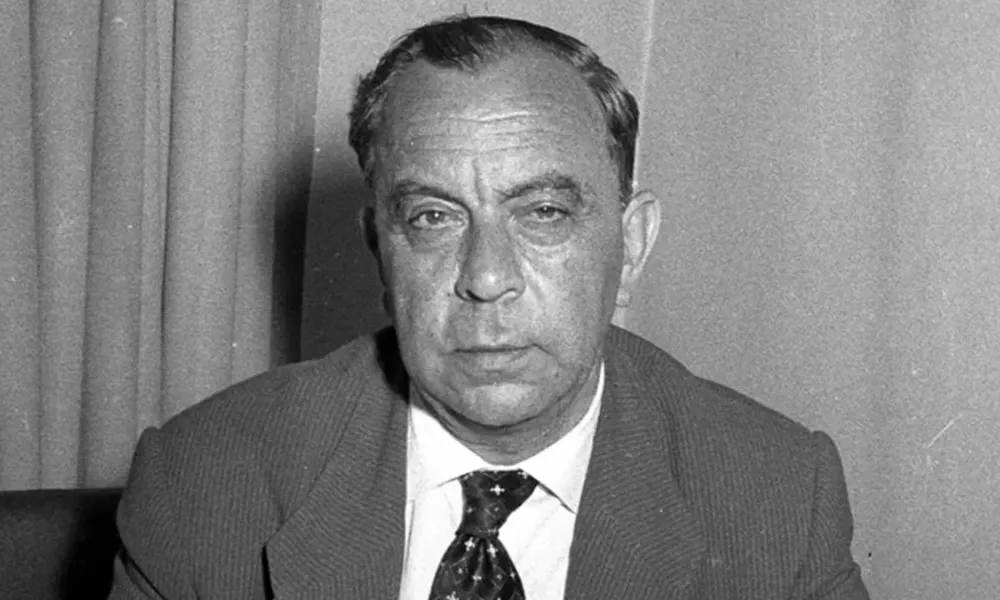
Fazil Küçük was one of the most important Turkish Cypriot political figures of the 20th century and served as the first Vice President of the Republic of Cyprus. A doctor, newspaper publisher and political organiser, he became a central voice of the Turkish Cypriot community during the final decades of British colonial rule and the early years of the independent state.
His political course was closely linked to the rise of Turkish Cypriot nationalism, the opposition to enosis, the promotion of partition as a political demand and the difficult constitutional life of the Republic of Cyprus after 1960.
Early life and medical studies
Fazil Küçük was born in Nicosia on 14 March 1906 and died on 15 January 1984.
After graduating from the Turkish Lyceum of Constantinople, he studied medicine at the University of Constantinople and later in Lausanne, Switzerland. He completed his medical studies in Paris, specialising in pathology.
Following the completion of his studies, he returned to Cyprus and began practising medicine in Nicosia in 1938.
Entry into politics
From 1938 onwards, Küçük became actively involved in the political affairs of Cyprus and soon emerged as a leading figure among Turkish Cypriots.
In 1943, he was elected as a municipal councillor in Nicosia, a position he held for six years. In 1941, he began publishing the daily newspaper Halkin Sesi, meaning “Voice of the People”, in Nicosia. He continued directing the newspaper until his death.
On 23 April 1943, he founded the Cyprus National Turkish People’s Party, known as KMTHP. On 15 August 1955, the party was renamed the National Turkish Union of Cyprus, in Turkish Kibris Milli Türk Birligi.
In 1946, he also founded the first Turkish trade union in Cyprus.
One of his significant political successes, following approximately 15 years of sustained efforts, was the transfer of the administration of Evkaf to the Turkish Cypriot community.
Opposition to enosis
In the period after the Second World War, the Orthodox Church of Cyprus reorganised and renewed more forcefully the Greek Cypriot demand for union with Greece.
Küçük led a parallel and intense Turkish Cypriot campaign against enosis. At the same time, from 1945 onwards, he also conducted a strong campaign against colonial rule, including through a series of hard-hitting articles in Halkin Sesi.
According to the source material, colonial authorities brought various charges against him 47 times. In most cases, he appeared before court and was fined.
Turkish Cypriot nationalism and partition
With Turkey’s support, Küçük worked to strengthen Turkish Cypriot nationalism as a political response to the Greek Cypriot campaign for enosis.
Against the Greek Cypriot demand for union with Greece, Turkish Cypriots promoted the slogan of taksim, meaning partition.
In 1955, Küçük renamed the Cyprus Turkish National Party with a title that reflected the political intentions and aspirations of the Turkish Cypriot leadership at the time: “Cyprus Is Turkish”.
In 1957, he published The Cyprus Question: A Permanent Solution. The book reflected his political orientation and featured a cover showing Cyprus divided into two parts along the 35th parallel.
The policy of partition was also being promoted by Turkey, where Cyprus was presented either as entirely Turkish or as geographically divided, including in official school geography textbooks.
The EOKA period and international activity
When the armed liberation struggle of Greek Cypriots began in 1955, Küçük became active in promoting Turkish and Turkish Cypriot positions internationally.
Among other actions, he travelled to London to follow the work of the tripartite conference on Cyprus. The conference, convened by the British, included Britain, Greece and Turkey.
Although the conference failed, it had important long-term consequences. Turkey secured recognition as the third official “interested party” in the Cyprus issue. This position was also recognised by Greece, since it agreed to participate in the conference despite the strong objections of Greek Cypriot leader Archbishop Makarios III.
Towards the Zurich and London agreements
In 1958, Küçük organised a series of rallies in Turkey, presenting the positions of Turkish Cypriots on the Cyprus issue.
In November of the same year, he travelled to New York, where he attended as an observer the session of the United Nations General Assembly during which the Cyprus issue was presented and discussed.
This was the 13th session of the UN General Assembly. During it, the foreign ministers of Greece and Turkey, Evangelos Averoff and Fatin Zorlu, clashed over Cyprus. Immediately afterwards, however, they began the first contacts that led, approximately three months later, to the Zurich agreements.
The final acceptance of those agreements by all interested parties took place in London in February 1959. The result was the creation of the Republic of Cyprus.
In London, Küçük signed the agreements as representative of the Turkish Cypriots and stated that he felt particularly happy.
First Vice President of the Republic
At the end of 1959, Cyprus held its first elections for President and Vice President of the Republic that was about to be established.
Under the Constitution prepared on the basis of the Zurich and London agreements, the President of the Republic would be a Greek Cypriot elected by the Greek Cypriots of the island. On 13 December 1959, Archbishop Makarios III won the first presidential election.
The Vice President of the Republic would be a Turkish Cypriot elected by Turkish Cypriots. Küçük was proclaimed Vice President on 3 December 1959 without an election, as there was no opposing candidate.
As Vice President, Küçük took part in the process of establishing and operating the new state, as well as the transfer of power from the British on 16 August 1960.
Constitutional difficulties
The new Cypriot state soon faced serious problems.
According to the source material, these arose partly from the lack of sincerity among Cypriots themselves. Greek Cypriots had not abandoned their original aim of enosis, while Turkish Cypriots, as presented in the source, acted in line with Ankara’s long-term objectives in Cyprus.
The problems also stemmed from the peculiarities of the Zurich and London agreements and, consequently, from the Constitution of the Republic of Cyprus. Several provisions proved difficult to implement and created opportunities for undermining the state.
One such provision was the Vice President’s right of veto. Küçük exercised this right in 1962 in an attempt to prevent President Makarios from bringing Cyprus into the Non-Aligned Movement. The veto was not taken into account.
The thirteen points and the 1963 crisis
President Makarios attempted to amend some of the Constitution’s problematic provisions by submitting to Vice President Küçük, on 30 November 1963, his well-known thirteen-point proposals. These were also communicated to the governments of Greece, Turkey and Britain.
Ankara reacted immediately, firmly and negatively to Makarios’ proposals, issuing statements and threats.
At the end of the following month, armed Turkish Cypriot unrest broke out.
Although at the beginning of the crisis Küçük appeared, at least officially, to cooperate with Makarios towards a peaceful resolution, he later followed Ankara’s instructions aimed at undermining the Cypriot state.
Together with Turkish Cypriot ministers, MPs and civil servants, he adopted from 1964 a policy of non-cooperation with Greek Cypriots.
The crisis deepened and the separation created by the Turkish side became entrenched. However, through multiple political and diplomatic efforts and with international support, Makarios managed to prevent the collapse of the Republic of Cyprus. The state became internationally consolidated, even without Turkish Cypriot participation, after the Turkish Cypriots isolated themselves from its institutions.
Attempted return to government
A few months after the crisis of December 1963, on 3 June 1964, Küçük asked Makarios for the return of Turkish Cypriots to the government.
Makarios replied: “You are no longer Vice President. The life and existence of the government does not depend on your will.” The statement was reported by Haravgi on 4 June 1964.
According to the source material, Küçük’s proposal was not entirely sincere, since he requested that the Council of Ministers meet on the Green Line. In the previous months he had also justified the Turkish Cypriot withdrawal while openly referring to a two-state solution, including in an interview with Le Monde on 10 January 1964.
Nevertheless, circumstances forced him to show some willingness for compromise.
Ankara’s position
Küçük’s position was strongly opposed by Turkish Prime Minister Ismet Inönü.
In a letter to the Turkish Cypriot leader on 9 March 1964, Inönü noted that the departure of Turkish Cypriots from their jobs and villages had given Greek Cypriots the opportunity to benefit from the absence of Turkish Cypriots from various levels of state organisation and to take unilateral decisions that caused major damage to Turkish interests.
Küçük replied in a strong tone, stating that no one in Cyprus could tell Turkish Cypriots who had lost children, fathers, husbands or brothers, and who had been deprived of their homes and families, that they should cooperate with the Makarios government, even temporarily.
Even so, Küçük could not resist Ankara’s guidance, nor could he ignore Greek Cypriot moves at the time, including the arrival of the Greek Division in Cyprus and the unfolding of the Acheson Plan. It was in this context that he asked Makarios, on 3 June 1964, for Turkish Cypriots to return to the government.
The move was not isolated. As time passed and Turkish Cypriots saw Greek Cypriots becoming consolidated as the dominant force on the island, and as the possibility of Turkish military intervention appeared more remote following Khrushchev’s statement and Johnson’s letter, they increasingly recognised the consequences of withdrawing from the government and the state more broadly.
Turkish Cypriot MPs and the House of Representatives
On 22 July 1965, 19 months after Turkish Cypriots had withdrawn from Parliament, Turkish Cypriot MPs also decided to attempt a return.
They went to the House of Representatives under military protection from UNFICYP and met the President of the House, Glafkos Clerides.
In the UN Secretary-General’s report of 29 July 1965, it is stated that Clerides told the Turkish Cypriot MPs that unless agreement was reached on Makarios’ proposals to amend the Constitution, they could not return to Parliament.
According to Clerides, following amendments made to the Constitution by the Greek Cypriots, there was no legal framework covering their return. The new legal order therefore did not allow the return of the Turkish Cypriot MPs.
Recognition as Vice President
Despite no longer participating actively in the exercise of executive power, Küçük continued to be recognised as Vice President of the Republic of Cyprus.
He was re-elected to the position in March 1968, again without an opposing candidate.
He withdrew from the office in 1973, when Rauf Denktash rose to the position of Vice President.
Relationship with Denktash and Ankara
Küçük was often described as a more moderate politician compared with Rauf Denktash, who was associated with the extremist wing of Turkish Cypriot politics.
However, according to the source material, Küçük never hesitated to serve even Ankara’s more extreme positions on the Cyprus issue, working consistently in favour of Turkey’s interests in Cyprus, even when these did not always coincide with those of Turkish Cypriots.
The source presents this as a political necessity for him, arguing that he could not have remained at the head of the Turkish Cypriots had he not followed Ankara’s line.
Final years and legacy
Küçük lived long enough to witness the Turkish invasion of Cyprus in 1974 and the military occupation of the northern part of the island.
The outcome created a situation that, according to the source material, did not differ greatly from the “permanent solution” he had proposed in his 1957 book.
Fazil Küçük remains a key figure in the political history of Cyprus. He was the first Vice President of the Republic, a founder of Turkish Cypriot political organisations, a newspaper publisher and a central figure in the development of Turkish Cypriot nationalism.
His role is inseparable from the wider history of the Cyprus problem: the struggle against enosis, the rise of partitionist demands, the difficult birth of the Republic, the collapse of bicommunal constitutional cooperation and the gradual consolidation of division.
Source: Great Cypriot Encyclopedia.