Demetris Christofias was the sixth President of the Republic of Cyprus and the first leader from the political Left to be elected to the country’s highest office. Before his election to the presidency in February 2008, he had served as President of the House of Representatives and, for two decades, as General Secretary of AKEL.
His political life was shaped by the labour movement, the experience of displacement after the Turkish invasion, his long service within AKEL and his belief in contact and cooperation with the Turkish Cypriot community as part of efforts to resolve the Cyprus problem.
Early life and family background
Demetris Christofias was born on 29 August 1946 in Kato Dikomo, in the Kyrenia district. He came from a working-class family and was forced to work from a young age.
His father was a builder and an active member of PEO, the left-wing trade union movement. This environment played a decisive role in shaping Christofias’ political identity and his connection with the labour movement.
He graduated in 1964 from the Neocleous Commercial Lyceum in Nicosia. After completing his military service, he worked as an accountant for a confectionery company.
Entry into AKEL, PEO and EDON
In the summer of 1964, Christofias became a member of AKEL, PEO and EDON, the youth organisation of AKEL.
At the same time, he was active in the local sports and cultural association “Achilleas” in Dikomo, where he was elected secretary in 1966. The following year, he was elected secretary of EDON in Dikomo, while in 1968 he became assistant secretary of the party group in his village.
In May 1969, he was elected to the Central Council of EDON.
Studies in Moscow
In 1969, following a decision by his party, Christofias went to Moscow for two years of study at the Institute of Social Sciences.
It was in Moscow that he met Elsie Chiratou, whom he married in the summer of 1972.
After completing his initial studies in 1971, he continued higher education in Moscow at the Academy of Social Sciences of the Soviet Union. He graduated from the Academy with a PhD in History.
Return to Cyprus and displacement
Christofias returned to Cyprus in April 1974 and was employed as a salaried official in EDON. The following month, he was elected central organisational secretary of the youth organisation.
Until July 1974, he lived with his family in his village, Kato Dikomo. He was displaced from there as a result of the Turkish military invasion.
The experience of displacement became part of his political and personal history, as it did for many Greek Cypriots of his generation.
General Secretary of EDON
In September 1977, Christofias was elected General Secretary of EDON, a position he held for ten years, until 1987.
During this period, he gained significant experience in organisation, guidance and political mobilisation. He also developed extensive contacts and cooperation with international and national organisations across the world.
His years in EDON strengthened his position within AKEL and prepared the ground for his later rise to the party leadership.
Rise within AKEL
In May 1976, Christofias was elected a member of the Nicosia-Kyrenia district committee of AKEL.
In May 1978, he was elected an alternate member of the party’s Central Committee. He became a full member of the Central Committee at the party’s 15th Congress in 1982.
In July 1986, he was elected an alternate member of the Political Bureau of the Central Committee and later became a full member after the 16th Congress. In 1987, he was elected a full member of the party’s Central Secretariat.
General Secretary of AKEL
After the death of AKEL’s historic leader Ezekias Papaioannou on 10 April 1988, Christofias was appointed by the party’s Political Bureau as temporary General Secretary.
On 22 April 1988, the plenary session of the Central Committee elected him as the new General Secretary of AKEL.
He assumed leadership at a difficult time for the party, as some officials had left due to ideological disagreements. Christofias managed to overcome the internal crisis, consolidate the party and eventually lead AKEL to become the strongest party in electoral terms.
He was re-elected General Secretary by the 17th party congress in October 1990, again by the 18th congress in November 1996 and once more by the 19th congress in December 2000.
Parliamentary career and presidency of the House
In May 1991, Christofias was elected as a member of parliament. He was re-elected in the parliamentary elections of May 1996.
In 2001, he was elected MP for a third consecutive term and assumed the office of President of the House of Representatives.
He served as President of the House until his election as President of the Republic on 24 February 2008.
As President of the House, he was widely regarded as an effective parliamentary figure, with strong communication skills and an ability to synthesise views within the legislature. According to polls of the period, he was considered the most popular President of the House of Representatives.
AKEL, the National Council and the Cyprus problem
As General Secretary of AKEL, one of the two largest political parties in Cyprus, Christofias also participated as a member of the National Council.
He and his party consistently worked towards bridging relations with Turkish Cypriots, following AKEL’s long-standing position that contact and cooperation with the Turkish Cypriot community were necessary to support a solution to the Cyprus problem.
However, during the critical referendum of 24 April 2004 on the Annan Plan, Christofias led AKEL into full alignment with DIKO and President Tassos Papadopoulos in supporting a “No” vote. In the days that followed, named AKEL figures, including Andreas Christou and Kikis Kazamias, disagreed with that decision.
Support for Tassos Papadopoulos
In the 2003 presidential election, Christofias and AKEL supported the candidacy of Tassos Papadopoulos.
Following Papadopoulos’ election, AKEL participated in government, with ministers coming from the party. This cooperation continued until later disagreements emerged, particularly in relation to strategy on the Cyprus problem.
The 2008 presidential election
In the February 2008 presidential election, AKEL decided for the first time in its history to contest the presidency with its own candidate.
Christofias managed to reach the second round of the election alongside Ioannis Kasoulides, an MEP supported by DISY and other groups. The sitting President, Tassos Papadopoulos, who had sought re-election, was eliminated in the first round.
In the second round, Christofias was supported by DIKO, EDEK and other political formations. He was elected President of the Republic with 53.37% of the vote, against 46.63% for Kasoulides.
His election marked a historic moment for Cyprus, as AKEL became the first communist-rooted party in the European Union to elect a head of state through democratic elections.
Renewed movement on the Cyprus issue
Immediately after his election and the formation of his government, Christofias created new momentum towards a solution of the Cyprus problem.
His declared willingness and determination to find a mutually acceptable solution as soon as possible received a favourable response internationally. The United Nations was encouraged to become involved again.
The negative international perceptions that had developed after 2004, when the Greek Cypriot side rejected the Annan Plan, had already been partly addressed by President Papadopoulos. Under Christofias, they were largely overcome, although references continued to be made from time to time to the possible return of the same plan, with modifications.
Talks with Mehmet Ali Talat and Derviş Eroğlu
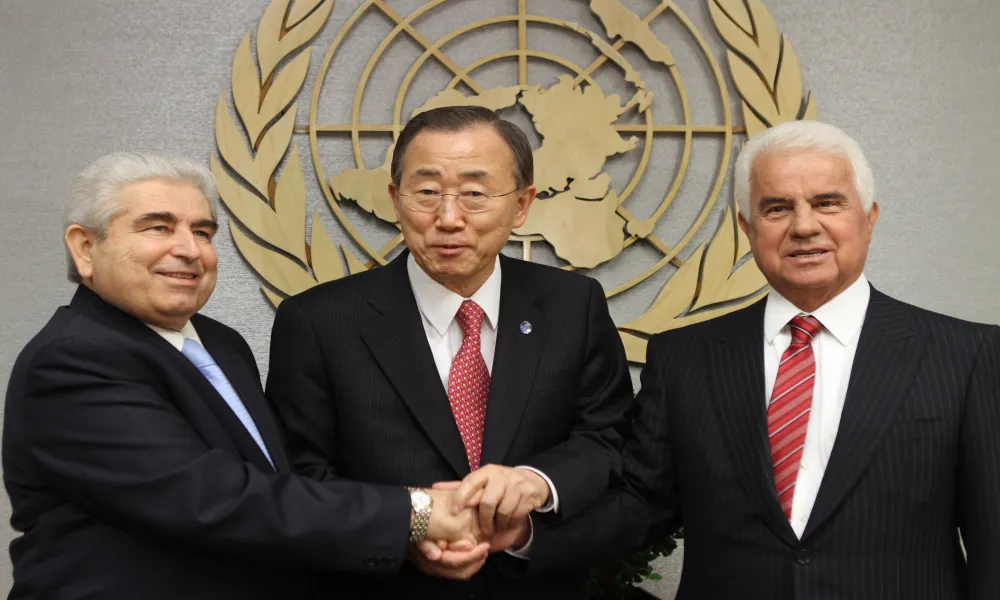
Within the same year of his election, Christofias began a series of meetings and negotiations with Mehmet Ali Talat, the Turkish Cypriot leader and his friend, under UN auspices.
The talks did not produce any substantive result.
Christofias later continued negotiations with Talat’s successor, Derviş Eroğlu. Again, no progress was achieved, with the source text attributing this to the inflexible stance of the Turkish side.
Resignation from AKEL leadership
The international and domestic responsibilities of the presidency, as well as his activity towards achieving a solution to the Cyprus problem, led Christofias to resign as General Secretary of AKEL in January 2009.
He then devoted himself exclusively to his duties as President of the Republic.
AKEL elected Andros Kyprianou as his successor at the head of the party.
Disagreement over Partnership for Peace
In February 2011, Christofias came into conflict with the House of Representatives.
A majority of parties, including DISY, DIKO, which was participating in government, EDEK and EVROKO, adopted a decision calling on the President to apply for Cyprus to join Partnership for Peace.
Supporters of the proposal argued that membership would strengthen the international standing of the Republic of Cyprus, its state entity and its ability to participate more actively in all pillars of European Union policy.
Christofias exercised his right of veto over the parliamentary decision. The government spokesman described the decision of the House as an act that violated the Constitution and the separation of powers.
Christofias opposed submitting an application to Partnership for Peace because no such commitment existed in his government programme, and because he considered the Partnership to be a NATO programme.
EDEK leaves the government
In February 2010, two years after Christofias’ election, EDEK withdrew from the coalition government.
The decision was taken by the party’s Central Committee following a recommendation by party president Yiannakis Omirou.
EDEK left government because it disagreed with President Christofias’ strategy on the Cyprus problem. Omirou stated: “We are leaving the government because we cannot be part of the irreversible concessions of President Christofias.”
DIKO leaves the government
In early August 2011, DIKO also withdrew from the government.
The withdrawal followed failure to reach agreement on proposals submitted by the party to address the crisis created by the explosion at the Evangelos Florakis naval base and the death of 13 people.
The departure of DIKO marked a further weakening of Christofias’ governing alliance at a time of intense political pressure.
The Mari explosion
The explosion at the Evangelos Florakis naval base in Mari occurred on 11 July 2011.
It involved 98 containers holding explosive material, which had been stored inside the naval base since early 2009.
The cargo had been seized from the Cyprus-flagged vessel m/v Monchegorsk, which was travelling from Iran to Latakia in Syria. The vessel had been intercepted on 19 and 20 January by a United States Navy ship in the Red Sea.
Following inspection of the cargo, it was considered to be in violation of United Nations Security Council resolutions imposing sanctions against Iran.
After intense diplomatic consultations, the vessel arrived at Limassol port on 29 January for inspection of its cargo. Following the relevant checks, it was decided that the cargo would be seized under customs legislation.
The seizure took place on 13 February, and the containers were transferred to the naval base at Mari.
For two and a half years, the cargo remained exposed in an open area, despite serious safety concerns. The greater part of the cargo consisted of various types of gunpowder and was vulnerable to high temperatures and humidity, especially during the summer months.
At 5.50 am on 11 July 2011, the contents of the containers self-ignited, causing a massive explosion.
Apart from the loss of 13 lives, the explosion caused enormous economic damage, including the near-total destruction of the Electricity Authority of Cyprus power station at Vasiliko.
The Polyviou inquiry
On 20 July 2011, the Council of Ministers appointed a one-member investigative committee, chaired by lawyer Polys Polyviou, to investigate all relevant events and the issue of responsibility for the explosion and its consequences.
In his report, published on 4 October 2011, Polyviou concluded that President Christofias bore “the greatest responsibility” for the inadequacy, negligence and delay shown, and therefore the greatest responsibility for what happened at Mari.
He also found that the President’s actions, decisions and conduct did not correspond to the minimum level of diligence expected of him, both in relation to the public interest and the country’s economy, but above all in relation to the safety of citizens of the Republic.
After the report was published, DISY, DIKO, EDEK, EVROKO and the Greens called for Christofias’ resignation.
Christofias rejected the demand. He maintained that he bore no personal responsibility and argued that the report was not supported by the evidence and material presented before the investigative committee.
The economic crisis
As President of the Republic, Christofias also had to confront the major economic crisis that affected Cyprus severely, especially from 2011 onwards.
In December 2012, he accepted Cyprus’ entry into a memorandum, which included significant cuts to public sector salaries.
He remained in office until the end of his term. In the following presidential election of February 2013, he did not seek re-election.
Final years and death
Demetris Christofias died on 21 June 2019 at the age of 72, following a long period of health problems linked to respiratory difficulties.
His death marked the end of a political life that had begun in the youth and labour movement and reached the highest office of the Republic.
Legacy
Demetris Christofias was a politician whose career began through direct engagement with ordinary people and the organised labour movement.
He rose through EDON and AKEL, led the party through a difficult internal period, consolidated its electoral strength and became one of the most influential figures in modern Cypriot politics.
As President of the House, he was recognised for his communication skills and ability to bring together different views. As President of the Republic, he opened a new phase of Cyprus problem negotiations but also faced severe criticism over his handling of major crises, particularly the Mari explosion and the economic downturn.
His presidency remains one of the most debated in the history of the Republic: historic for the election of a left-wing leader to the presidency, ambitious in its declared pursuit of a Cyprus settlement, but overshadowed by institutional confrontation, coalition breakdown, the Mari tragedy and the beginning of Cyprus’ memorandum period.
Source: Great Cypriot Encyclopedia.